
Magazine #26 | August’20. Babel Music XP, Mikołajki Folkowe & a life that deserves a movie
How are you? Today it would be my grandmother Manuela’s birthday, August 18th. And I still miss her quite often. Even so, I’m glad she’s not going through this nightmare. They already had their disaster… In Spain we are having upbreaks of the virus, you might now. This picture is 10 days old. Masks were already mandatory all over the country, all the time, but this was done somewhere deserted in Castilla-La Mancha, between two magnificent windmills, with no one around. The municipality is Tembleque, in Toledo province.
The day after the picture, we had the first concert by Vigüela after the start of the situation. It was openair, with control of access, with mandatory masks and hydroalcoholic gel for the hands and paired chairs with distance between them. Beside some rare cases, in Spain the population is following the safety measures. We felt totally safe and the public too. This is how the place looked like before the arrival of the public:

We still can do this kind of little events, but the restrictions are increasing. In other countries, like Israel, the restrictions are even bigger: there, they can’t host more than 20 people in the audience.
Today, Tuesday 18th, we are together in El Carpio de Tajo, preparing some things related to the online events we will have in September.
Nevertheless, music doesn’t stop and our community keeps the flame alive with thrilling plans. Read the interview with Olivier from Babel Music XP, the reincarnation of Babel Med, and with Agnieszka from Mikołajki Folkowe. All the good for you!
Remember that you can send any suggestion of content for the next editions. And if you like this, tell me and share it with your friends. You can read the previous issues here.
Thanks for your attention and remember that during the reading you can listen to some great music by our artists collaborators –>
Araceli Tzigane | info@mundimapa.com | +34 676 30 28 82
Subscription is available here.
Summary:
· How is it going to be: Babel Music XP with an interview with Olivier Rey
· Mini interviews with festival manager: Agnieszka Matecka from Mikołajki Folkowe
· In deep with Andrzej Bieńkowski, a life devoted to the dissemination of the traditional music
|
BABEL MUSIC XP, THE NEW PROFESSIONAL DATE FOR THE COMMUNITY
I call it “new” because, despite collecting the legacy of Babel Med, Babel Music XP has a new vision, a new team and new ambitions. As already mentioned in the previous edition, it will start in two parts: a professional meeting in November 26th-27th and trade fair with concerts in March 25-27th, in Marseille. Olivier Rey, from Dock des Sud, kindly answered our questions.
 Mapamundi Música: What has happened that made this rebirth possible?
Olivier Rey:
Mapamundi Música: What has happened that made this rebirth possible?
Olivier Rey: A lot of energy and conviction, a new dialogue with institutionnal partner and a new collaboration with Zone Franche.
MM: Why did Babel Med stop?
OR: Probably a lack of understanding with our principal partner, Region Sud, mixed with some political change and decision at this moment. That was the main reasons for the money cuts. In 2017, It was violent for all the members involved in the organisation of Babel Med Music.
“That’s our ambition: to become again a international platform for the music sector, a Mediterranean gate for music exchange”
But we have to say, maybe, the event hadn’t evolved enough. In 2005, Babel Med Music was pioneer – with Womex – in world music forum. 14 years later, many meetings had grown everywhere with success and music had changed: creativity, tools, business, live, interactions between artists, pros, audience. So Babel Med Music was great to connect all the music family under the same roof (and we want to keep this human atmosphere which is specifical to Babel) but we have now “to upgrade” the event whith this new context.
That’s our ambition: to become again a international platform for the music sector, a Mediterranean gate for music exchange, to develope economical impact for the world music sector and also to add some new societal contents connected to the musical sphere (innovation, women’s role in the music industry, environmental responsability…).
I have to say that, today, discussions are much more appeased with Region Sud which supports us in this rebirth. We are grateful for this new essential chapter between us.
MM: The name of this initiative is not exactly the same. It was Babel Med, it is Babel Music XP. Has this change of name any transcendental meaning? What is the meaning of “XP”?
OR: We have to mean the change and also to affirm our heritage. So we propose a new experience (XP) of Babel. As we have a much different experience in music. And for many pro in the world, Babel Music is linked with Marseille. So we can be proud of that.
“Past, present and future of music from the world is our credo.”
MM: You have already closed the application period for the showcases. Will the event keep the same artistic line? Babel Med’s offer of showcases was very diverse, with many acts related to the cultures that have been historically connected to France, but not exclusively. There were from totally acoustic and quite traditional performances to miscegenated and electric ones. Will this approach be kept?
OR: Yes, from acoustic to digital music, we want to propose a photography of world music at the instant. Past, present and future of music from the world is our credo.
Same artistic line than Babel Med Music: open-minded to the world sounds…
 MM: I think that many of the selected acts for Babel Med were produced or represented by French companies. Correct me if I am wrong, as I don’t have the data, this is just my insight after the editions I attended so I might be biased. Will Babel Music XP be more open to other countries’ presenters than Babel Med was?
OR:
MM: I think that many of the selected acts for Babel Med were produced or represented by French companies. Correct me if I am wrong, as I don’t have the data, this is just my insight after the editions I attended so I might be biased. Will Babel Music XP be more open to other countries’ presenters than Babel Med was?
OR: The selection of bands which have to answer to the call for application. Historically, it was 50% produced or represented by French companies. Today, we have many propositions from Europe, Argentina, Caribean, North African, Mediterranean area, Indian Ocean and Francophonic Africa. Our project is to work with different musical ambassadors all over the world who can incite local producers to answer to the call for application. That’s a point to expand.
.
MM: Who are the people in the jury for the selection of showcases?
OR: They are artistic directors, programmers of festival, journalists or artists. We’ll publish the list this Autumn. The only thing we can say today is the “honorary patron” for this year is Gilles Peterson. He’s an outstanding headhunter and he’s at the same time DJ, producer, label founder, media… A different approach of worldmusic…
.
MM: What will happen in the pre-edition in November? If the current situation of the pandemic didn’t allow it to be as planned, do you have a plan B?
OR: The pre-edition in november is a particular rebirth with Covid-crisis. All the musical sector have to gather, to discuss and to imagine new collaboration in this context. The Before Babel Music XP must be used for that. In November, we organize professionnal meetings (without stand or forum) and few concerts. In March we’ll find again the fundaments of Babel: international exhibition, stands, agora, meetings and presentations for pros and 30 concerts for pros and general public.
.
MM: Which is the calendar for the next steps? I mean, to register for the events in November, to register for March’s event, to publish the line up of selected artists…
OR: More news in September (and the selection for March will be revealed in November – or at the early December.
.
Credits:
- The portrait of Olivier is provided by himself and the photographer is Jean de Peña.
- The banner is their cover picture in Facebook.
**** Do you have a world music festival and you want to be included in our mini interviews? Contact us. ****
CURRENT AND FUTURE CHALLENGES FOR FESTIVALS
And this festival that is our focus today is also included in the project MOST, about which I talked in a previous issue.
For already 29 years, Agnieszka and her team have been developing this festival in the beautiful city of Lublin, at the East of Poland. Remember this city hosts also the Jagiellonian Fair, about which we talked with Karolina Waszczuk and Bartek Drozd in this issue.

I met Agnieszka in person was in Scotland, the last September, at The Visit. I hope they will be able to make a proper celebration of the 30 anniversary, and ephemeris worth celebrating. In the meantime, let’s discover more in her own words.
 Mapamundi Música – What do you search in an artist when you create the programme?
Agnieszka Matecka:
Mapamundi Música – What do you search in an artist when you create the programme?
Agnieszka Matecka: Mikołajki Folkowe is an intimate festival which takes place in December indoors. We can invite no more than 8-10 artists (groups) a year, this is why we choose the performers very carefully so that their music meets the expectations of our audience. Musicians both from Poland and abroad (3-4 bands) perform at the festival. We typically organize concerts on two stages (for 400 and 150 people). At the main Saturday concert there are usually larger and lively bands who play, as we call it, “folk of the centre”. On the other hand, the Sunday concert, on the smaller stage, presents more avant-garde, experimental music.
.
MM – Which are the global objectives of your festival?
AM: Mikołajki Folkowe is an interdisciplinary festival. The goal of our festival is to popularize culture, especially traditional music, in a form that is accessible to modern audiences, while respecting in crudo music. Therefore, an important part of the festival is the competition for beginner musicians, to which foreign artists can also apply. We try to follow the idea that folk culture must be alive in order to survive. It cannot be an archaic closed form.We also want to show through workshops that everyone can benefit from folk culture for their own needs. One does not have to be an educated musician, dancer or visual artist.Another goal of the festival is to break down the national prejudices in accordance with a saying “culture is the best ambassador of nations”. Mikołajki Folkowe is accompanied by an interdisciplinary international scientific conference.We also promote handicraft inspired by folk art, through organizing a handicraft fair.
.
MM: What are the most complicated or difficult issues you have to deal with at your festival?
AM: It’s hard to say. After 30 years of work, we have already developed many patterns of conduct. Each year seems different, poses new challenges, but with a well-coordinated organizational team all difficulties can be overcome.
.
MM: What are the main challenges for this kind of cultural proposal like yours right now?
AM: Maintaining the interest of the audience and creating an interesting program, taking into account the financial and spatial capacity of the event.
.
MM: In one sentence, summarize the reasons why you should go to your festival.
AM: Mikołajki Folkowe is almost a family festival. Owing to its date, all people interested in the same cultural phenomenon stay in one building for three days. One can feel an extraordinary bond that develops among the audience.
.
MM: Is this the experience we are experiencing now, the coronavirus crisis, changing your festival in any way (apart from postponing this year’s edition, if so)?
AM: This year’s festival takes place in December (10-13/12) and we still hope it will go on normally. We follow the news about the virus on an ongoing basis and consider various scenarios. In previous years we used to have the program ready before the summer holidays. We are currently waiting for the situation to develop. Will it be a festival with bands from abroad, or a typically Polish edition? How many viewers will be able to take part in the festival and what will happen to revenue from ticket sale? We are also ready for the “virtual variant” of the festival, we plan to broadcast concerts. There are so many unknowns, now there are holidays, but from September we are getting back to hard work. It is a pity that it happened to us just at the 30th jubilee festival.
—-
Thank you very much, Agnieszka!
Pictures’ credits:
- Portrait from her FB profile
- Banner, cover of the Facebook page of the festival
IN DEEP WITH ANDRZEJ BIEŃKOWSKI
Andrzej’s life would be perfect for a film or a novel without having to invent anything. Learn more, here.

In this occasion the content is not going to be included here. This is just an announcement of the report that is published at the website Culture.pl about and with an interview with a person that devoted his life and made many sacrifices in order to record and disseminate the legacy of the rural music from his country.
I had the luck of visiting Andrzej in his house in Warsaw 3 years ago, when I made this picture.
More recently, my friend Ewa Gomółka made me the big favour to meet him and record his answers to some questions, thought out using the memory of what he had already told me before and with some new curiosities. She made the translation from Polish to English, so you can imagine what a huge work she did.
By the way, the website Culture.pl is an amazing source of information related to Poland and to the events, culture and art of this country that has been in the axis of the hurricane of Europe’s History.
WHO WE ARE AND SISTER PROJECTS
Mapamundi Música is an agency of management and booking. Learn more here. Check our proposals at our website.
We also offer you our Mundofonías radio show, probably the leader about world music in Spanish language (on 49 stations in 18 countries). We produce the Transglobal World Music Chart with our partner Ángel Romero from WorldMusicCentral.com. And we lead also the Asociación para la Difusión de los Estilos.
Feel free to request info if you wish. For further information about us, get in touch by email, telephone (+34 676 30 28 82), our website or at our Facebook.
Do you like our newsletter? Tell us! Forward it to your friends! To sign up, click HERE.
This newsletter is open to sponsorship. Feel free to ask for details.

 Son is performed mainly with percussion and voices. A light accompaniment with string on drone, with the rabel (rebec), can be included. In the picture above you see some instruments used for the son: frying pan, saucepan, mortar, cañera, zambomba, frame drum, bladder rebec.


 Since I read these words by Chris Moss in Songlines, it has been in my mind the idea of how needed it is to disseminate the traditional music from the center of Spain. A music that is


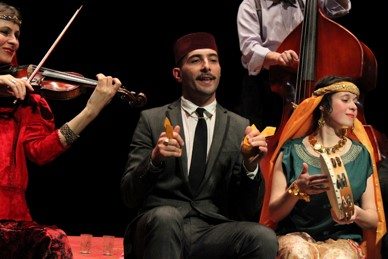


 MICHAL: It’s a traditional nigun (song without the words, or with some kind of citation). In this case nign “Niezhuryca khlopcy” has in three sections (A, B, C), three typical kinds of texture:
 ARACELI: About you: year and place of birth, place where you are settled. Did you receive lessons for liturgic singing or anything like that? I think you can conduct religious services and I know it requires a lot of time for studying. What made you interested in that?
 The event mentioned in this song dates back to 1497 and tells the story of the murder of Juan de Borja y Cattanei, II Duke of Gandía (he is the man in the portrait). He was stabbed and his body was thrown to the river in Rome, when he was only 19 years old. The last time he was seen alive was in a place called the square of the Jews.