A song of good wishes for you, when we need them most, by Janusz Prusinowski

How are you? I hope well! This is a season’s greeting email, how original! In fact I think so ? 

A few days ago Janusz Prusinowski sent me two recordings he had made for a project to disseminate the music from Łukowa, a village with 2.600 inhabitants in the South-East of Poland with a musical tradition that was lastly added to the National Heritage list. A group of people there are working to transmit this music to the new generations.

Listen to: the solo voice version or the version with instrumentation
– You can download and use them if you make a radio show or podcast or similar and send our best wishes also to your listeners –

What is the song about? Let’s let Janusz explain it by himself.
Click on Janusz’s face to listen the explanation  ?
 

Some more info about the song, by the artist:

“This is traditional wishing carol, that used to be sung by young men to the girls, walking from house to house. The name of a girl, for whom the wish is dedicated, is consequently repeated in each couplet of the song, as the magic incantation, in order to bring the “ideal bridegroom” next year. Naturally the real “ideal bridegroom” was just the one, singing the “dunaj”.

This year the covid situation stopped traditional carol singers in all regions of Poland. I hope, that internet would at least in 1% substitute the real situation of meeting, singing together and sharing good wishes.”

I am grateful to Janusz for allowing me to use his beautiful recordings to wish you a happy season. I hope 2021 will make us forget the grieves of 2020.

? And thank you, for being here visiting me. This is my first season greeting. More will follow soon!


And these are the lyrics. I had the support of Ewa Gomółka for the translation:

To the river, Maria, in the morning, to bring the water, to the river,
And with two buckets, to the river!
She picked up water, dropped the wreath of flowers, into the river,
And she went along the bank, to the river,
And she found three ospreys, to the river,
My dearest ospreys, fish my wreath of flowers, to the river
And how will you pay us, to the river,
To the river, Maria, in the morning, to bring the water, to the river?
For the first one, the present will be my rue crown, to the river,
For the second, the present will be my wedding ring, to the river,
For the third one the present will be the bride, to the river,
The bride, beautiful like a blueberry, to the river,
Work, work and while you are looking for money, to the river,
[One of the singers makes the prolonged sound “Iiiiiii”]
Go to the chest and look for the złoties, in the river,
Take the stick, bring down a sausage, to the river,
Search in the chest, pull out half a pig, to the river,
Look on the shelf, take out a loaf of bread, to the river,
To the river, for those in this house, to the river,
To the river, for the grandma who is sitting on a bench, to the river,
To the river, for the grandpa who is sitting on the table,
To the river, Maria, in the morning, to bring the water, to the river.

I hope you enjoyed this post as much as I loved writing it for you.

How was Conciertajo.com, the event specially designed for the online context

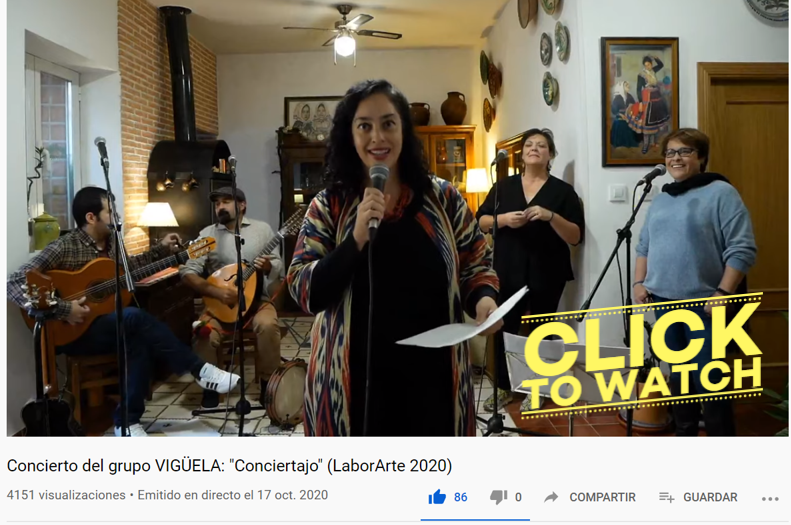
I illustrate this post with a moment of the Conciertajo, the online live interactive event we made last Saturday with Vigüela for International Labour Organization. Click the picture to see the event. It has been a thrilling success that deserves to be explained in more detail ✌️. I reveal it all for you more below.

Conciertajo.com has been part of LaborArte festival, by the Spanish office of the International Labour Organization (ILO). 

It took place the last Saturday and I think it was a success in various aspects. The main one is that we got to transfer the emotion of the direct contact with the public, to an online environment. How did we get that? There are several features that allowed us to get that:

  • For one month we developed the engagement of the public. We provided them several ways for the participation in the creation of the lyrics. We have been publishing special videos done with lyrics that were sent by the followers or that have been created about the topics that are relevant for them (confinement, health workers, masks, the situation of the cultural workers, the shocking news about our crown…). Check the videos here.
  • We made a contest of stories. The one that won is a portrait of Andrés José, a Colombian immigrant in Valencia, who ends up working as a delivery man on a bicycle to support his family (parents and two younger sisters). The first day he works on that, his little sister is very happy because he comes back home very early: his bicycle has been stolen. Juan Antonio Torres made it in shape of a romance with the zambomba. Check it here.
  • Some more videos were made for media friends, like WorldMusicCentral and Mundofonías.
  • During the event I was presenting, explaining the band the requests and comments from the chat and chatting with the public.
  • Of the repertoire for an event of two hours it was prefixed only the 4 first pieces and the very last one. Between that, that band sang about the topics that the public was asking, using the traditional styles (jota, several variants of fandango, seguidilla, son). For this, we prepared more than 100 new couplets organiced in the main topics of our nowadays and of the field of world of ILO. And the band decided the specific style to apply to those lyrics in that very moment.
  • All this was accompained by a campaign of advertisements in Youtube, Facebook, TikTok and Spotify.
  • The technical part was very professional, the responsible of video was Jaime Massieu and the sound engineer was Toni Quintana. The location is so nice that it looks like a ethnography museum but it is not: it was Juan Antonio Torres’ house in El Carpio de Tajo.

Xabi Aburruzaga wins the Musika Bulegoa Saria (Music Office) award with Bost

“For its quality, originality, folk innovation and collaborative work.”

Xabi Aburruzaga wins the award Musika Bulegoa Saria for his album Bost

Photo by Javier Martín, with Xabi Aburruzaga and his musicians collaborators Aitor Uribarri and Eriz Perez


It is a pleasure to share good news in these times. Also to receive them. Yesterday Xabi explained to me the specific details of this award and sent me several photos. In this one above, although you can’t see their smile, you can feel it.

This is the fourth edition of these awards created by the Euskal Herriko Musika Bulegoa Elkartea (Basque Country Music Office). The merits recognised by the jury have been:

  • “For the quality, originality, folk innovation and collaborative work”.
  • Mekoleta is called to be one of the great songs of Basque music.”
  • “The whole work has a perfect sound.”

And about the work Bost they indicate, for example, that “Xabi Aburruzaga has made a journey inside himself and has dedicated Bost to the public, to continue feeding the universe of Basque folk music”.

Xabi has just sent me this photo from his studio, Xabi’s Road, in Zamudio, very close to Bilbao airport, and I cannot resist sharing the moment with you with his spontaneity. Xabi has given me permission. The studio also hosts productions by other artists.

¡Haz click en la imagen para escuchar Bost


Conciertajo.com in WorldMusicCentral.com

“Vigüela to Interact with Audience in Conciertajo, Send your Couplets and Tales”. This is the beginning of the report about Conciertajo.com in World Music Central. Read it all, including some statements by Araceli Tzigane and by Juan Antonio Torres, the musical director of the band, in the web or here below. Thank you very much, Ángel!!!

Would you like to travel to South Korea? Vigüela would have gone… In the meantime, let me tell you a Korean tale

Would you like to travel to South Korea?
Vigüela would have gone to perform there for their first time…  For now, it will have to be through the wire.


In the meantime, let me tell you a Korean tale ?

Hello, how are you? I hope well!

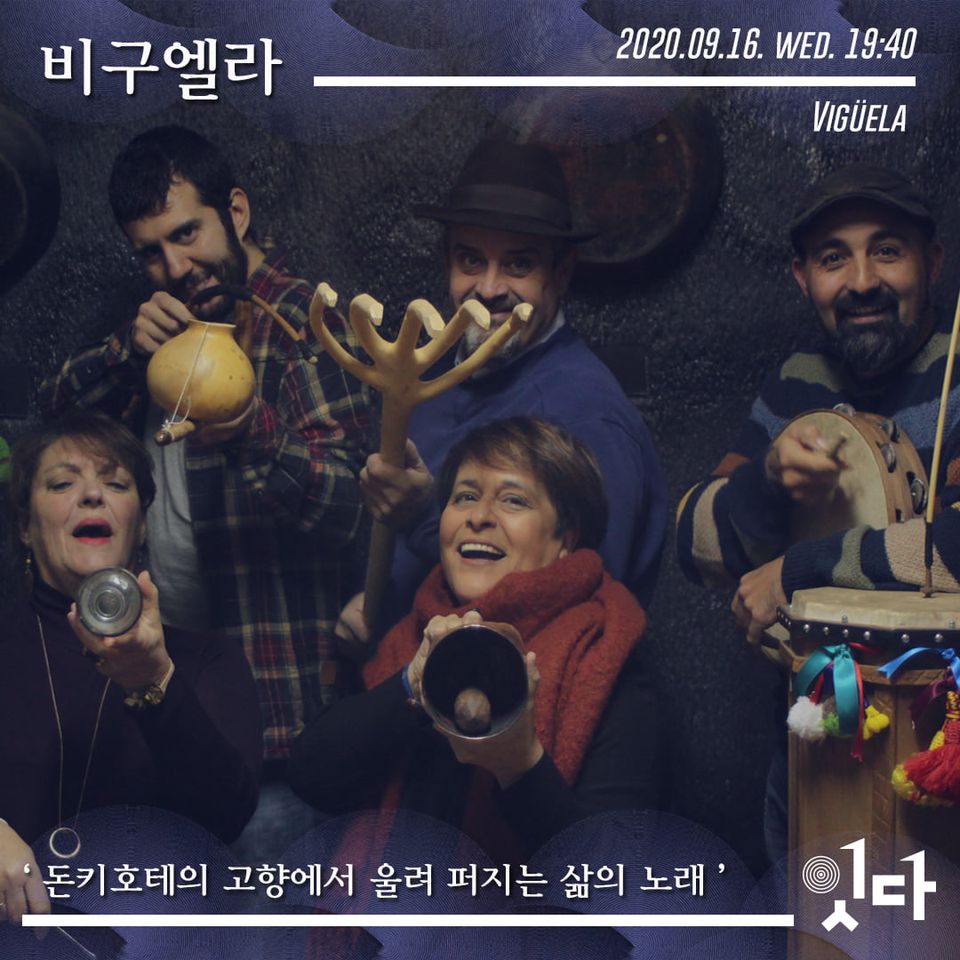
This year Vigüela, like most of us, has lost the chance to do many wonderful things, like playing for the first time in Greece and to debut in South Korea. But, they will share a very special moment with the oustanding Jeonju International Sori Festival. Enter our Facebook that day September 16th at about 12 noon (CET) to see us! There will be 9 artists from different countries.

And the promised tale? Yes, yes, under the video ? and, before, a little bit of context:

The name of the festival comes from the tradition of Pansori. What is Pansori? You might know already. Very brieftly, it is a collection of epic stories that are sung by one singer and accompanied only by subtle percussion. The percussionist pulls and responds in a very punctual manner. As you will see in the video below, the person singing also performs the song as an actor or actress. He or she carries a fan in the right hand and a handkerchief in the left, used to represent the objects that are been talked about.

A small set of Pansori has been preserved, and there are five of them that are almost always sung. But keep in mind that each Pansori can last up to 5 hours! 5️⃣ It is a very difficult art and there are artists who specialize in only one of the Pansori.

Click on the image to see the video!

A part of Pansori Chunhyangga, by Kim Myeongsin & Jeong Sanghee  

The promised Korean tale:

And what does this Pansori in the video talk about? Ohhh, it’s a love story ? between the daughter of a retired courtesan, Ch’unhyang, and Yi, the son of an aristocrat with a position as a magistrate in the city. But, oh, their love is impossible because they are from different classes. So they marry in secret ?.

But soon the boy’s father is sent to the capital to work and the boy has to accompany him. The new magistrate who comes to replace Yi’s father, has a craving with the girl. And, as she rejects him, he imprisons her. The magistrate says that if she does not agree to his desires, he will kill her ?.

What do you think that will happen? Will there be a happy ending or will it be a tragedy? Arg, what a lot of anxiety! Let’s go on!
.

But, in the meantime, Yi has been hired as ? a secret inspector to investigate the complaints about the evil magistrate. He arrives in town in disguise and no one recognizes him. He goes to the jail and she doesn’t recognize him. So Yi lets the girl know who is he. She is already desperate and says that he will not be able to save her: tomorrow is the day of the execution. But that night there is a party and Yi comes. There at the party he is requested to compose and recite a poem, and he does. The poem tells the crimes of the magistrate to the attendants of the party. He is then arrested and Ch’unhyang is released. Yi and Ch’unhyang will get married, this time publicly. ? Long live life and long live love!

Remember: on September 16th, visit the Facebook page of the festival or of Vigüela at around 12 noon (Central European Time) to attend the online gala concert with 9 artists from different countries! Before that, feel free to watch also this recent video by Vigüela in an intimate moment:

I hope you enjoyed this post as much as I loved writing it for you.

Vigüela at the Jeonju International Sori Festival, South Korea

The pandemic didn’t allow us to travel to Jeonju, but anyway, Vigüela will have the joy of participating in the Gala of the Jeonju International Sori Festival.

I was there the last year with Janusz Prusinowski Kompania and Manu Sabate and it was an amazing experience.

In this occasion we will count on Toni Quintana, from Jennyrecords, who has been Vigüela’s sound engineer for the last albums, and Jaime Massieu, in charge of the video, with whom we have also collaborated before.

This video below is just a little advance to greet our future public from Jeonju, recorded and subtitled by me (Araceli Tzigane):

A life that deserves a movie: Andrzej Bieńkowski & Muzyka Odnaleziona

Have you ever listened to music so captivating, so crazy and so different from anything else that you wondered ‘For God’s sake, what do these people have inside them to make that music?’ Sometimes, I even want to sneak into their minds to understand the source of that beauty…

This is just the start of a report written by Araceli Tzigane and that has been recently published in Culture.pl, the outstanding communicative project by the Instytut Adama Mickiewicza. It includes a brief bio of Andrzej Bieńkowski and his partner Malgorzata, as well as an interview, translated from Polish to English by Ewa Gomółka.

Andrzej’s life is one of those that make a change in the world. Andrzej, a painter and a teacher at the Academy of Fine Arts in Warsaw, was widely disdained at the time by his colleagues because of his obsession with rural musicians from around Radom: he would constantly play their music at his house and they were practically the only motif in Andrzej’s paintings over the last few years. He had opted out of a promising career as a painter, even though he was demanded and valued in Switzerland and Italy, so that he did not to have to leave his rural Poland. For years, he recorded without respite those old forsaken musicians from the Radom region, one of the poorest and most isolated in Poland.

Read all the thrilling report here: https://culture.pl/en/article/music-lost-refound-an-interview-with-andrzej-bienkowski You’ll understand how this demanding obsession developed to be one of the most relevant shapers of the current escene of folk music in Poland. 

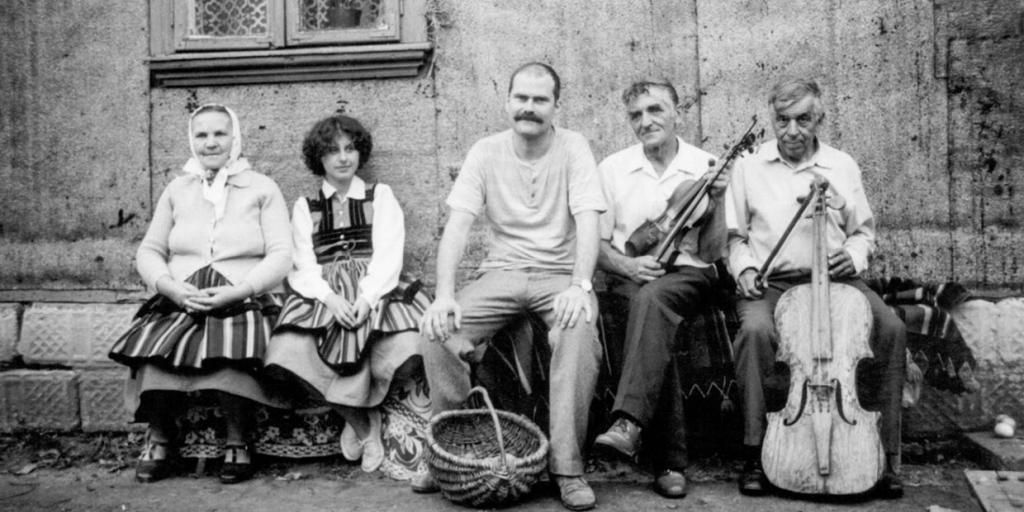
Małgorzata Bieńkowska & Andrzej Bieńkowski with musicians, photo: Muzyka Odnaleziona archive

The subtle eroticism of traditional Central Iberian music in this son, by Vigüela

Wage claims, feminism and sublimated eroticism in the Central Iberian musical tradition

Translating lyrics from the traditional village music is a challenge. Nevertheless I think it is worth the effort when it is to share lyrics like these. In the video below you have the piece with the subtitles. And the truth is that the message is quite clear and, at the same time, it is said very elegantly.

In the center of Spain there is a music style that is even more unknown than jota, rarely performed nowadays, because few people know the languaje: it is the son.

About jota, we have something ready with the basics, specifically for non Spanish people, here. Like the jota, son is improvised combining melodies from a body of guiding melodies from the people, that are in the personal baggage of the singer. The singer redress the melody in real time. The same happens with the lyrics. The shape of the son allows the group to sing together, as it includes repetitions, so anybody can join to sing in that part.

And it is a huge body of lyrics, most of them short, than can be combined to produce the messages you want. There is also a massive amount of enchanting melodies with an ancient bewitching sound.

Son is performed mainly with percussion and voices. A light accompaniment with string on drone, with the rabel (rebec), can be included. In the picture above you see some instruments used for the son: frying pan, saucepan, mortar, cañera, zambomba, frame drum, bladder rebec.

If there are plunged strings, they are used like percussion, because son is modal, not tonal. The drone can be provided also by the zambomba, that is tuned. In this piece below, the singers sing in several different tones, all of them are allowed by the armonics of the zambomba. Despite being a percussion instrument, zambomba can be tuned to produce the armonics you want.

Vigüela are preparing their new album, which will include some sones. In the meantime, you can listen to this piece that we recorded last Tuesday. 

Araceli Tzigane, Mapamundi Música, Spain. +34 676302882 

What is “jota”? Didn’t you ever heard that word? Learn the basics of the most popular traditional style all over Spain

JOTA FOR NON-SPANISH
Learn the basics of the most popular traditional style of music in Spain

 “After decades of flamenco fusions and mestizo mélanges, Spain is probably in dire need of some raw, honest roots music […] Folk group Vigüela have the ultimate credentials.” 
Since I read these words by Chris Moss in Songlines, it has been in my mind the idea of how needed it is to disseminate the traditional music from the center of Spain. A music that is so unknown, not only abroad (that is logical, as very few efforts have been done so far to explain it for the international audiences), but also very neglected inside our country.

I won’t hide how much perseverance this vision made us develope, but also what a pleasure is for us to share it: the music from this land, from this landscape, that inspired such big epitomes of the creation of histories, from Don Quijote to some of the most inspired images of Pedro Almodovar films. In the last months Juan Antonio Torres and me are creating some videos with a didactic approach and now we wanted to share with you this one, made specially for not Spanish people, that explains, from the basic, the style that is the most popular: jota. Here you are the video and, below, you’ll find some concepts that will be useful if you want to delve more.

*** A short digress: we can make a lecture about this and also Vigüela is available to perform in concert. More about the band, here. ***

IF YOU WANT TO DELVE:

As promised above, here you are some concepts to delve into this huge universe of Spanish traditional music:

Concept of style vs. repertoire

This concept must be explained using a term that would like a kind of opposite: the repertoire. Style is not a song, it is not a corpus of songs. It is a language of communication through music.

Style has some rules, codes, ingredients, let’s say. When performing style, the rehearsal is not present. The performers use the code to create a conversation. It is like when you speak English: you don’t know the conversation from before and you don’t make rehearsal of the conversation. You just talk with the other and you wouldn’t say the same things if you were talking with other people in any other moment. It is a conversation between all the people involved. What will be said, is not predetermined. So you have to pay attention to what is been said. Also the moment to end is not set in advance. Style is fluid. Anyone who speaks the language / knows the code of the style can participate. That’s what it makes it so thrilling.

But, in the opposite, the repertoire concept is prefixed. Songs are premade. Only the ones who know the song can participate. The song has the lyrics, melodies… already predefined. In traditional music in Spain sometimes it is used the term “jota of the village X”. And what is performed under this name is like a still picture of the stream of a river. The style is the stream, moving and unpredictable. The repertoire is the still picture. Moreover, that denomination of “jota XXXX whatever name” is most of the times product of a deliberate creation in order to have something to rehearse and to put in a stage.

Other styles

Jota is one of the styles. You find jota all over Spain in the peninsule and also in the Islands. It is probably the most disseminated and popular of the styles. The others are:

  • Son. Learn more in this other video.
  • Fandango. Its family is composed by many variations: rondeña, malagueña, verata… It is not the flamenco fandango, that has other codes.
  • Seguidilla. It also produces many variationssome of them very knownlike the “sevillanas“, that are “seguidillas sevillanas“, so, from Sevile city. In the South East there are parrandasperetasmanchegasgandulaspoblatas… And, welleven when we love it, the seguidillas” by Bizet composed for Carmen opera are not proper seguidillas because it doesn’t use the codes of seguidilla X-D.
And we have also free singing, that is tonadaWe have videos too: this is the first and this is the second. Tonada is not style.

World Music Central interviews Jako el Muzikante

Check the comprenhensive interview by Ángel Romero with Jako el Muzikante and learn how the Galician artist Xurxo Fernandes incarnates the historic character of the hustler of the café aman.

The interview unveils all what is behind the work Ven al Luna Park, with statements like this:

The Sephardic identity is based on their language, a language in danger of extinction. My fascination with Ladino is linked to a feeling of debt to the community from which I learned so much, and publishing this work in that same language is an acknowledgement I want to give.

Read the complete interview here.