“Vigüela to Interact with Audience in Conciertajo, Send your Couplets and Tales”. This is the beginning of the report about Conciertajo.com in World Music Central. Read it all, including some statements by Araceli Tzigane and by Juan Antonio Torres, the musical director of the band, in the web or here below. Thank you very much, Ángel!!!
Music Before Shabbat Shuvah with Kol Nidre by Yisrael Oshri
Shabbat Shuvah is almost here
With Kol Nidre by Yisrael Oshri, getting into the mood for Yom Kippur

 Hello! How are you? I have been waiting many months since I discovered this man, Yisrael Oshri, in Youtube and I saved this video for the time around Yom Kippur. I will be very brief in this occasion, in part because I have no information at all about this person. There are some videos in the Youtube Channel but no biographic info. If you know anything about him, please, let me know. I will come back in the future with more Yemenite music, by the way.
Today is Shabbat Shuvah, the Shabbat between Rosh Hashanah and Yom Kippur. I have learnt if from MyJewishLearning. And the people in Israel are again in confinement. I am remembering my dear Igal Mizrahi Gulaza and so many friends there that are going through this holy days in this situation. Here in my city, we are not confined so far, but the situation could change at any moment.
I will come back to you next Shabbat, after Yom Kippur. If you are going to make fasting, I wish you an easy fast. And in any case, have a good holy day.
If you like this, as usual, please: share it with your friends! Thank you in advance.
 |
Share this with a friend, right from here |
Kol Nidre by Yisrael Oshri
Click the picture to listen to the recording:
I hope you’ll like it and, if so, feel free to share it and invite your friends to join us.
It is as symple as sending … this link to sign up.
Tzom kal צוֹם קַל Easy fast
Araceli Tzigane | Mapamundi Música
To know more about our artists, click here.
MBS before Rosh Hashanah with Keter Musaf by Rabbi Hagay Batzri
Shabbat is almost here. Rosh Hashanah is almost here
May you be inscribed in the Book of Life. Let’s begin this time of reflection with a contemporary chazzan of outstanding artistry, Rabbi Hagay Batzri
Hello! How are you? This is the first Rosh Hashanah of Music Before Shabbat and I am thrilled for sharing with you this moment, that is full of meaning. I think you can take advantage of this time to reflect, whether you are religious or not. To find yourself and to consider your contribution to the world. Have a prosperous, a sweet year. Shanah Tovah.
As usual, you have the video at the bottom. And if you like this, as usual, please: share it with your friends! Thank you in advance.
“Music crosses all boundaries and unifies us”. The voice of Rabbi Hagay Batzri
 I love the old recordings. In previous editions we have listened to Sephardic chazzanim, like İsak Maçoro (don’t miss to listen to his Avinu Malkeinu, in this previous edition) and İzak Algazi (listen him in a love song, here). It is not that easy to find currently alive singers who get close to them and that haven’t tended to a commercial sound. Even so, some are really enchanting, like David Kadosh (listen to him in this edition) and our protagonist of today: Rabbi Hagay Batzri.
According to his Facebook Page (from where I got the portrait), “Rabbi Hagay Batzri was born in Jerusalem into a family of rabbis and cantors. He is descended from the Ben Ish Chai and from Rabbi Yehuda Ftaya, and his father heads the supreme rabbinical court of Israel. In 1997 he received his rabbinical smicha from Rabbi Mordechai Eliyahu, Chief Rabbi for the State of Israel.”
Who was the Ben Ish Chai? According to Chabad.org, “Chacham Yosef Chaim (1832-1909), known as the Ben Ish Chai, was a highly-revered Torah scholar and master of Kabbalah. Based in Baghdad, Iraq, he was recognized by the Sephardic community both locally and abroad as an eminent Halachic authority.”
 And Rabbi Yehuda Ftaya? According to JewishIdeas.org, Hakham Yehudah Moshe Yeshua Fetaya (in the picture, from Wikipedia, was born in Baghdad in 1860 and was disciple of the Ben Ish Chai.
What is chacham? According to Jewish-Languajes.org, khokhem, chocham, chochem, hacham, haham, chuchum, chochem, means wise, genious and for Sephardic, it is the same as rabbi.
“Rabbi Batzri enjoys teaching what he calls practical kabbalah, the kabbalistic reasons and explanations behind Jewish laws, concepts, and practices. He balances his study of Jewish mysticism and his rabbinical duties with concert performances in the United States, Israel, and other countries. […] He has performed, among other venues, at UCLA with the world-renowned Yuval Ron Ensemble. His musical philosophy is simple and beautiful: “Music crosses all boundaries and unifies us.” For Rabbi Batzri, creating music is a way of expressing gratitude and appreciation for all we have. When we make music, we embrace life and all living creatures.”
.
|
Share this with a friend, right from here |
Keter Musaf by Rabbi Hagay Batzri
What is Keter Musaf? Keter means crown and has a special meaning in Kabbalah. You can learn more, here. Musaf is an additional offering or prayer, for holy days like Shabbat, Shavuot, Pessach or Rosh Hashanah. It is an aditional religious service for those days, added to the usual Amidah. Musaf would be a fourth Amidah (the usual days they are three Amidah).
Keter is part of the Kedushah. Kedushah means holiness and it is the sanctification of God’s name during the Amidah prayer. What is Amidah? According to MyJewishLearning, “the Amidah is the core of every Jewish worship service, and is therefore also referred to as HaTefillah, or “The prayer.” Amidah, which literally means, “standing,” refers to a series of blessings recited while standing.” The part of Keter in the Musaf prayer recited on Shabbat is sang only by Sepharadim, not by Askhenazim.
According to DailyHalacha.com, “The recitation of “Keter” at Musaf thus marks a very significant and sacred moment, when we join together with the heavenly angels for the purpose of declaring Hashem’s sanctity.”
About Musaf, there is much more information in the JewishEncyclopedia.
Click the picture to listen to the recording:
.
I hope you’ll like it and, if so, feel free to share it and invite your friends to join us.
It is as symple as sending … this link to sign up.
May you be inscribed in the book of life.
Shanah Tovah
Araceli Tzigane | Mapamundi Música
To know more about our artists, click here.
Magazine #27 September’20 – Brave answers to our common challenge by AMP Concerts, Sori Festival, charts time and +

Brave answers to our common challenge
How are you? I hope well. In this edition we’ll pay attention to some ways of facing the current challenge for our activities of live music as well as to some interesting dates for our community.
I am contacting you from El Carpio de Tajo, Vigüela‘s village. Tomorrow, Wednesday 16th, it will be the online opening gala concert of Jeonju Intl’ Sori Festival. For some days we are working in the preparation, making technical checks and rehearsals. 9 bands from different countries and from their locations will play together. Yes, together! Check the details below. This is one of the creative responses to the situation we are facing.
The Spanish office of the International Labour Organization has provided us the chance to make a virtue of necessity. On October 17th we have an online event that will be the culmination of one month of participation of the public in the design of a concert in which the repertoire is created with their direct support. Learn more below too.
Neal Copperman, from AMP Concerts, explains us how they are keeping the activity, with live offline events too. I find their experience very inspiring!
And sadly, WOMEX had to announce the decision of cancelling the on-site event and the change into an online event. I am curious to see what they surprise us with.
Meanwhile, I really miss our old normality. Some drops of hope take place day by day. The new tour Klangkosmos, the first one after the beginning of the pandemic, organized by alba Kultur in North Rhine-Westphalia, is taking place and, so far, it is going well. The band on tour is Haratago, from Iparralde (North Basque Country). You can learn more about Birgit Ellinghaus, director of alba Kultur, on this edition.
Do you want to share any useful experience you have had during this difficult time or another content relevant for our community of the global music? Contact me. And if you find this interesting, share it with your friends. You can read the previous issues here. 
Thanks for your attention and remember that during the reading you can listen to some great music by our artists collaborators –>
–
Araceli Tzigane | info@mundimapa.com | +34 676 30 28 82
Subscription is available here.
Summary:· And more difficult still: 9 artists from 9 locations, playing together for Sori Festival’s gala concert· Rethinking the program, with Neal Copperman from AMP Concerts· Our value proposal or how to make virtue from the neccesity. The online event for ILO by Vigüela + Mapamundi· Interesting dates· News from our sister projects |
AND MORE DIFFICULT STILL!!!
9 artists from 9 locations will play together online for the Sori Festival’s Opening Gala. Tomorrow, Wednesday, at 19:40 UTC+9
This issue of the monthly magazine has as the main topic the bravity of our community when facing the situation that is making our lifes and works so complicated.
This morning I found this picture in Facebook. The team of Sori Festival, in South Korea, are preparing for the online gala concert that will take place on Wednesday. I have been directly involved so I know for how long all this has been organiced to make it possible. 9 artists, from their locations, will play together, listening to each others. It will be not just a succession of performances. The show can be watched from the festival’s Youtube channel.

The artists will be: Khoomei Beat (Tuva Republic, Russia), ESSE-Quintet (St. Petersburg, Russia), Sebastian Gramss (Germany), Cube Band (Taiwan), Constantinople (Canada, Iran), Vigüela (Spain), Toine Thys’ Overseas (Belgium, Egypt, Luxembourg, Brazil), Boi Akih Duo (Netherlands), Imran Khan & Naim Khan (India), 2020 Sori Festival Sinawi (South Korea).
RETHINKING THE PROGRAM FOR THE NEW CHALLENGE WITH NEAL COPPERMAN FROM AMP CONCERTS
 You might already know Neal Copperman. He is one of the usual attendants of Womex as well as co-director of Globalquerque! for years, as well as director of AMP Concerts, the non-profit organization that has keep going on many activities despite the pandemics, in their state of New Mexico. In this meaningful interview he explaines more about their usual activities and the current ones they are developing in the context of the pandemic. Really thrilling!
 Mapamundi Música: Thanks for taking the time to chat with me Neal. Can you quickly introduce yourself?
Neal Copperman: It’s always nice to chat with you Araceli. I’m sorry I won’t be seeing you at WOMEX this year!
I’m the founder and executive director of AMP Concerts. We are a non-profit that presents events across the state of New Mexico, in the United States. In a usual year, we put on over 200 events, ranging from free monthly events in the local libraries to large outdoor concerts for 8,000 people. And everything in between. We do not have our own venue and rent spaces of all sizes across the state, whatever makes sense for the event. A third of our programs are free, and we have a nice mix of school programs, workshops and residencies too.
MM: I think in your region the pandemic didn’t affect that much as in other places of the USA, did it?
NC: New Mexico is pretty isolated. With small populations and spread out population centers. And our Governor was once the Secretary of Health for New Mexico. As soon as things started to go South, she took it very seriously and has never let go. Sometimes that is frustrating, but mostly we support her efforts to keep our community safe. We are surrounded by some states with really terrible statistics, like Arizona and Texas. The other good thing about New Mexico is that we can go outside. We have mountains that rise out of my city that I can get to the top of within an hour. I can go on great bike rides.
 MM: Despite the situation you have been able to do some nice things, haven’t you? Please, tell us what you’ve been doing during the pandemic.
NC: Obviously none of the things we usually do have been possible since March. We’ve been constantly reinventing ourselves, coming up with new programs and activities to bring music and arts to people virtually, keep local musicians employed and just stay connected with our community.
We started streaming as soon as the pandemic shut down our shows and have presented 20 streaming events. We film them in closed theaters, outdoor spaces and my favorite – the socially distanced neighborhood block party, where audiences watch from their porch, front yard or driveway. The musicians usually live on the same block, so it’s a real gift from the musicians to their neighbors.
We have also produced a community art contest (Art As Antibodies), a series of single song videos in iconic locations around Santa Fe (Postcards from Santa Fe) and we are in the midst of a run of drive-in shows on an equestrian center’s polo field.
HIPICO Santa Fe drive-in concert venue ?

MM: How are you managing to keep the finances alive within the company? Are you managing to make these initiatives profitable or at least, not losing money with them?
NC: That is an excellent question. Sadly, what we are doing is not a viable business model. We think it’s important and we are working super hard to stay active and engaged, but without putting on viable concerts, we don’t have any regular business income.
We successfully grabbed a number of bailout and emergency funding opportunities. The government issued a loan that you don’t have to pay back if you use it all for payroll, so we got that and it was 2.5 months of payroll.
We got emergency grants from a City arts fund and from the National Endowment for the Arts.
We also reached out to some historical funders the first week of the pandemic and said – Look, things are falling apart and no one knows what is going to happen. But we are primed and ready to make interesting things happen in the community regardless of the limitations, and we will pay local artists and keep people employed. Anything you can give us will help us make that happen. And one funder (who had actually cut our funding) gave us $5K, which is what we started with. And the City gave us $12K to do virtual programs.
Some projects cost very little. Like the art competition. We gave out $2,000 in cash prizes, but I think it would have been just as successful had we just given out donated prizes. Beside the $2K in prizes, it probably only cost a few hundred dollars.
We cut staff salaries at the higher levels by 40% and at the lower levels by 10%.
Most of the live streams do not pay for themselves. But we use the money that we raise, alongside audience donations, to help cover the costs.
The Drive-Ins are the most expensive projects. They cost upwards of $15K night. They are not paying for themselves either. However, we would usually do a free concert and movie series all summer. We raise enough money in sponsorships to pay for that project. Since it didn’t happen this year, we asked our main sponsors if we could roll their money into other projects and they have been cool with that.
One of the Postcards from Santa Fe ?

The remaining sponsorships we are using towards the Drive-Ins. We are hopeful that some of the Drive-Ins will pay for themselves. But we are able to make up the difference right now too.
We take donations on top of everything we do, and people have been pretty generous with that.
We have probably paid over $30K to local artists and $10K to local tech people since the pandemic started. I’m pretty happy about that!
I did leave Globalquerque! – the world music festival that I helped found and run for the last 15 years. It wasn’t going to happen this year anyway and I decided to focus my energy full time in making my company be as vibrant as possible during the pandemic and poised to come out the other side once it was done. But that was a bittersweet decision. I might not feel it so much this fall, but I’ll probably feel it a lot more next year!
Reminder of voting time for proyect Art as Antibodies ?

MM: I interviewed Tom Frouge in a previous edition of this magazine about Globalquerque!. Will he continue working on it?
NC: Tom will continue to work on ¡Globalquerque!. He’s now the main person in charge. Before it was just the two of us.
MM: I think our community are people used to facing complications and we are also quite stubborn because we have a strong vision that allows us to pursue our dreams despite the obstacles.
NC: That is totally true! We are dedicated and passionate! And most of our job is problem solving and figuring how to make impossible things happen 🙂
Check also these links related to the conversation:
- Official website, with pages for the Art As Antibodies and Postcards projects: http://www.ampconcerts.org
- YouTube channel where everything that has been streamed can be found: https://www.youtube.com/c/AMPConcerts
- Facebook site: https://www.facebook.com/ampconcerts/
Credits:
- The portraits of Neal are provided by himself.
- Hipico venue, Carlos Medina’s Postcards from Santa Fe flyer, Art as Antibodies flyer, from the Facebook page of AMP Concerts.
|
**** Do you have a world music festival and you want to be included in our mini interviews? Contact us. ****
|
The series of Challenges for the festivals will continue soon
VIRTUE FROM NECESSITY. OUR ONLINE EVENT WITH A TWIST
Technology can be not only a way to reach our audience from a screen but also to engage them in the artistic creation itself. Let me explain you our value proposal for the festival Laborarte.
 For some years, the office for Spain of the International Labour Organization has been doing the festival Laborarte (you can guess it is a game of words with labor -work- and arte -art-) in Madrid. It used to include conferences, concerts and exhibitions.
The director of the office has had in mind for some time to book Vigüela for 2020 its edition. In 2019 the festival didn’t take place. In the picture you see a frame of the 2018 promo video.
Considering the current situation, already in May he asked us a proposal for an online event for Laborarte. But he didn’t want just a concert in streaming. He wanted something else. What? That was his challenge: something online different than a streaming.
We started to reflect on how can we use the technology to strengthen our value proposal, taking into account the artistic possibilities of the music we work with. Popular music that has given the voice to the people by channelling their claims, needs and complaints of their daily life. So let’s give the voice to the people! With this idea in mind we decided to develope three ways of collaboration by the public, two previous and one during the event:
- Survey to check the most relevant topics nowadays for our public, in the field of labour. We are now dealing with the tele-work, working from home with kids, temporary layoff, physical conditions of isolation at work, 8 hours at work with the mask, reaching the work place by subway during a pandemic… Which are the topics that produce more headaches to our public? The results will feed the band to create new lyrics about the most relevant ones. The lyrics in the music styles of jota, fandango and seguidilla are couplets. In just four verses you transmit a strong idea.
- Contest of life stories related to work. In a short text (300 words), any person can submit a life story, real or invented. A professional jury of journalists will chose the best one, that will become a song in shape of romance, the term used for story telling songs in Spanish tradition.
- During the event, there will be time for performing the results of the previous tools as well as some free time in which the band will improvise about the topics that the public requested in the chat. Musicians has been always at the service of the clients, as in any other profession. Do you want us to dedicate a song to you mom? Do you want us to sing about flirting in mask times? About the Sunday blues? Tell us!
We have set up the website www.conciertajo.com (Tajo is the river that passes by the village and tajo is an informal way of saying work in Spain) to collect all the infos and participation tools.
Of course, all this is not possible without a band that is open to do any crazy and demanding idea and of an organization like ILO Spain that has trusted us. We’ll find out soon how does all it result ?.

INTERESTING DATES
Hundreds of online events are taking place this season and many are really appealing. For instance:
- Arts Midwest + Western Arts Alliance 2020 Conference. October 6-9. Described as “a four-day virtual convening to hear from thought leaders, gather new ideas, connect with colleagues, and map a way forward.” The registration for professionals is open, here.
- Fira Mediterrània de Manresa. October 13-18. This year it will combine on site and online activities. The registration for professionals is open, here.
- And, ehem, a moment for self-promotion. On 5th November I will participate in Noam Vazana‘s proyect of interviews in the frame of her Why DIY initiative. I am proud for being considered interesting enough to be in this list of interviewed that includes, between many others, Davide Mancini (check also my interview with him about the festival Musicastrada, here), Minna Huuskonen, Martyna Markowska or Balázs Weyer.
- Global Music Month 2020. The team of BU Global Music Festival will host the program of day 1st October, as a part of Global Music Month 2020, “with 19 festivals and presenters from the US and Canada joining together for a month of online celebration of music from around the world, from August 29 to October 1.” So, we are in that month. Check the complete program here. You can read the interview with Marié Abe from the BU Global Music Festival made at the beginning of the pandemic in Europe, here.
NEWS FROM SISTER PROJECTS + CHART TIME
Two brief news from Transglobal World Music Chart of enough interest to share with all the colleagues and friends:
- A step to break the language barrier by TWMC: “For around three weeks now, if you access the website, it now includes a plugin to translate the website automatically to all the languages included in Google translator. It is very intuitive to use and shows clearly our intention to be open to other languages. The Album Submissions page has also been edited to reflect this approach. Nowadays, technology allows us to resolve this situation, not perfectly but reasonably. We expect that the most internationally-oriented producers will continue communicating in English but now we can also welcome others that don’t have those skills and might be producing musical jewels that wouldn’t reach us if they had to communicate in English.”
- The Best TWMC albums of 2019-2020 Season are here! Congratulations for the great work, artists, producers, panelists! Check the link to read about the change of period for the annual chart.
About Mundofonías, we have re-started the activity after a break in August and our monthly favourites are the last albums by Khusugtun, Trio Tekke and L’Attirail.
Juan Antonio Vázquez re-starts A La Fuente, for Radio Clásica-RNE, in October. In the meantime, during July-September, his work for that station has been La Ruta de las Especias.
WHO WE ARE AND SISTER PROJECTS
Mapamundi Música is an agency of management and booking. Learn more here. Check our proposals at our website.
We also offer you our Mundofonías radio show, probably the leader about world music in Spanish language (on 49 stations in 18 countries). We produce the Transglobal World Music Chart with our partner Ángel Romero from WorldMusicCentral.com. And we lead also the Asociación para la Difusión de los Estilos.
Feel free to request info if you wish. For further information about us, get in touch by email, telephone (+34 676 30 28 82), our website or at our Facebook.
MBS with the Jewish music from the place where all was lost: the reconstruction of the Hungarian Jewish music with Di Naye Kapelye
11th September 2020 – Shabbat is almost here
And the life history of Bob Cohen, founder of Di Naye Kapelye, will inspire us with his commitment to an almost, almost lost legacy. An outstanding story, the cherry on top before the Yamim Noraim.
Hello, how are you? I am almost shivering with emotion to share with you the interview with Bob Cohen. Why? I must tell you that my personal background, my family roots, are not connected to music at all and much less with these musics that were very difficult to reach more than 20 years ago. Moreover, I am from the periphery of Europe, a country where there are not Jewish people for more than 5 centuries, apart from the ones that came as inmigrants during the last decades.
In such a context, to discover in 1998 something like Di Naye Kapelye and their powerful rendition of Dem Rebns Tants would cause the piece to be marked in my memory.
And 22 years after, the man behind it is answering my questions with immense generosity and explaining us how the magical mix of commitment, effort, talent and ethics made all that work possible. Enjoy.
As usual, you have the video at the bottom. And if you like this, as usual, please: share it with your friends! Thank you in advance.
.
|
Share this with a friend, right from here |
The search where there was “nothing” left

A few days ago I realiced that Poland and Ukraine were quite present in this MBS. But somehow I was not reaching to so many facts about Hungarian Jewish popular music, a Hungarian cantor or anything recorded before the World War II… While trying to find something I found phrases like there is nothing recorded, nor written in scores and not even described, about the Jewish music from Hungary from before the Holocaust. Heartbreaking.
But I thought what about Di Naye Kapelye? They play Hungarian Jewish music. How did they do that? The answer is this interview with Bob Cohen, founder of the band. This man on the right is he in a profile picture from his Facebook.
Bob was born at the USA. He will unveils his life story for us. If you want to know more, don’t miss a visit to his blog, Dumneazu: Ethnomusicological Eating East of Everywhere. Along the interview I will include also some digressions, in this colour as well as many links (in orange) in case you want to learn more.
I am moved by Bob’s generous answer, so deep and detailed, that is a lesson for life.
- When you decided to travel to Hungary to make research, why did you do that? Where your parents from there?
 I moved to Hungary in 1989 to teach English at the ELTE Law University and to study traditional Transylvanian fiddle style with friends in the Hungarian Tanchaz movement such as Csaba Ökrös.
.
– This man in the picture is Csaba Ökrös. He passed away last year (2019 June). Click the picture to watch a video with him at his 20 years old, in 1980. Bob has a thrilling tribute in his blog –
.
I wanted to continue to learn Hungarian language and the difficult fiddle style of central Transylvania. My Mother was born in Hungary and left during World War II, but I still have family here and had visited and fallen in love with Hungarian folk music and the “dance house” revival of traditional music during family visits in the 1970s. (My father’s family originates in Bessarabia, today’s Moldova.)
I was raised in the Bronx at a time when Yiddish language culture was still strong among secular working class Jews. My parents and grandparents spoke Yiddish with each other, but they did not want the children to learn it (I spoke Hungarian with my mother.)
.
– In the edition with the greetings from David Krakauer it was mentioned that “His grandparents arrived to the USA from Eastern Europe at the end of XIX century and, after the religious prosecution they had suffered, they decided to leave all that behind and to talk only English.” Now with Bob we see a similar experience of avoiding the permanence of the cultural roots associated to so many disasters, when moving thousands of kilometres trying to create a new future.
.
Like many young New York Jews – Henry Sapoznik (who was with us in a previous edition) and Andy statman, for example – as a teenager I played bluegrass and also listened to a lot of the very active immigrant Balkan musicians in the New York area.
Around 1975 some of these musicians in the folk fiddle scene began to pass around cassette tapes of klezmer recordings at the Appalachian fiddle jam sessions held at the old Eagle Tavern on 9th Avenue. A lot of us folk musicians also went to concerts sponsored by the Balkan Arts Center (now the Center for Traditional Music and Dance) which featured early klezmer revival artists such as Zev Feldman and Andy Statman (in the picture on the right, that is from Discog), who also presented concerts of newly rediscovered Yiddish perfomers such as Dave Tarras.
I then moved to Boston where I became friends with musicians who would play in the Klezmer Conservatory Band (Frank London and I go wayyyy back… we met while jamming in a salsa band) although in Boston my musical life was mostly involved in Greek music, African music, and reggae.
I did not actively pursue Jewish music until I was living in Hungary and traveling to Transylvania to find older Romani fiddlers to learn the Transylvanian village style of violin. They would quickly identify me as Jewish (I had a beard) and begin to play Jewish melodies that they knew. I asked what these were, and they told about playing for Jewish weddings before the Holocaust, so I began to travel around Romania and Hungary actively seeking older musicians to ask if they knew any Jewish music. This led me to do the same when I was back visiting the United States – I went around Brooklyn and the Bronx visiting Orthodox Jewish communities and working with established Klezmer researchers like Michael Alpert and Zev Feldman.
- Are you settled in Hungary now, or in the USA?
I have lived in Budapest since 1989, and I am now a dual Hungarian-US citizen. I travel a lot, but most of my time is in Budapest these days. I live right in the middle of the old Budapest Jewish ghetto – 7th district – and there are synagogues, kosher butcher shops, and Jewish bookstores all around this area. Unlike Krakow, where the Kazimerz neighborhood is a highly visable monument to a nearly extinct Jewish past, the 7th district is a living Jewish area with little on the outside to show its Jewish connections. Budapest has at least 50,000 Jews, with 11 functioning synagogues, and three neighbohoods that can be considered “Jewish neighborhoods” with kosher markets, mikvehs, and synagogues. I can walk out my door and speak Yiddish any day – although Yiddish is no longer very widespread. I tend to identify with our local Orthodox community – as opposed to the larger more assimilationist Neolog community – however I am not particularly religious.
.
- How did you find the materials? I have read that there was nothing recorded from the Hungarian Jews of before the World War II. Is it true? If so, how did you manage to create your music?
Nobody had sought out Hungarian Jewish folkore, as Bartok had with Hungarian folk music or with other groups. Jews were considered “cosmopolitan” and therefore did not, by the definition of early nationalism, have “folklore.” Hungarian Jews were granted full citizenship rights in 1867 – and defined themselves not as an ethnic minority (as in Poland or Romania) but as “Hungarians of Mosaic faith.” Hungary was a birthplace of the Zionist movement, and Yiddish was looked down upon by Hebrew language supporters. Among assimilated middle class Hungarian “Neolog” Jews, “folklore” was seen as superstition. The Yiddish speaking Orthodox community was concentrated in the rural East and North of the countryside, and had little interacttion with the educated Jewish elite of Budapest. And then the Holocaust arrived and wiped out 80% of Hungary’s Jews.
Dr. Judit Frigyesi had done extensive collecting of Hungarian Jewish religious music before 1990, but official attitudes under communism had kept her research suppressed. So beginning in 1990 I began traveling on a regular basis to rural regions where Jews had been populous: in Romania, especially in Moldavia, Maramures, Crisana, Bucharest. I taped recorded interviews with older Jewish community members, and sought out older professional Romani musicians who remembered repetoire from the past when they had played for Jewish weddings.
I was incredibly lucky to meet the Yiddish writer and theater director Itsik Svarts in Iasi, who was born in 1905 and had taken an interest in Yiddish folklore in the 1920s and actually knew many of the key figures in 20th century Yiddish folklore, such as the poet Itsik Manger.
If you want to learn more, visit this link in KlezmerShack with a report by Itsik Svarts about Jewish Musicians in Moldavia
.
His wife, Cili, was the best Yiddish folk singer I had ever heard. Itsik guided me and mentored me and was my link to the world of Yiddish Southeast Europe before the Holocaust.
Cili Svarts sings a little piece in the album by Di Naye Kapelye A Mazeldiker Yid (Oriente, 2001)
.
 I learned a lot from the musicians of the Manyo Band, also known as the Tecso Band, from Tyaciv, Ukraine. They were Hutsul (Ruthenian) Romani who still played many Jewish tunes they learned from their father. I ended up playing with them on tour a lot and brought them to festivals in Holland and New York.
.
In this picture from Bob’s blog you see the Manyo Band in Greenwich Village, New York, 2010.
.
My Mother was born in Veszprem, Hungary. Her Mom was actually born in Travnik, Bosnia. She came to the USA in 1948.
Learn more about his mother, here.

<– The picture of the Synagogue of Veszprem is from the report Antiszemita zavargások, atrocitások és pogromok vidéken 1881-1884 available in this page of the Eötvös Loránd Tudományegyetem and acredited from Mazsihisz.
To learn more about the Jewish people in Veszprem, check this. In advance, I tell you that around the 90% of them didn’t survive the war. And about Travnik, learn more here. It was even worse. For a follow up of the situation about synagogues and Jewish present, check this blog, Jewish Heritage Travel.
.
My Dad’s family came to the USA in 1924. My Grandfather was born in Criuleni, Moldova (Krivlyany in Yiddish.) His name was Onitskansky, which was changed to Cohen (his Jewish/Hebrew paternal name) because the immigration officials could not spell it. Onitscan (nowadays, Onițcani) is a few miles south of Criuleni, and is “famous” as the historical occurrence of the first pogrom in 1726 on accusations of blood libel (killing Christian children for blood for Passover matzoh).
.
You can learn more details about the Jewish communities in the region of Iasi and about this specific event, in the website of Jewishgen.org
.
Just this month I received a message from a Jewish historian from Chisinau that they had discovered the grave stones of the Onițcani Jews and she was amazed to meet descendants of them.
.
About this, Bob provided two links, this from Maghid, Explore the Jewish Moldova, and this from his blog.
.
I visited Criuleni in 2008 while participating in Alan Bern’s “the Other European Project” (you can read about it on my blog…). My Grandmother came from the village of Telenesti in Moldova.
.
You can learn a little bit about the Jews in Telenesti, here and on Bob’s blog.
.
This is a picture of Di Naye Kapelye, from their Facebook page.

Around 1993 I formed Di Naye Kapelye in order to play a “klezmer” music based on the descriptions I had gathered from the information on how Jewish music was performed in small towns and villages before the influence of 20th century technology, mass emmigration, and the holocaust. It was a reconstruction, but Itsik Svarts would coach me on how the band sounded – I would tape rehearsals in Budapest and play them when I visited Itsik in Iasi and he would offer his opinions. In this way, for example, we reconstructed the use of the cobza (Romanian lute) as he heard Romani bands using it for Jewish Purim celebrations in his Moldavian village before 1920.
.
Check this post by Bob about the cobza.
.
In Di Naye Kapelye our clarinetist and singer was Yankl Falk, who is an orthodox cantor in Portland Oregon and now an archivist of Jewish Music. He has a expert command of Jewish liturgical traditions and of living Hasidic repertoire, and also traveling with him always put us in touch with local Jewish communities (we have to keep our clarinetist supplied with kosher food). We also played several years with Jake Shulman-Ment, a young New York Klezmer violinist who is probably the best in the world without exaggeration. Jake spent a year living in Botosani in northeast Romania researching Jewish influences in Romanian folk music.
.
Listen to Jake Shulman-Ment in this promotional video about his work.
And you will also enjoy this video with the Roma performers from Maramures, Nicolae and Victor Covaci from Jake’s Youtube channel.

This collection of pictures are frames from the videos with the musicians from Covaci family in the channels of Youtube of Fiddle Music of Transylvania and of Bob Cohen (Dumneazu).
.
I collected most of the material we use from older Romani musicians in Hungary and Romania, several of whom had played in bands with Jewish musicians until the 1960s such as András Horváth from the Szatmar region of Hungary, Ferenc “Arus” Berki from Cluj in Transylvania (who used to actively ask among other Roma musicians for Jewish songs for me to record), Arpad Toni from Voivodeni in Mures County, and many musicians from the Covaci family of musicians in Maramures (the brothers Ioannei, Nicolae, and Rajna Covaci as well as Gheorghe Covaci from Sacel and Ion “Paganini” Covaci from Saliste, and Gheorghe Covaci “Cioata” from Vadu Izei) as well as musicians in the Republic of Moldova (Fanfara din Edinets, Slava Farber, Arkady Gendler, German Goldenshtyen, Adam Stinga, and Marin Bunea). Many of these older musicians have now passed on.
Some people (in the klezmer world) have called us “the right wing of klezmer” and say we are trying to play a museum piece from 150 years ago. My answer has always been simply “Well, we learned this from a living musician three months ago.” At performances I encourage the audience to get up and dance, saying to them that this is not a music museum.
.
I need to comment a reflection about this last paragraph by Bob. I have seen this kind of argumentations in many other occasions and cultural contexts, in different countries: a claim suppossedly againts the “purists”. Most of the times, the ones who claim are the ones who didn’t want to make the extreme effort to learn and interiorize from the sources and the ones that pretend to “renovate” or to “reshape for its use nowadays” without the real knowledge of that tradition they are supossedly renovating. The deep knowledge of the tradition drives to a natural updating. But you can’t renovate something that you don’t master.
.
- What about the current activity of life music (I mean, before the pandemic)?
Although the full band of Di Naye Kapelye rarely performs in Hungary – with two members living in the USA we usually get together only for larger festivals and tours – the five Hungarian members of Di Naye Kapelye still play for Jewish community events (but not for Hasidic weddings after the orthodox ban on orchestras in 2006. We used to play a lot of those.) In Budapest I play with accordinist Adam Moser for monthly Yiddish dance parties sponsored by a Jewish feminist collective called “Esztertaska” which are taught by Sue Foy, an American dance ethnomusicologist who studied Yiddish dance in New York with folksinger Bronya Sakina.

I played in a small formation called “Shrayim” which was primarily for the Orthodox Jewish community some years ago – strictly “kosher” music (no secular love songs, for example, mostly Hasidic music and usually in Orthodox community spaces.)I also play with Daniel Kahn, Michael Alpert, Psoy Korolenko and Jake Shulman-Ment in “The Brothers Nazaroff” – a tribute to Yiddish folk singer Prince Nathan Nazaroff (here on the right it is the cover of their album). A documentary made about us called “Soul Exodus” is presently on European Netflix.
.
- About the song Dem Rebns Tants, where did you find this or how did you develop it? I like it a lot!!
Its from a gramophone recording of the Art Shryer Orchestra reissued on the CD “Klezmer Pioneers“. Here is the original.
|
Share this with a friend, right from here |
The dance of the rebbe
I have chosen the first piece I listened from Di Naye Kapelye, 22 years ago. It is also a special song because we put it some lyrics over it and sang in a jingle of the radio show Mundofonías, that I do with Juan Antonio Vázquez.
Click the picture to listen to the recording:
I hope you’ll like it and, if so, feel free to share it and invite your friends to join us.
It is as symple as sending … this link to sign up
Shabbat Shalom.
Araceli Tzigane | Mapamundi Música
And we share with you one hour of music for joy in this playlist.
To know more about our artists, click here.
May you always find the light in your path.
These is our artistic offer for live show:
Gulaza – Janusz Prusinowski Kompania Jewish Memory
Would you like to travel to South Korea? Vigüela would have gone… In the meantime, let me tell you a Korean tale
Would you like to travel to South Korea?
Vigüela would have gone to perform there for their first time… For now, it will have to be through the wire.
In the meantime, let me tell you a Korean tale ?

H ello, how are you? I hope well!
This year Vigüela, like most of us, has lost the chance to do many wonderful things, like playing for the first time in Greece and to debut in South Korea. But, they will share a very special moment with the oustanding Jeonju International Sori Festival. Enter our Facebook that day September 16th at about 12 noon (CET) to see us! There will be 9 artists from different countries.
And the promised tale? Yes, yes, under the video ? and, before, a little bit of context:
The name of the festival comes from the tradition of Pansori. What is Pansori? You might know already. Very brieftly, it is a collection of epic stories that are sung by one singer and accompanied only by subtle percussion. The percussionist pulls and responds in a very punctual manner. As you will see in the video below, the person singing also performs the song as an actor or actress. He or she carries a fan in the right hand and a handkerchief in the left, used to represent the objects that are been talked about.
A small set of Pansori has been preserved, and there are five of them that are almost always sung. But keep in mind that each Pansori can last up to 5 hours! 5️⃣ It is a very difficult art and there are artists who specialize in only one of the Pansori.
Click on the image to see the video!
A part of Pansori Chunhyangga, by Kim Myeongsin & Jeong Sanghee
The promised Korean tale:
And what does this Pansori in the video talk about? Ohhh, it’s a love story ? between the daughter of a retired courtesan, Ch’unhyang, and Yi, the son of an aristocrat with a position as a magistrate in the city. But, oh, their love is impossible because they are from different classes. So they marry in secret ?.
But soon the boy’s father is sent to the capital to work and the boy has to accompany him. The new magistrate who comes to replace Yi’s father, has a craving with the girl. And, as she rejects him, he imprisons her. The magistrate says that if she does not agree to his desires, he will kill her ?.
What do you think that will happen? Will there be a happy ending or will it be a tragedy? Arg, what a lot of anxiety! Let’s go on!
.
But, in the meantime, Yi has been hired as ? a secret inspector to investigate the complaints about the evil magistrate. He arrives in town in disguise and no one recognizes him. He goes to the jail and she doesn’t recognize him. So Yi lets the girl know who is he. She is already desperate and says that he will not be able to save her: tomorrow is the day of the execution. But that night there is a party and Yi comes. There at the party he is requested to compose and recite a poem, and he does. The poem tells the crimes of the magistrate to the attendants of the party. He is then arrested and Ch’unhyang is released. Yi and Ch’unhyang will get married, this time publicly. ? Long live life and long live love!
Remember: on September 16th, visit the Facebook page of the festival or of Vigüela at around 12 noon (Central European Time) to attend the online gala concert with 9 artists from different countries! Before that, feel free to watch also this recent video by Vigüela in an intimate moment:
I hope you enjoyed this post as much as I loved writing it for you.
MBS with the sanctum sanctorum of hazzanuz and the Jewish Caruso
4th September 2020 – Shabbat is almost here
And Warsaw and its History of hazzanut at the Great Synagogue will guide us to a vanished time, through the voice of Gershon Yitzchok Sirota
Hello! How are you? Yes, I am a bit delayed today!!! But this is still before Shabbat! I have had very busy days and here I am again.
In this occasion, we follow the thread of Thomas La-Rue, the black cantor’s story, who performed in Warsaw at a time where the Great Synagogue at Tłomackie Street was the landmark of hazzanut. La-Rue didn’t perform there, but many other cantors did, like our protagonist of today, Gershon Sirota, whose life is connected, for better and for worse, with the city.
I won’t hide that I have a special love for Poland, that country in which, according to my dear Janusz Prusinowski, there is still the feeling of something that is lacking: it is the presence of Jews. He also considers that “Polish and Jewish cultures have quite much in common, so I can understand better Polish culture thank to Jewish music/culture knowledge.” Read more about these reflexions by Janusz, here.
I invite you to listen to a recording that takes us back in time to the Wielka Synagoga w Warszawie, with the voice of the hazzan who was its Obercantor from 1907 until 1926.
As usual, you have the video at the bottom. And if you like this, as usual, please: share it with your friends! Thank you in advance.
|
Share this with a friend, right from here |
The Great Synagogue in Warsaw
There isn’t any synagogue now in Tłomackie Street. According to Sztetl.org.pl “On 16 May 1943, explosives were set up around the site and the synagogue was blown up personally by General Stroop to mark the end of his mission to exterminate all Warsaw Jews”.
Nevertheless, f*** you, Stroop: the synagogue dissapeared but the headquarters of the Main Judaic Library and of the Institute for Judaic Studies, that are here in the picture on the left, are now the Jewish Historical Institute and the Jews were not erased from Polish land. This picture is from its website:

This is how it looks like today in Google Maps:

The cornerstone of the Great Synagogue was laid in a ceremony held on 14 May 1876. The architect was Leandro Marconi, who also built the Synagogue Nożyków, the only one that survived the World War II (more info, at the website of Jewish.org.pl). The grand opening and consecration of the synagogue took place on the day of Rosh Hashanah of the year 5639 (on 26 September 1878). Find much more information about the building and its history and the use by the community in Sztetl, a website by POLIN Museum.
Let’s visit the Great Synagogue
 Arik Boas Animation made a few years ago this animation you have below, for The Museum of the Jewish People (Beit Hatfutsot).
Pay attention to the face of the chazzan! Doesn’t he look like Gershon Yitzchok Sirota? In fact he does, but note that the singer in this animation is accredited to be another superb cantor, also born in Ukraine, but about whom I haven’t found references of his presence in Warsaw at the Great Synagogue: Yossele Rosenblatt, who will be our star in a future MBS –>
Anyway, immerse yourself in the Great Synagogue!
The great chazzan at the most prestigious position in the cantorial world
Gershon Sirota became the Obercantor in the Great Synagogue in 1907. The World War II brought the end of the Synagogue and also of Sirota.
According to Rabbi Geoffrey Shisler, “Not without good reason was Gershon Sirota spoken of as the ‘Jewish Caruso.’ Even with the poor quality recordings that we have of him today, it’s quite clear that he had a most extraordinary voice and since he was a contemporary of Caruso (1873 – 1938), the comparison was bound to be made. An apocryphal story has it that Caruso would come to hear Sirota sing or conduct a service whenever they were in the same town at the same time.”
 Gershon was born in Podolia in 1874. His father was a cantor in the local synagogue and, already as a child, Gershon helped his father in the services. The family moved to Odessa, where he would be cantor in Shalashner Shul. Later he gave service at the Shtat Synagogue of Vilna. His performances granted him more and more popularity and was called to make special concerts in many cities around, first in Russia and Poland, and later much further. He was the first cantor to record his voice on phonograph records and he became world famous thanks to this.
Between 1912 and 1927 he toured in many ocassions at the USA. It made him lose his position in the Great Synagogue, because he was absent too much time, specially in the High Holy Days. No problem. He was already a very demanded star.
He toured at the USA for his last time in 1938. It is sad that he didn’t decide to stay there. He had to return to Warsaw because his wife was very ill. The start of the war found him there. The family was imprisoned in the Guetto, where he would conduct the High Holy Day services in 1941.
In the first months of 1943, a strong resistence arised in the Guetto of Warsaw and an uprising started on April 19. The bombing of our Synagogue, that was out of the Guetto, was the symbol of the end of that uprising. Sirota was murdered with his family in the last day of Pessah, during the destruction of the Guetto.
The sources for this brief bio have been: Jewish Music Research Center, Music and the Holocaust.
The voice of the “Jewish Caruso”
I have chosen his rendition of Avinu Maikenu. Check also the version of İsak Maçoro in this previous edition of Music Before Shabbat.
.
Click the picture to listen to the recording:
|
Share this with a friend, right from here |
I hope you’ll like it and, if so, feel free to share it and invite your friends to join us.
It is as symple as sending … this link to sign up
Shabbat Shalom.
Araceli Tzigane | Mapamundi Música
And we share with you one hour of music for joy in this playlist.
To know more about our artists, click here.
May you always find the light in your path.
These is our artistic offer for live show:
Gulaza – Janusz Prusinowski Kompania Jewish Memory
Vigüela at the Jeonju International Sori Festival, South Korea
The pandemic didn’t allow us to travel to Jeonju, but anyway, Vigüela will have the joy of participating in the Gala of the Jeonju International Sori Festival.
I was there the last year with Janusz Prusinowski Kompania and Manu Sabate and it was an amazing experience.
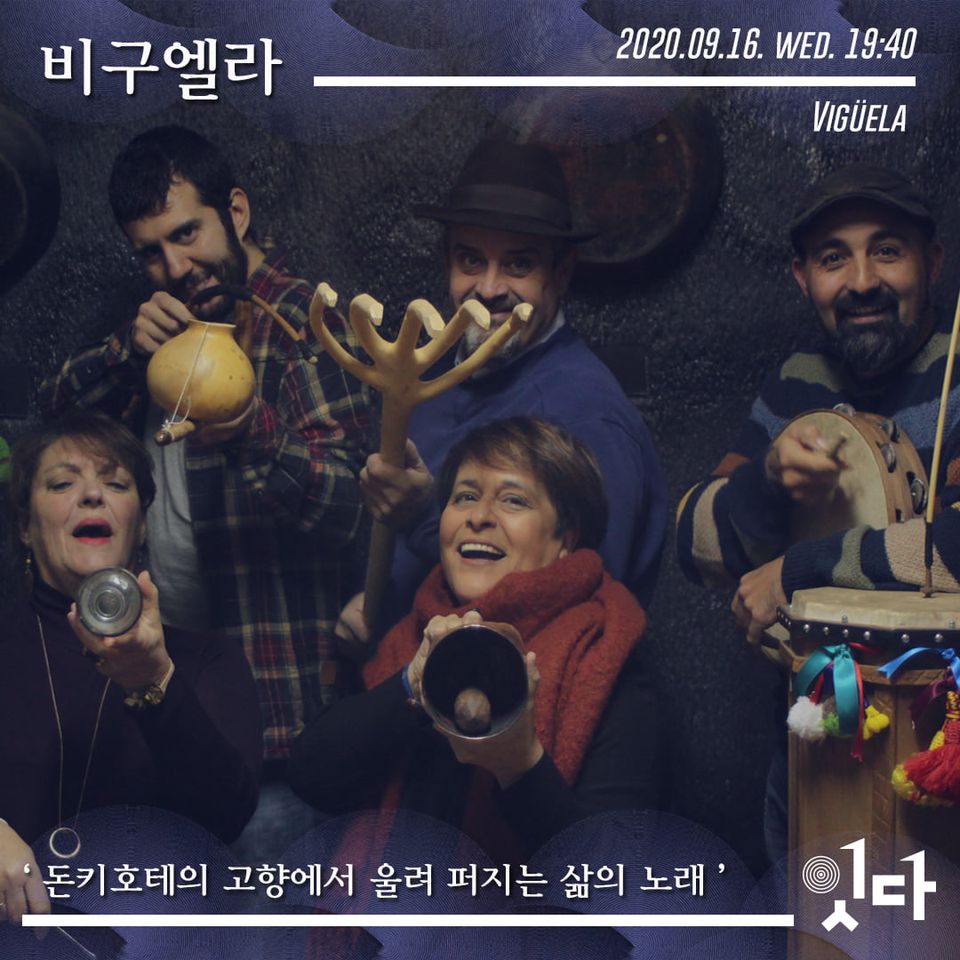
In this occasion we will count on Toni Quintana, from Jennyrecords, who has been Vigüela’s sound engineer for the last albums, and Jaime Massieu, in charge of the video, with whom we have also collaborated before.
This video below is just a little advance to greet our future public from Jeonju, recorded and subtitled by me (Araceli Tzigane):
MBS with the black cantor Thomas La-Rue, through Henry Sapoznik
21th August 2020 – Shabbat is almost here
And today we travel with our imagination to the USA of one century ago with Henry Sapoznik to answer this question: How does a non-Jewish African-American boy born at the beginning of the 20th century end up making a living singing liturgical music in Yiddish?
Hello, how are you? I hope well. This week I have had two reasons to celebrate:
- my birthday, that is on August 26th
- and to discover the amazing blog by Henry Sapoznik and his series of posts about the black cantors in the 1920s and 1930s at the USA.
I invite you to listen to a recording that tells us so many things! It wouldn’t be available without Henry’s work.
.
As usual, you have the video at the bottom. And if you like this, as usual, please: share it with your friends! Thank you in advance.
.
|
Share this with a friend, right from here |
Who is Henry Sapoznik

I have the feeling that at the USA, any person interested in Jewish culture knows Henry. Despite the globalization, there is still a big gap between North America and Europe in the field of not mainstream culture, so let me introduce him.
I took this picture from his Facebook profile. It is meaningful: he is a Jew who plays banjo. But he is much more. According with his website, he is a native Yiddish speaker and child of Holocaust survivors, award-winning producer, musicologist and performer, and writer in the fields of traditional and popular Yiddish and American music and culture.
He explained to me that he started his blog as an answer to the situation produced by the pandemic. We are experiencing much suffering because of it but at least some little jewels are being born in this dramatic conditions. He also told me that he has the idea of starting a podcast. I will be checking to update you.
Sapoznik was the founding director of the sound archives of the YIVO Institute for Jewish Research in New York from 1982 to 1995, as well as founder and director of KlezKamp, beginning in 1985 for the next 30 years.
Henry’s parents were both from Rovno, between Lvov and Kiev. It is the region of Volhynia, also known as Volinskaya, Wolin, Wolyn, Wolina, Wolinsk, Volinski, Wolinski, Volenskii, Wolenskj, Wolenskja, Volin and Volyn, according to the JewishGen website. It is a land that has changed from the hands of Poland, Ukraine and Soviets. Nowadays it is part of Ukraine. Apart from the extermination of the Jews of Volhynia, that began in the first days after the outbreak of the war between Germany and the Soviet Union, according to the Jewish Virtual Library, in 1943–44 the region was the scene of ethnic massacres in which some 100,000 Poles died and some 20,000 Ukrainians were killed in revenge. The Polish film of 2016 Wołyń, in which my colaborator Janusz Prusinowski played, shows this situation.
According to JGuideEurope, on 6 November 1941, the 17500 inhabitants of Rovno’s ghetto were executed in a single day and left to rot in a huge, circular mass grave. The Sosonki memorial, on the road to Kiev, around two miles from Rovno, reminds this massacre.
Rovno has a synagogue very near the former (and bigger and newer) synagogue and Google Maps is very nice to show them to us:

You know this Music Before Shabbat uses music for the joy in itself and as the thead to learn more about history and I feel this very close to Henry’s vision. I can’t hide what a big joy it has been for me to meet this man and talk with him at the Facebook.
Toyve Ha’Cohen or the black cantor Thomas La-Rue
This amazing story is widely told by Henry in his blog in this post about Larue, and in this one about the tour he made in 1930. I strongly recommend you to check those links. Here I will just make a brief summary of Henry’s work. This poster is from his website too.
 Thomas was born in 1902, son of a single mother. They lived in Newark (New Yersey) and she faced much racism. She could make friends only in the Jewish women. With the time, she started to become into their religious believings. Her son and her daughter received a traditional Jewish primary school education. It is not clear if she converted.
How did he start to become a professional singer in Yiddish?
According to Henry’s blog: «One anecdote about LaRue which was repeated so often it has the burnished patina of a creation myth, concerns a Sabbath service he attended as a young boy. During the service, the cantor was taken ill so LaRue quickly put on a prayer shawl and, before the congregation could orient itself, took to the lectern and in his soprano voice began to intone the prayers. The congregation was ready to storm the podium to take him down but he sang with such great feeling that they remained standing and began praying.» True or false, who knows. Thomas was hired by a manager and his career started in 1921 and soon he became usual at the stage in shows of Yiddish theatre. And the recording below is from June 1923.
In 1930 he made a tour in Egypt, Palestine, Israel, Germany and Poland. He was welcome in Warsaw with big scepticism. It was at the time the landmark for cantorial art, specially by the role of the Great Tłomackie synagogue, that will be our focus in a future edition of MBS. This wonderful picture below is from the website of the Jewish Historical Institute.

For that tour, the productor, Edvin Relkin, invented a totally fake story in which his mother died when he was young and his father was a high official in the local Abyssinian government, they were descendents of the Ten Lost Tribes.
Thomas’ last performance documented is in 1953 in Newark. It is not known his date of death nor where is he buried.
|
Share this with a friend, right from here |
The song encouraging the Polish Jews to keep the hope
From the available recordings by Thomas La-Rue in Henry’s Youtube channel, I have chossen the one that I prefer the least in terms of melody but that has very meaningful lyrics, specially taking into consideration the story of Henry’s parents. The whole lyrics are in this post by Henry and I will just copy a little part. You’ll understand what I mean:
.
Don’t give up hope yet, Mr. Jew
One day it will all work out for you
Pharaoh, Haman and Amolek taught a bitter lesson
But those days are through
Czar Nikolai, has met his destiny
And from Poland, you’ll be free
.
Click the picture to listen to the recording of Thomas La-Rue:
I hope you’ll like it and, if so, feel free to share it and invite your friends to join us.
It is as symple as sending … this link to sign up
Shabbat Shalom.
Araceli Tzigane | Mapamundi Música
And we share with you one hour of music for joy in this playlist.
To know more about our artists, click here.
May you always find the light in your path.
These is our artistic offer for live show:
Jako el Muzikante – Gulaza – Janusz Prusinowski Kompania Jewish Memory
A life that deserves a movie: Andrzej Bieńkowski & Muzyka Odnaleziona
Have you ever listened to music so captivating, so crazy and so different from anything else that you wondered ‘For God’s sake, what do these people have inside them to make that music?’ Sometimes, I even want to sneak into their minds to understand the source of that beauty…
This is just the start of a report written by Araceli Tzigane and that has been recently published in Culture.pl, the outstanding communicative project by the Instytut Adama Mickiewicza. It includes a brief bio of Andrzej Bieńkowski and his partner Malgorzata, as well as an interview, translated from Polish to English by Ewa Gomółka.
Andrzej’s life is one of those that make a change in the world. Andrzej, a painter and a teacher at the Academy of Fine Arts in Warsaw, was widely disdained at the time by his colleagues because of his obsession with rural musicians from around Radom: he would constantly play their music at his house and they were practically the only motif in Andrzej’s paintings over the last few years. He had opted out of a promising career as a painter, even though he was demanded and valued in Switzerland and Italy, so that he did not to have to leave his rural Poland. For years, he recorded without respite those old forsaken musicians from the Radom region, one of the poorest and most isolated in Poland.
Read all the thrilling report here: https://culture.pl/en/article/music-lost-refound-an-interview-with-andrzej-bienkowski You’ll understand how this demanding obsession developed to be one of the most relevant shapers of the current escene of folk music in Poland.