
Summary 👇
- Editorial
Losses, European Music Day and a few words about Muziekpublique - Talk with Davide Mastropaolo about Napoli World, Agualoca Records and much more
- A little something from my side: Mustafa Said‘s new album Maqam Pilgrims
- Two Venues for the Hide & Seek Festival 2025 Highlighted by Peter Van Rompaey
- Brief news from the media, charts and sister projects
- Open calls: Babel Music XP, Napoli World
- Meet me at ✈️
➡️ This is the link for subscription
Hello, how are you? hope you are very well. I can’t complain. I’m doing well, although, as I imagine you are too, I’m closely following the situation in the Middle East. And I’m thinking, among others, of the people from Iran I know who are in exile. A couple of years ago I spoke here with Behzad Pournaghi, the manager of Rastak, about their exit from the country and their move to Turkey so they could continue making music, especially due to the presence of women in the group and all the complications and persecution that this was bringing them.There are dozens of women musicians we feature on Mundofonías quite frequently, because they are prolific and outstanding artists, but of course, all of them whose music reaches us are outside their country. We always point this out on the show. I hope that in the near future we will be able to feature Iranian women musicians creating and recording music from within their own country.
Mentioning these critical situations that are so present in the global conversation shouldn’t make us forget about other peoples who don’t receive as much attention, like Sudan, Yemen, Myanmar, Haiti, Ethiopia, the Congo — and surely there are others I’m not even aware of. The other day, I was reflecting with a musician I collaborate with on what place people like us could have in all of this. I remembered a quote — I don’t recall who said it or where — that suggested if people know the music (or art in general) of other peoples, it becomes harder to go to war against them. Someone who wasn’t me (but I share the insight) replied that Putin wouldn’t have been stopped by hearing a beautiful Ukrainian folk song.
About the losses
Everyone dies, sooner or later—we know that. This past week I learned about the passing of two musicians I don’t want to leave unmentioned. Both lived long lives and left behind a legacy of recordings that is a true treasure. I got the cover of two old albums from Discogs.

Petroloukas Halkias, a Greek clarinetist, passed away at the age of 90 a few days ago. I first heard him about five years ago, thanks to the album The Soul of Epirus, with laouto player Vasilis Kostas. The full album is here. Two years ago they released Volume II, which you can hear here. On some tracks, Kostas Tzimas sings. I feel like I melt listening to this. I honestly feel drained of all strength.
The other is Aharon Amram. He passed away on June 2 at the age of 91. I found out on Friday. I had posted this recording of the piyut Kirya Yefefiya on Facebook, wondering where Aharon Amram might be, and someone told me he had passed away a couple of weeks ago. He was a Yemeni Jew who was brought to Israel at the age of 11 during Operation Magic Carpet. His role and his legacy related to the Yemenite Jewish music is huge.
About the European Day of Music
I am working on this newsletter on day 21st of June, the European Day of Music. And an idea came to my mind. I feel such sadness for people who are unaware of so much music. Although right now, anyone with a bit of curiosity has everything at their fingertips. I’m sure there are people who feel sorry for people like me who are totally ignorant when it comes to cinema. Or literature. Or series at the digital platforms. And even I have such a limited knowledge of music. I know little about Western classical music. I know nothing about British pop music from the 1970s. For some people, that might be a cornerstone of life. For me, this cornerstone in mine keeps opening new or deeper perspectives on the world, time and time again. I have this playlist on YouTube, it’s called Música Maravillosa. Not everything that’s wonderful is there, but everything that is there is wonderful. I’ll keep adding more.
 About Muziekpublique
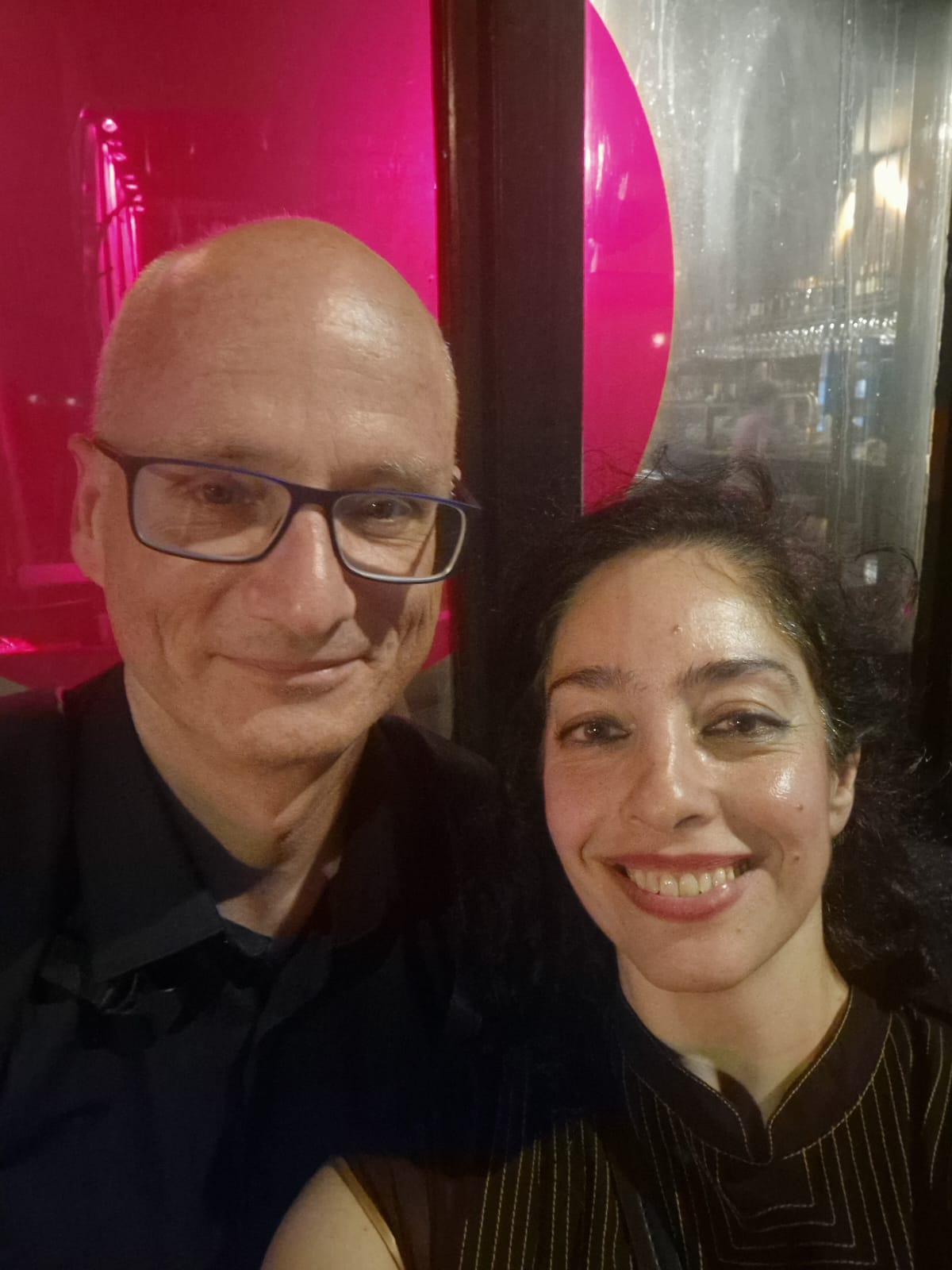
In the photo I’m with Peter Van Rompaey in Brussels. I travelled there once again this year, this time to attend the European Forum on Music, organised by the European Music Council. I attended the Lab on the 11th of June, as a board member of the European Folk Network. The 12th of June was open to anyone who wanted to register.
With Peter, I had a very long and fascinating interview, which you can find here. He is the driving force behind Muziekpublique and a key figure in our field, both personally and in terms of the organisation he leads. It’s always a great pleasure for me to spend time with him. If you’re not familiar with their work, make sure to visit their website.
And you can also subscribe to their newsletter at the bottom of their website. Muziekpublique has been hosting hundreds of concerts at the Théâtre Molière, which is currently under renovation. In the meantime, they continue organising events in other venues, such as the Hide & Seek Festival, which celebrates its 10th edition this year from August 17 to 23. Its motto is “Concerts of traditional music in unusual places in Brussels.” I asked Peter to tell me two of the venues he finds most special among those hosting the festival this year. You’ll see them further down. I am happy for Peter also because they have two artists selected for WOMEX 2025: Toasaves and another one that is not announced yet.
If you enjoyed any part of this newsletter, feel free to share it with someone who might like it too. Thank you in advance.
Remember: if you have any news of interest for our community, let me know. Thank you very much for your attention. Araceli Tzigane | Mapamundi Música | +34 676 30 28 82
AND NOW THE FLOOR IS FOR:
DAVIDE MASTROPAOLO, FROM NAPOLI WORLD AND AGUALOCA RECORDS
 The portrait of Davide is by Riccardo Piccirillo
I don’t remember when I first met Davide. I think it was in Spain. He has lived in Spain and speaks Spanish quite well. But I couldn’t say for sure — I’ve seen him in so many places! At first, I associated him with his label, Agualoca Records, which has released albums by Flo, Vesevo, Ilaria Graziano & Francesco Forni, Fanfara Station, Maria Mazzotta and, most recently, Ra di Spina. And more recently, his flagship project — at least from the perspective of our community (as he’s also active in the field of music for audiovisual media) — is Napoli World. The recently opened call for showcase proposals, which welcomes international artists, was the trigger for this interview. But, as you’ll see below, we talked about many other things as well.
Davide’s journey is truly fascinating. He brings experience from several angles and shared some insights that are nothing short of remarkable. I’m sure you’ll find the interview just as inspiring as I did.
☀️ While I am editing this interview I am listening to Orchestra Joubès, the band of Davide. In this enchanting album, he played the upright piano and other instruments and co-composed the pieces (except one by Pascal Comelade) with his partners Ernesto Nobili and Antonio Fraioli.
Listen to it, here🎶
 About Napoli World Napoli World will take place from 27th to 29th of November. The call for applications for showcases is open until 15th of July. It is organiced by Italian World Beat, lead by Fabio Scopino e Davide Mastropaolo. The artistic director is Enzo Avitabile.
It is part of the platform UpBeat (The European Showcase Platform of World Music).
On the website you can download the rules and conditions and fulfil the form with the proposal of a showcase. “Musical projects belonging to the World Music, Ethnic and Folk Music, World Jazz, World Electro and Global Beats genres will be considered eligible.” Candidates who have not received any communication by 31th August 2025, will be considered “not selected”, a communication will be sent only to selected candidates.
Sixteen showcases will be scheduled.
The showcasing artists will receive a fee, per musician:
- regional project: 150 €;
- national projects: 200 €;
- international projects: 300 €;
all amounts + VAT where applicable; national and international will have one in hotel + local transport where required).
If you are going to apply, check the official website.
And here is the interview.
ABOUT NAPOLI WORLD
AT: The initial reason for the interview is Napoli World, but I’d also like to know a bit more about you. About Napoli World. In 2022, but you did another similar event in another place. This year will be the fourth edition in Naples.
DM: The fourth in Naples, which is the fifth of that MusicConnect project, because in 2021 we organized it in Pistoia. It was like a first attempt to see if something could be set up, because after Covid there were some funds that could be applied for to organize events. And we tried, because we already had in mind the idea of, in the future, organizing a showcase festival in Italy, because there was nothing. Many years ago there was Medimex, but it was a very large structure with stands… Old style, let’s say, which I loved. I was at Medimex in 2012, in Bari. But the size I liked was another, it was more informal, with fewer delegates. Well, maybe someday… I don’t know if we’re going to have so many people. But the idea has always been to remain informal, on the one hand, but very professional with the artistic proposal and the quality of the guests.
“The idea has always been to remain informal, on the one hand, but very professional with the artistic proposal and the quality of the guests.”
But we’ve always liked that kind of special showcase, different from the big one, which is a bit anonymous. Because mainly in Womex, you basically go to meet the people you already know. And everything goes fast and there are lots and lots of people. I, the first time I went, felt completely lost.
Well, for the type of idea I have and that I share with Fabio Scopino, who is my travel companion in that type of proposal, which is an artistic proposal, we wanted to make it small. For years together, we’ve had that experience of being delegates at different kinds of fairs, the big ones, the medium ones, the tiny ones… And as Italy, we always arrive last, so we had the advantage of trying to take what we liked from each fair to make our own. And we started in Pistoia.
This is Fabio Scopino’s LinkedIn profile.
DM: And the following year the opportunity came up to do it in Naples, which is clearly a city that has returned to being at the center of culture. It got lost for a while, but now people like to come. There’s a new wave of cultural tourism too. So we decided to keep MusicConnect, but we gave it the name Napoli World, because it’s dedicated to the city of Naples, which is a brand that is easily recognized.
HOW NAPOLI WORLD WAS BORN
The project was born in Cape Verde in 2018, when we got together with some Canadians who invited us to Canada to make a first idea of that MusicConnect project, which was international, but very free. Each one brought an idea of making a group of professionals in their country and exchanging projects, but, above all, organizing 2 or 3 days of fair. And we did it in Paris one year, in 2019. It was organized by José da Silva with his daughter Elodie, who at that time still worked in the music sector. And in the end Fabio stood up and said: “Well, the following year we’re going to do it in Italy.” He took that risk. And then Covid arrived and nothing was done.
So, when we came out of Covid, with a one-year delay, we did that first edition, very small, in Pistoia, which is a city in Tuscany, very close to Florence, but is a size more, let’s say, of cultural province. And from that moment, the idea was to do it in different cities. Because Italy is very diverse, also in terms of its musicians. And the delegates like to see different parts of Italy.
And it turns out that I lived in Naples for a good part of my life and never had a euro of subsidy to do anything. And magically, in 2022, a new city administration arrived that accepted new projects. And I proposed that project and they liked it, because they saw it as an opportunity to open the city to an international context and, above all, the professional part. Because the festival has a public part, open to a general audience, and at the same time it is a work opportunity, of connections and of networking. That concept pleased the city council a lot and they gave us the possibility to do a first edition in 2022.
And already the second in Naples was very successful because we had a historic theatre, one of the most important ones, the Teatro Bellini. And we started with the artistic direction of Enzo Avitabile, whom we already knew as an artist, and he was the only known artist whose manager went to the fairs. Because Italy is a bit strange, there has always been a somewhat divided presence in this type of events, not so structured. And he appreciated the work and we proposed to him to be our artistic director and that clearly gave us a more important profile at national and local level. So, since that 2023, we have the artistic direction of Avitabile. And the formula changed a bit, because in 2022 the idea was to focus above all on artists from Naples. In 2023 there were nationals with some international guests, because the collaboration with the fairs with which we are in network is also an opportunity to connect. These are similar fairs, with which we share an attitude.
“Above all, in the city of Naples, now the festival is known. It’s known that, at the end of November, there is a festival where I’m not going to find big names, but I’m going to discover projects from all over the world, which are going to be of quality.”
And in 2024, it was a disaster, because the City Council didn’t finance us. So we decided that we had to do it anyway. It was a personal investment. And we were supported by UpBeat, which is the platform of showcase festivals. With the UpBeat system basically we covered the expenses, but it was a very barricade-style edition because it was, really, without any local public financial support. And people liked it a lot. New musicians also came, new delegates… And, above all, in the city of Naples, now the festival is known. It’s known that, at the end of November, there is a festival where I’m not going to find big names, but I’m going to discover projects from all over the world, which are going to be of quality.
Despite the complicated situation that Davide has explained, the program of 2024 was very interesting. You can check it here.
Well, the normal audience is going to discover a new project. The local musician comes to listen to other musicians and they meet each other. The international delegates meet here. Napoli World turns out then to be a place where things happen at all levels: artistic, cultural, for the city, for the delegates, for the artists.
HOW THIS EDITION OF NAPOLI WORLD WILL BE
DM: And this year for the first time we have made an open call to the whole world and we will do a promotion with an official campaign when we have the selection of the artists. For the first time in 4 years we will have a program 3 or 4 months in advance. This for me is a dream, because never in my life did I have that opportunity to have the program so many months before… (Italy…😊)
This year we will have 16 showcases: 8 international and 8 national. We will have a special event on Thursday, in collaboration with the City Council of Marseille. And we will organize some activities, but also leaving free time, so that the delegates don’t have an impossible schedule from 8 in the morning until 10 at night. There will be time to go out into the city. For me, professionally, it is much more interesting because informal relationships are created outside the fair.
At the fair we will have 3 hours of speed meetings on Saturday morning and some panels that also serve us to gather everyone together in the morning.
The venues are more or less all close. I think that is the problem of big events of that kind, having to decide because you have to move around. I prefer a smaller venue for the day, with day case, and a bigger venue at night, but so that people don’t have to run and sacrifice one they want to see, because you really can’t see everything.
WHAT NAPOLI WORLD BRINGS TO THE ARTISTS
DM: Clearly, our intention is to be the center of an international network, but the effort is toward promoting the presence of Italian artists. For a long time now Puglia has supported artists and they have an important presence. But there are many independent professionals who don’t know, don’t find their place. They don’t understand anything. I was also one of them. So I said to myself: “Well, I want to do something that nobody did for me.” So, to help the artists to meet people who can be relevant for their career.
For example, now a Neapolitan group that played last year – they are called PS5 – is a jazz, world, a bit funk quintet, fucking great musicians who are very successful here in Naples, they’re going to Sunfest because Alfredo Caxaj liked them and they also have a date in Toronto. And in the previous years, groups like Ars Nova Napoli and, above all, Suonno D’Ajere, entered the international world music circuit through this.
Besides, we have established a payment for the artists. I am very sensitive on this subject, but clearly, last year we couldn’t. Many of the delegates even paid for their own trip because we had no money for anything. But we did cover the on-site expenses.
This year we have established a fixed fee. For the internationals we have more support because they have to travel here. And the idea is that it doesn’t have to be an expense for the musician, but an opportunity, at least you cover expenses, but you play your card, it’s an opportunity. That is very hard to explain to the groups, especially in Italy, because we are very talented, but we are a bit lost. And, above all, because there is no continuity. In our case, the city council supports you one year and the next year, who knows. But the festival improved. It’s not that they don’t support you because no one came. No: about 2000 people came in two days, the theater was full. We have fantastic images. And in response to this, the logical thing would be for them to keep financing it. But last year it wasn’t like that.
So it’s like a game of chance…
This is the story of Napoli World and MusicConnect Italy. This year we also have a small support from the Ministry of Culture for the first time, in addition to the city council.
AT: So, this year, as new elements, there’s that open call for international artists. And I wanted to ask you something. You mentioned that you report back to the city council. If the groups from Naples are performing abroad after their participation in Napoli World, do you have any formal way to gather that information about the result? Or is it informal? Until now, you have been very much in contact with the artists who have performed, quite directly. But do you have or are you thinking of establishing some way to collect that information in a more formal way?
Indeed, artists say “how am I going to go if I’m not getting paid.” And then they say, for example: “in the showcases, the waiter gets paid, the sound technician gets paid, and the musicians, who are the main figures, don’t get paid.” I, obviously, from my point of view, perfectly understand what a showcase entails. But the artists, as you say, complain that they’re not being paid. So, if we had a way from your side to show that if you do a good showcase, look, the results are worth it. This was the outcome from last year. And this over the last 2 years. These groups did this concert, this collaboration, etc.
DM: That can be done not only for the Italians, but also for the internationals, the UpBeat platform also monitors this. Because here international artists have been shown to international professionals. So, we discovered that it makes more sense for it to be an international showcase, because here relationships are formed on the Neapolitan stage, but many opportunities have emerged beyond that.
So, we’re going to prepare a list of the artists who have participated from 2021 to today, and what festivals and experiences they’ve had.
AT: I’ve already made three proposals for NapoliWorld. And I have experience in other showcases that did result in concerts for me afterwards.
But a professional recently pointed out to me that sometimes you don’t know that the concert you’re being hired for came from that showcase, because it’s 2 years later, or 3 years later. I understand that it’s really difficult to keep track of these things. But I think that if there isn’t even the intention to collect this information, then you really are lost. You have no data to hold on to. That’s why I find it very important to have data in order to make arguments to the musicians and also to institutions, of course. You now have to fight every year with the city council of Naples. To obtain this support you will need strong arguments, right? And in the end, numbers are what are understood most easily.
I sometimes miss in these kinds of events that formal intention to collect that information about the results. From what we’ve talked about, I understand that you are indeed going to make that specific effort to track the results.
DM: Without a doubt, without a doubt.
AT: And regarding the panels, how do you select them? Are there any particular topics you are interested in?
DM: Each year it depends on the type of delegates. Last year we had an important delegation from Asia because people came from Korea, Taiwan and India. So, we focused on how to present oneself to the Asian market in those different countries. It’s a way for people to get to know it, including myself. I didn’t know, for example, that there are those 5 festivals in Taiwan, for example. So, on an informative level, a presentation is made of what the delegates do.
The first year, in Pistoia, we did a panel on performers’ rights. We had a small support from the society that manages them in Italy and we did a panel about those rights.
But what I see, especially in the last fairs where I’ve been, is that maybe the topics are too generic. For example, the digital in music dissemination. That cannot be a topic. What’s it about? Because this kind of music doesn’t follow the reasoning of playlists on Spotify. Of course, it also has to be on Spotify, but those are topics that are too scattered.
So, our idea is to do panels that have a concrete focus and, above all, that the delegates are introduced. Last year Joan Rial came, the new director of MMVV, who replaced Marc Lloret *, whom we miss a lot, he was a friend and a wonderful person, and he told me, “Thanks, because it’s the first time I’m here as director, nobody knows me, and I’m meeting the people I’ll be dealing with in the coming months, so you’re introducing me not only to the public and the participants, but to the delegates.” I find this very useful both for the musician who is listening and for the professional.
As for the speed meetings… They are very controversial as a concept. I think it’s important that there is a moment of direct interaction. They are open to everyone and we do them very informally. Since I know the type of festivals that are coming and I know the musician, I tell them to talk to certain people with whom their work might fit. Because you can be a very good musician but maybe a certain person is not going to be interested in what you do, because they have a different editorial line. So I try to do it, in a slightly informal way, in the moment, because no one ever did it for me when I was there, and I would go talk to festivals that would never have looked at me for anything, because they did completely different things.
And so, it is also a moment that, if well managed, is not so exhausting for the delegate who has to sit there. And it has been important for many musicians. I’m sure Joan might like a project by some very good musicians from here who do like electronic indie, and I saw that it fit in MMVV, so I told them to talk to him, because I think that’s the place where they could present themselves. I’m sure that, if not this year, it could be next year. But I’m sure they will remember that conversation.
“You have to think in the long term. With a global perspective, because you can work with a long timeline, but with the whole world. That’s a characteristic of this type of music that I think other styles don’t have.”
And you have to think in the long term. With a global perspective, because you can work with a long timeline, but with the whole world. That’s a characteristic of this type of music that I think other styles don’t have. A festival might pop up in Kazakhstan… anywhere in the world, the world is big.
AT: Yes, I agree. It’s niche music, but the niche is all over the world. It’s not music that’s a bit niche, but it’s a niche for everyone.
WHAT IS DAVIDE’S BACKGROUND IN THE MUSIC WORLD
AT: Besides Napoli World, you’ve already talked several times about how you’ve taken these steps before, going to speed meetings and so on. I want you to tell me about your label Agualoca and also, why do you do all this? What’s your origin? Are you from a family of musicians, did you study music, or how was it?
DM: Well, that’s the question my therapist also asks me. (Laughter)
Since I was little, 15 years old, 16 years old, 20 years old, I had the dream of being a musician. I played piano and keyboards in pubs. I studied classical music, but always in private institutions, I studied jazz for a few years, composition and orchestra conducting with composers. At the same time, I was doing my degree in modern literature, in philology. I lived in Madrid doing a degree, because I was studying Spanish philology of the Middle Ages. So, I had those two lives. And at one point I realized that what I liked the most was music for images, because I really liked the idea of making music that related to the emotions of the video, of cinema. And I started working professionally very young. I did soundtracks for films.
I went to the Venice Festival, the Berlin Festival… I started, also with luck, we were like a group of artists from here and with a director. We did the music for like a new wave of the new Neapolitan cinema. I’m talking about the years 1996, 1997, up to about 2000.
And from then on I started doing it professionally. I’ve lived from music, always making soundtracks for documentaries, independent films, mainly, also a bit experimental… We did like electronic music mixed with played instruments. At that time it was something new. We carried computers to the stage, which were big. It wasn’t like now. Powerful laptops didn’t exist.
We also did the Romaeuropa Festival, we played at the Venice Biennale… I had a good resume, but I was alone and I never found someone to help me. Because I worked as a musician, I didn’t handle other aspects of the professional side, I didn’t have tools to strengthen my career. So I realized later that I missed a lot of opportunities because I didn’t know how to manage them. And there came a time when I started working less, but I knew musicians, here in Naples. I had the opportunity to have my own studio. So I said to myself, “Well, let’s see: we’re musicians from here. We have ideas, nobody helps us. How can we help ourselves?”
THE BIRTH OF THE LABEL AGUALOCA
DM: So I thought about starting a record label. Why? Because when I was a professional musician, I also worked part-time at FNAC, selling records. That gave me experience of the “market.” And I saw with my own eyes how people bought, what they bought, what they didn’t buy, what the perception of music was like. But at the same time I told myself there was a niche and I decided to talk to these people at FNAC, because out of every 10 records, one is of this kind of music not necessarily “commercial.” Perfect. I want to be there.
“I saw with my own eyes how people bought, what they bought, what they didn’t buy, what the perception of music was like. But at the same time I told myself there was a niche.”
So I opened that label and started producing unpublished projects. The name was born in Madrid; that year I was on Erasmus and lived in Lavapiés, which was an extraordinary neighborhood, and in the afternoons we went out to listen to music; on Sundays, friends came to the house of the Italian who cooked 🙂 and one day I prepared a fish “all’acqua pazza,” which is a way of cooking it in Neapolitan style. An Argentine friend asked me what that recipe was called and I gave him the literal translation into Spanish: “al agua loca”…
Often, at night, we went to concerts and listened to fabulous “world” selections at Suristán, a venue that I’m sure you know and have been to… I was so impressed by that style that I told myself: one day I will open a record label and I will call it Agualoca Records, and it will produce music like this. Thirteen years later, my prophecy came true…
Within that, there was a project of mine, Orchestra Joubès with Antonio Fraioli, the violinist of Spaccanapoli, a historic group from Naples produced by Real World, and now violinist of Vesevo, whose album I just released and that was also in our catalog. And with Ernesto Nobili, who is the artistic producer of Maria Mazzotta and Flo. I started with Flo. And I also published Ilaria Graziano and Francesco Forni. There was a moment when I was so excited and so happy that I took on a lot of productions. And then there came a moment when I realized I didn’t have time to play. Everyone was asking me to release their records, I put myself in the most uncomfortable position in the world. But in the end I started or helped in the career of many people. I liked that because it was like the support I hadn’t had when I was a musician and looking for someone like me. I did more or less the same path in cinema, because I am above all an audiovisual producer. I am a producer of documentaries, of an independent film… Because, with my experience in post-production, music, sound… That also grew.
“There came a moment when I realized I didn’t have time to play. Everyone was asking me to release their records, I put myself in the most uncomfortable position in the world. But in the end I started or helped in the career of many people.”
And it was in those years, when I was with the label, that I started attending markets, like Medimex. I went with my idea of an editorial line production, with some artists… And I met Fabio. He had all his experience with Eugenio Bennato, he had had his club in Naples for years… He was older than me, more experienced. So, I really liked him. The relationship was very easy. And he told me: “I’ve listened to Flo, I really like her. I want to be her manager.”
So I put them in contact. I sent Fabio everything I had of Flo and he told me: “Look, I’ve seen everything you have: Flo doesn’t need a manager because you are the manager.” (Laughter)
I had no idea. I just did the things the project needed, but I never positioned myself as a “manager.” So he taught me what it meant to be a manager. So, Fabio wanted to do it but together. I realized he was the person who knew things I didn’t and, also, we are very complementary. That’s how the relationship with him started. There was a moment when Flo went with another manager. Well, she changed her direction.
THE SEED OF THE IDEA TO CREATE A NETWORK
DM: And Fabio and I for a year went to markets, thinking about what to do, but we didn’t have an artist. But what we always noticed was that there were no Italian stands. Italians who aren’t from Puglia are scattered… So we started that idea of creating a network. We took charge of bringing everyone together. At the beginning, we set a minimum fee that each one paid. And we had the possibility to say, “WOMEX: we’re Italians, we are 40, give us a discount.” And then thanks to our work, many Italians who hadn’t spoken to each other until then started talking. We had the Italian stand up to Tampere, in Finland, 2019. And that year I was also invited as a panelist at WOMEX.
That year SIAE came, the Italian authors’ society, to see what was happening. There was a new agency that was investing in the internationalization of Italian projects around the world. And from then on, they took control and started managing it themselves. So Fabio and I weren’t going to be competitors of SIAE, so we went back to being delegates, now within a group managed by SIAE.
But something was still missing. At that moment, the stands were bought by SIAE and the Italians already had a discount and had structures. So that was solved. At the beginning, even the Italians weren’t in the same place. Puglia was in one place, a festival in another… So, if there’s one piece of work I can say was our idea and that gave results, it’s that one. Now, an Italian who goes to a fair, WOMEX, Babel Music XP… whatever it is, has a structure that you didn’t have before unless you were from Puglia.
So now that that’s solved, there’s no showcase in Italy. Medimex became a more mainstream festival, with incredible concerts. I saw Iggy Pop in Bari, the Chemical Brothers… but it had nothing to do with the original spirit, which was MEDIterranean Music EXpo. But they do f***ing great concerts.
“But the dream has always been to do a showcase ourselves and the possibility of doing it in Naples, for me, was a total surprise”
But the dream has always been to do a showcase ourselves and the possibility of doing it in Naples, for me, was a total surprise, because I had never had support in my city in my life.
Davide has a relevant career in the audiovisual world. One of his recent works is the film Querido Fidel, of which he was executive and associated producer. It is available for instance in Filmin.
Apart from this, now I’m also working on 2 documentaries that are about to be finished. But now, in this part of the year, we are going to work mainly on Napoli World, because we have time, we have the chance to spread it as much as we can.
What I like most about all of this is that now the festival is known in the city. People know, people come to discover concerts. And that is very important to me, it’s like a cultural vehicle for a city where there is a lot of tourism, a lot of interest. It’s a clearly very sectoral cultural proposal. In Naples there are very mainstream proposals, and a lot of classical music, there’s a very important baroque music tradition… But something like this didn’t exist in Naples. I’m very happy and proud of this.
The latest release by Agualoca Records is Vocazioni, by Ra di Spina. Here it is the playlist of the album:
THE MEANING OF A RECORD LABEL TODAY
AT: And you’re still releasing records with the label.
DM: Yes. Now, after many years that I had abandoned it a bit, now, we have released the album by Ra di Spina, a project that premiered at Napoli World, whose manager is Andrea Saladino, a guy who collaborates with us, who goes to the fairs. It’s one of the projects that fits into that larger structure, which is the showcase, the international presence. And clearly now, the record label part.
“I like the idea that it can be a label that continues releasing interesting musical projects.”
Well, the numbers are very low, but there was a time when I also had distribution in all the countries of Europe, until 2015 or 2016. Through distribution, not through concerts, I’ve sold like 15,000 CDs, in 6 years, which, for me, are incredible numbers, because we’re talking about completely new projects in the time of the beginning of the definitive end of physical formats. Of course, with promotional support. But we didn’t have major label tools. But I like the idea that the label continues to live, because everything started from there. And I like the idea that it can be a label that continues releasing interesting musical projects, not only Italian ones.
Of course, it’s no longer my main activity, but now I have a bit of experience, and I know that things can be done without incredible budgets. But now, printing the discs and spreading them is a promotion. The numbers are not interesting at an economic level, but they are interesting at a promotional level.
I’m from the generation of independent labels that had their editorial line and their projects. I stick with that. That I think still makes sense. It’s harder, in my experience, to explain it to the new generations, those under 35, it’s very hard, because they have another attitude, completely. They imagine a world that… They expect things that maybe don’t exist.
AT: In relation to recorded music or what?
DM: Yes. They expect presence, numbers… Why don’t we play more? The usual things. Results in minimal time.
THE VISION FROM THE ARTIST’S SIDE
AT: I think that’s always been the case, it really depends a bit on the person. But I do think something is missing for artists. Opportunities to learn. I get proposals from bands looking for agents and managers every day, and I always try to be very didactic. They have no idea how to approach someone like me. But how could they have learned? There are no ways. It’s very hard for artists. You said it too, that you used to go to fairs and didn’t know how to do things. It’s true.
So I try to be compassionate and didactic with them. But they don’t understand everything it involves… When someone comes to me and says: “I want you to be my agent, we have a concert in France. I want you to find me concerts in Spain and so on.” They can’t imagine everything it takes to be able to do those things. I mean, “Why should I dedicate time to you and not to any other project when there are 20,000 groups like yours, that are also good? Why should it be you?” And it’s hard for them. They’re very caught up in themselves. You’re an artist too. So I imagine you understand how they’re caught up in themselves and how hard it is to step out and perceive the whole picture of the enormous competition that exists globally right now. They have to learn over time.
DM: Well, life gave me the luck of going through a role that wasn’t mine. Stepping outside of myself, from the idea where you say “Well, I work hard. The music is good. People like it. Why don’t I reach what I want?” That’s a very personal level.
“You want to go on that adventure that is like traveling on a plank across the ocean. The difference is whether you’re there with oars or without oars.”
I’m also lucky that my parents are psychologists. My father told me at the beginning: “You want to be a musician. Perfect. But remember that you have to manage yourself, there will be moments of very deep depression, moments of great exaltation. And you have to manage all this. And that’s not easy, I think. If you can manage this, maybe you can have that career.” But it’s what I always tell the musicians I work with: “If it goes very well, okay, calm. If it goes very badly, let’s not shoot ourselves because things can change suddenly.” I’ve seen that so many times, right? I think this is the hardest point of all. Because there is a moment of imponderability, when you don’t know if you will make it or not. So you want to go on that adventure that is like traveling on a plank across the ocean. The difference is whether you’re there with oars or without oars. But having oars doesn’t mean you’ll get there.
“The list of composers registered in the UK authors’ society is 5,000. Do you still want to do this? First thing: the world is not waiting for you..”
After my degree I moved to England, where I studied music for films at an English university, with a very important professor from the BBC, Stephen Deutsch, with a lot of experience. On the first day he told us: “Well, you are 10 composers. Well, the list of composers registered in the UK authors’ society is 5,000. Do you still want to do this? First thing: the world is not waiting for you.” Everyone has their own way of managing this.
AT: That quote is amazing, Davide: “The world is not waiting for you.”
DM: That’s true, because no one was waiting for me.
AT: Yes, yes, exactly, you have to find your place. But it’s difficult… I think artists, also, in their whole environment, people tell them: “Oh, how wonderful! How beautiful! How well you sing!” Everyone around them tells them that, so it’s hard to see the big picture of who you’re competing with, which is the whole world. Also, with this kind of music, it’s literally with the whole world. So it takes an effort to step out of your environment that applauds you and think that you are a drop in the ocean of art in the world.
DM: But that can happen when you have the need to step out of that, because you say “Ok, I have this now. Now I want to go further.” So I think everyone who builds an artistic career wants to go further. And at that moment they come up against reality.
What I do with films is worse. We do one of the sessions watching a cut. We show it, to whom? Choosing the producer friend, the cinephile friend, some people from the sector, a few, to get feedback. Because when you’re inside something, it may be that you don’t realize it. And so often there are like 6 people and 4 tell you the same thing, that they’re not convinced… That, for me, means it’s like that: it needs to be changed. And they are people who are completely different. I’m used to this from working in film. I took part a lot in those post-production sessions. The film is shown to the producer. “What will the producer say? Oh, the producer doesn’t understand anything.” Doesn’t understand anything, but is producing your film, so they have the right to tell you what they think. Do you know how many times I’ve seen directors fighting?
“You can’t risk what might be the only moment you have to launch a project, because the project is not ready yet. There are projects that need to grow.”
I think it’s kind of the same. I can’t sell you, I can’t propose you if I’m not 100% sure of what I’m proposing, because you can see it in my face. And it makes me look bad if the concert doesn’t go well. There will have to be rehearsals and tests. You can’t risk what might be the only moment you have to launch a project, because the project is not ready yet. There are projects that need to grow.
AT: You’ve explained a lot of things I wanted to ask you so I’ll just ask if you have anything else you want to share or any final thoughts.
WHY KEEP BETTING ON NAPOLI WORLD
DM: Well, about Napoli World, it gives me strength in the field of entrepreneurship because I think it’s a contribution, small, but one I can give, with my experience also as a musician.
AT: Yes. I think so too, honestly. Look, you were at the MUM** fair last year. I think it’s going to do a lot of good. It’s in Extremadura. My mother is from Extremadura and it’s a region that’s a bit forgotten by God… And I think that’s going to change. It’s going to make Extremadura emerge as a new relevant creation center for music in the medium term. It’s still on the way, I think, because there still aren’t so many good artistic proposals. But I think it’s necessary to give artists some spaces, even to projects that are still mediocre. But if people don’t see that there are places where they can show their art, they won’t do it. Artistic projects won’t be created and everything will stay the same.
DM: I didn’t go this year because on those same days I was in Cape Verde at AME, but I’ve been several times, both in Mérida and when it was held in Villafranca de los Barros. It’s a dimension I like because it’s the kind of place where you can make human and interesting relationships.
AT: So you’re absolutely right about what you’re saying. Also, to make other regions of Italy visible aside from Puglia.
DM: Yes, we collaborate. Now also the region of Emilia Romagna is investing money in music. So, Emilia Romagna Region, Puglia and we are the Italians who are present at the fairs. But they are institutional. It’s another story. We, as an independent company, cultural association… never, we were never in competition with them and it has taken years to explain that it’s us, Davide and Fabio. What can we do in comparison with the region of Puglia? We support. Up to this year we asked them to put us in their Puglia stand, because I don’t have one and I don’t want to go to the bar with the delegate. The following year I said to myself: “Well, this year I want a stand where there are x Italians, mixed, plural.” But I really have to say that the region of Puglia in Italy is one of the few regions that has always made a great investment in culture. In the 90s it had a regional president from the left, from a party that was born after the end of the Italian Communist Party. It was the only experience of regional government in the south in the 90s, because in the 70s there were already some mayors, but in the regions, never… And they continue doing it. The form of government changed, but they kept that idea. In cinema, in music, in culture. That has been a very important experience in the Italian cultural landscape.
* In the interview Davide mentions Marc Lloret, the former director of Mercat de Musica Viva de Vic. Marc died of lung cancer last February at his 51 years old. You can read more in the newspapers, for instance, here.
** I talked about the MUM fair earlier on several occasions. For instance, here. It is a showcase-conference-festival in Extremadura region, in Spain, that I have attended several ocasions. The website is this.
| Davide sent me the links to all his releases on Spotify, so here you are:
· ALCD001 – SINETERRA – Fadisia |
Thank you, Davide!!!
A LITTLE SOMETHING FROM MY SIDE:
Mustafa Said’s new album, Maqam Pilgrims
In 2019, the gala and ceremony of the Aga Khan Music Awards took place in Lisbon in 2019. Mustafa Said won. This is now history. He performed alone with his oud and his thrilling voice. For me it was a combination of freshness and surprise at every moment, grounded in his deep knowledge of classical Arabic music. By then, Said had already released four albums and had founded the Asil Ensemble. I never forgot that performance. The competition was fierce, and the artistic level was outstanding. Even so, Said’s victory filled me with joy.
It is now an honor for Mapamundi Música, six years later, to collaborate with the Aga Khan Music Program to share Mustafa Said’s new work with you. The album is produced in CD too. If you need more information, just let me know.
🎶Listen to the extraordinary Maqam Pilgrims, here.

TWO VENUES FOR THE HIDE AND SEEK FESTIVAL 2025 HIGHLIGHTED BY PETER VAN ROMPAEY
The Hide and Seek Festival brings together two things that, to me, don’t usually go together. First, it takes place in spaces that are generally closed to the public — and even more so when it comes to concerts. And then it goes a step further with the kind of programme it offers, which follows the spirit of MuziekPublique’s work. You can check out the programme here.
I asked Peter Van Rompaey to highlight two of the unusual venues for the festival on its 10th edition. He selected two venues: the Council of State and the Palace of the Academies.
About them, Peter explained this (I am sharing his words):
 🔸 Council of State
(picture By User:Ben2 – Travail personnel (selfmade), CC BY-SA 3.0) ➡️
We are in two places: the ancient ballroom and the ancient court room.
▫️ The ancient ballroom
Some places are usually reserved for suits and official summonses, the ballroom of the Council of State is one of them. But this year, you are invited to an extraordinary concert in this rarely seen Brussels gem. Imagine a discreet neoclassical palace, hidden in the heart of the European quarter, built between 1858 and 1860 by none other than Alphonse Balat, the royal architect behind the reconstruction of the Royal Palace and the famous Royal Greenhouses of Laeken.
At the heart of this magnificent mansion lies a magnificent ballroom where people once waltzed all night long and where, until recently, high-level gatherings met under a dazzling XXL crystal chandelier. Framed by two large tapestries telling stories and legends from Flanders and Wallonia, the hall even hides a charming musicians’ balcony, a nod to the chamber music evenings of another era.

The Marquis of Assche once called this place home. So did Prince Albert and Princess Elisabeth, and King Lepold III was born there. American ambassadors followed. And now, for one night only, you are invited to enter this world of power and history. Come and experience a concert that is anything but ordinary.
▫️The ancient court room
Picture by Peter Van Rompaey.
🔸The palace of the Academies ⬇️
Once a royal palace, now a temple of knowledge, the Palais des Académies is one of Brussels’ best-kept treasures. Originally built for the Prince of Orange, this neoclassical masterpiece has been home to Belgium’s top scientific and artistic academies since 1876, including the Royal Academy of Science, Letters and Fine Arts and the Royal Academy of Medicine.
Behind its majestic columns, you’ll find grand staircases, opulent salons, historic artworks and period furniture, the kind of setting that whispers history and elegance. For one night only, this place of wisdom becomes a stage for music, mystery and magic.
Picture by Peter Van Rompaey

BRIEF NEWS FROM THE MEDIA, CHARTS AND SISTER PROJECTS 
🔸#1 for Transglobal World Music Chart in June of 2025 is: Adrian Raso & Fanfare Ciocărlia’ The Devil Rides Again (Asphalt Tango)
🔸Mundofonías: the three favourite of the month are Marc Crofts Klezmer Ensemble’s Urban myths (Frémeaux & Associés), Assafir’s Traversées (Rakomelo) and Kaabi Kouyaté’s Tribute to Kandia (Buda Musique).

|
Do you have a call of interest for our community that you want to share? Let me know asap |
OPEN CALLS
This section is open for news. It is free of charge. You can let me know if you have any open call of relevance to the community.
NEW IN THE NEWSLETTER:
🔸 Babel Music XP
Call for applications open until July 19, 2025. I’ve attended the past three editions. In this year’s edition, as I had mentioned in previous ones, I took part in a roundtable moderated by FAMDT, which gave me the chance to reflect on very important and deep topics, and to share that moment with the other speakers — something I truly enjoyed.
This year, all panels had simultaneous interpretation, which I deeply appreciated and saw as a strong gesture towards a more international audience.
I think I’ll be submitting several artistic proposals. For now, I’m sharing a few key points and invite you to visit the official website in case you’re interested in sending proposals or attending as a delegate.
▫️What is it about?
According to their website:
“A career accelerator and a showcase on an international scale, Babel Music XP stands out as an incredible amplifier of global musical diversity.
With 1,800 professionals, over 50 countries from 4 continents, and 10,000 spectators, the 3rd edition of Babel Music XP in March 2025 generated real excitement, drawing numerous international delegations.”
▫️What do they cover?
· Minimum wages for every artist / musician / 1 technician on stage (direct contract with Babel Music XP or performance contract with the production, minimum union wage). – I have search how much is it and I found that it is 175 € gross per person (from this source). I don’t know how much it is net.
· Accommodation in a twin room on the night of the performance for artists + 1 technician
Airport transfers / Rail transfers to the hotel and venue – only available from Wednesday 18th March and Sunday 22nd March.
· An evening meal on the night of the performance for artist and the technician and 1 representative of management. Light refreshments backstage for all groups.
· Accreditation passes for the artists and technicians + 1 representative of the group.
· Basic, shared light, sound equipment & backline (they have a backline list but I haven’t found it on the website – so check with them in case of special needs).
· Professional technical assistance (sound, lighting, stage management).
· Information on selected groups and artists on Babel Music XP communications.

🔸 Napoli World
THIS SECTION REPEATS SOME OF THE EARLIER CONTENT, PRIOR TO DAVIDE’S INTERVIEW.
Napoli World will take place from 27th to 29th of November. The call for applications for showcases is open until 15th of July.On the website you can download the rules and conditions and fulfil the form with the proposal of a showcase. “Musical projects belonging to the World Music, Ethnic and Folk Music, World Jazz, World Electro and Global Beats genres will be considered eligible.”
Candidates who have not received any communication by 31th August 2025, will be considered “not selected”, a communication will be sent only to selected candidates. Sixteen showcases will be scheduled.
The showcasing artists will receive a fee, per musician:
- regional project: 150 €; national projects:
- 200 €; international projects:
- 300 €;
all amounts + VAT where applicable; national and international will have one in hotel + local transport where required).
If you are going to apply, check the official website.
🔸 MOST Sessions

▫️What is it?
It is a “training programme between 11–12 September 2025 at SHIP Festival, Šibenik, Croatia” dor emerging artists.
▫️Who is it for?
Eligible countries: Hungary, Slovakia, Slovenia, Serbia, Croatia, Bosnia and Herzegovina, Montenegro, Kosovo, Albania, Macedonia, Romania, and Bulgaria.
Criteria: emerging artists who are connected to the world music industry and are ready for international work. A good level of English is required. Applicants haven’t participated in the MOST – Bridge for Balkan Music project before.
▫️How to apply? Check the details and the application form, on the website. Deadline: 15th July
MEET ME AT
- 16th July. With Thanos Stavridis & Drom in Palma de Mallorca.
- 1st-2nd August. With Vigüela at the Urkult Festival.
- 13th-16th August. With Vigüela in South Corea, TBA
WHO WE ARE AND SISTER PROJECTS
Mapamundi Música is an agency of management and booking. Learn more here. Check our proposals at our website.
We also offer you our Mundofonías radio show, probably the leader about world music in Spanish language (on 50 stations in 18 countries). We produce the Transglobal World Music Chart with our partner Ángel Romero from WorldMusicCentral.com.
Feel free to request info if you wish. For further information about us, get in touch by email, telephone (+34 676 30 28 82), our website or at our Facebook.