This is how Vigüela’s visit to India went

Last Tuesday we returned from Kolkata after two weeks of travel that took us to three locations in West Bengal, where Vigüela gave concerts, workshops and made collaborations with local artists. Our participation in the Sur Jahan festival, organiced by Banglanatak dot com was made possible thanks to the support of the Embassy of Spain in India. It has been a fascinating adventure, full of contrasts, and we’d like to share a few moments with you:

FIRST LOCATION: KOLKATA

In Kolkata we gave a concert, a workshop, and rehearsed and presented to the public the collaboration for the “Grand Finale”: a panoramic piece with the participation of all the groups programmed on the bill. Click to watch a snippet of our performance:

In the one-hour workshop we had time to explain some key ideas behind our music and a few basic notions of jota dance:


We worked a lot! Here we are with the rest of our colleagues at the end of the rehearsal for the Grand Finale:


But we also had time to enjoy ourselves. Here we are attending the opening ceremony, where our Carmen helped water a plant together with representatives of the other groups, as a symbolic gesture:


SECOND LOCATION: BANNABAGRAM BAUL ASHRAM

At the ashram—an encounter space for baul musicians (a tradition of mystic singers and musicians from Bengal who convey a spiritual and life philosophy through song, poetry and music), located next to a small village in a very rural area—besides our own performance we had the pleasure of preparing and presenting a collaboration with several baul musicians. Click to watch the beginning of the rehearsal and be amazed by how Girish Baul interacts with our peretas. Below you’ll find some musicological notes about this collaboration:

After briefly listening to Vigüela developing several stanzas in peretas genre, at this point in the video Girish Baul listens to the peretas prelude and comes in, placing his stanzas from the baul tradition in exactly the right place. How is this possible? We explain it. Peretas and, more generally, many traditional styles have a harmonic code that unfolds over metronomic rhythms, that is, rhythms characterized by a constant regularity of pulse, comparable to the tick-tock of a metronome. This also happens in baul music and in many other musical traditions around the world, as a globally shared principle. On this metronomic basis, and listening to the harmonics of the guitar as it develops the peretas genre, Girish starts singing his melodies, moving them within the pulse, just as he does in his own baul music.

Later in the day, a musician with a cajón was introduced, marking the rhythm from a different concept. This musician tried to identify the “rhythms” of baul music and to “guide” the baul musicians to follow that pattern. This caused the baul musicians to have to alter their performance, modifying the places in the melody where they placed the accent in order to try to constrain themselves to what the cajón was doing. Girish Baul placed accents in his music in positions that seemed illogical to the cajón player from their perspective of meter understood as a pulse divided into closed bars. They seemed illogical because they did not fit into those bars, but the accents Girish used are, for him, completely logical. By trying to force the melody into a meter of closed bars, baul music stopped working in the same way, because a rhythm that is not its own was imposed on it, thus forcing the baul musicians to do something that is not the music according to their tradition. This text has been developed together by me and by Juan Antonio Torres, musical director of Vigüela.

The result of the collaboration was presented on stage during the festival programme. Click to watch it:


Some of the group slept at the ashram and others at a nearby hostel where monkeys serenaded us every night 🙂

At the ashram they have a vegetable garden with lots of produce, and there’s a nearby river where they fish. The background image of this email is from the ashram. On all our road trips we also saw shops with live chickens that you can buy and they sell them freshly slaughtered—so fresher is impossible. Here’s a typical dish of what we ate those days: fish or chicken, chapati bread, rice, lentil soup and several vegetable stews. This is the kind of menu we also had at the next location.


THIRD LOCATION: IIT KHARAGPUR

And the third stop was at the Indian Institute of Technology in Kharagpur, a university specialized in technology that also pursues the holistic education of students from a humanistic perspective. There we carried out many activities, such as this workshop. We’re sharing a moment here practicing hand clapping with students in some seguidillas sevillanas. Click to watch it:

We also gave our own performance. Here’s a fragment of tonada and jota in the style of Candeleda:

We attended the conference by Prof. Dr. Denis Laborde about the festival Haizebegi, a cross-border Basque festival that combines vocal traditions and contemporary creation with a clear political commitment to cultural diversity, minority languages and social engagement.

And we once again opened the Grand Finale with a wedding song from Extremadura, in which we collaborated with colleagues from Transylvania, Latvia, Denmark and India:

It’s hard to condense everything we experienced over these days into one email, but we hope we’ve conveyed a little of our journey. It has been a pleasure and an honour to bring the music of our land once again to faraway latitudes and to see how its beauty and energy win hearts wherever they go.

Contact me for bookings:


Vigüela
Castilla-La Mancha

Rural Spain, raw voices, timeless power

40 years, 10 albums and the same fire. They have performed at top-level festivals and circuits across Europe, Asia and the Americas.

🔸“Interpretive nuances of folk styles that embody emotional depth and cultural storytelling. Their work resonates with audiences of all ages.” World Music Central, USA

Their latest album, We, included in:🔸the Bestenliste (honor list) of the Preis der Deutschen Schallplattenkritik 🔸Top 10 Flamenco and Roots Music Albums by the veteran Spanish music magazine Mondo Sonoro

🌐 Web – ⏯️ Video – 📷 Instagram


Plans for the Autumn

I will be busy this Autumn. These is Araceli’s calendar for September and October:

  • 5th-6th September. With Thanos Stavridis & Drom in Tavira, Portugal.
  • 19th-21th September. World Music Festival Bratislava, as a delegate.
  • 23th September. Almería. Celebration of the European Folk Day by Clasijazz, with a concert by Vigüela.
  • 1st – 6th October. I will join Ali Doğan Gönültaş in this tour →
  • 9th – 11th October. Fira Mediterrània de Manresa + Annual Conference of the European Folk Network
  • 13th – 15th October. Sofia, Bulgaria. For SoAlive Music Conference. It includes the performance by Ali on the opening evening on 14th October.
  • 20th – 26th October. WOMEX. Tampere, Finland.

16 laying the ground for excellence

On this day like today, 27 December, 16 years ago, the first concert under the Mapamundi Música brand took place. I have told it many times but I will repeat it. It was a concert of the trio Cherno More, with Wafir Shaikheldin and the brothers Nasco and Ivo Hristov, in Sevilla la Nueva (Madrid province). So it’s our birthday.

What I don’t know if I’ve told you is that I couldn’t go. I registered Mapamundi Música as a brand, taking over the legacy of the radio programme Mapamundi, which Juan Antonio Vázquez had been doing since 2001 (the programme was renamed Mundofonías in 2009 when it joined RNE’s Radio Exterior). I was registered as self-employed and issued the invoices in this way. But I was also working with an employment contract in a training company and I left at 6:15pm. I wouldn’t have been on time for the concert…. It broke my heart.

For a while I was working as an employee in that company and carrying out a lot of activities on the side, as a freelancer, working non-stop. Until I took the not easy decision to leave an indefinite contract with very good conditions, in a very constructive job, in order not to go through more moments like that, to be where my heart was asking me to be and to be able to focus on developing what was already both my passion and my profession. With Juan Antonio’s support, I left that company at the beginning of 2009. The company went bankrupt in 2016. I still have friends from that company.

In September 2015 I created the limited society Mapamundi Cultural, which would allow me to do many more things, such as being a partner in projects for the European Union.

I am still working like a mule but every day I feel that I am going one step further towards my mission. Soon I will announce something very important that I am working on, which will help me to continue on this path with an even firmer step. In the meantime, I invite you to visit my website where you can find information about my artists and the 66 editions of the monthly newsletter, with news and interviews with personalities from the world of music.

I only have left to wish you a good end and beginning of years, may 2024 be generous to you and thank you for reading this far 🥂

Introducing A&A Music Booking, the new tandem between Asya Arslantaş (Turkey) and Araceli Tzigane (Spain)

Hello, let us introduce to you
The new tandem between Araceli Tzigane from Mapamundi Música, Spain, and Asya Arslantaş from Asya Music & Management, Turkey.

Two women from each corner of the Mediterranean and a common objective: to disseminate the artistic legacy of the music from the peoples, taking care of both its carriers, the musicians, and the essential third part, the client, whose trust and complicity enable the public’s access to this heritage.

Find below the first project designed by the partnership and if you need any further information, contact us.


Echoes of Peaks and Waves
A Century’s Journey in Anatolian Music


Sinafi Trio & Ali Doğan Gönültaş

A female trio from Greece, a male trio from Anatolia, two sides from the border and a common background. Peoples separated by the vicissitudes of 20th century history.

Click here to download the dossier

A century has passed since the Treaty of Lausanne, that meant the largest mass population swap up to that time. But the thread that connects the music of Greeks and Anatolian peoples has not vanished. This project celebrates a common background, in a turbulent time, in which music creates new shared spaces.

The proposal consists in a double program with a concert by Sinafi Trio and a concert by Ali Doğan Gönültaş, with a shared part at the end. It can be enriched with extra activities, to discuss with the client according to his/her needs, that can be interactive workshops, talks, conversations with the artists… Let’s discuss your specific needs.

Sinafi Trio

Sinafi Trio was created by three Greek women musicians who met in Istanbul in 2014. As a group, they grew inside the meyhane and the bars of Istanbul. They listened to and learned from the local music stories, the music wealth of the place, hearing its sensitivity and complexity. They’ve won recognition in a short while and had a distinctive audience

Ali Doğan Gönültaş

The thrill of the expressive voice of the Eastern Anatolian artist settled in Istanbul, the dreamy melodies of his pieces and his deep background, are shown in all their glory in the magnificent debut album Kiğı, which opened the doors of the European stages. During 2023, his trio has played in Germany (15 concerts), France (10), Spain (3), Portugal, SwitzerlandSweden and Belgium.


Ali Doğan Gönültaş: A Year In Review And Upcoming Plans

Last year in May, when I received Ali Doğan Gönültaş’s digital album, Kiğı, his voice and his music captured me. I felt compelled to talk to him to explore the possibility of a collaboration.

It was clear to me that there would be some challenges… The increasing cost of transport, the visas… Even his English was almost inexistent when I travelled to Vienna for his concert in September! But the music and the talent were more powerful than all that.

A little over a year has passed. Ali and his band have performed in 2023 in Germany, Switzerland, Sweden and Spain. The concerts have been adapted to indoor and outdoor formats, captivating audiences in both contexts.

He has given a three-day workshop for teachers in Valencia (here ⬇️ you can see him with his students).

We have made a physical CD of his album. We have made a video of a performance commissioned by the Library of Congress of the USA.

Today, 18th of August, they will play in Dersim, the cultural capital of their homeland.

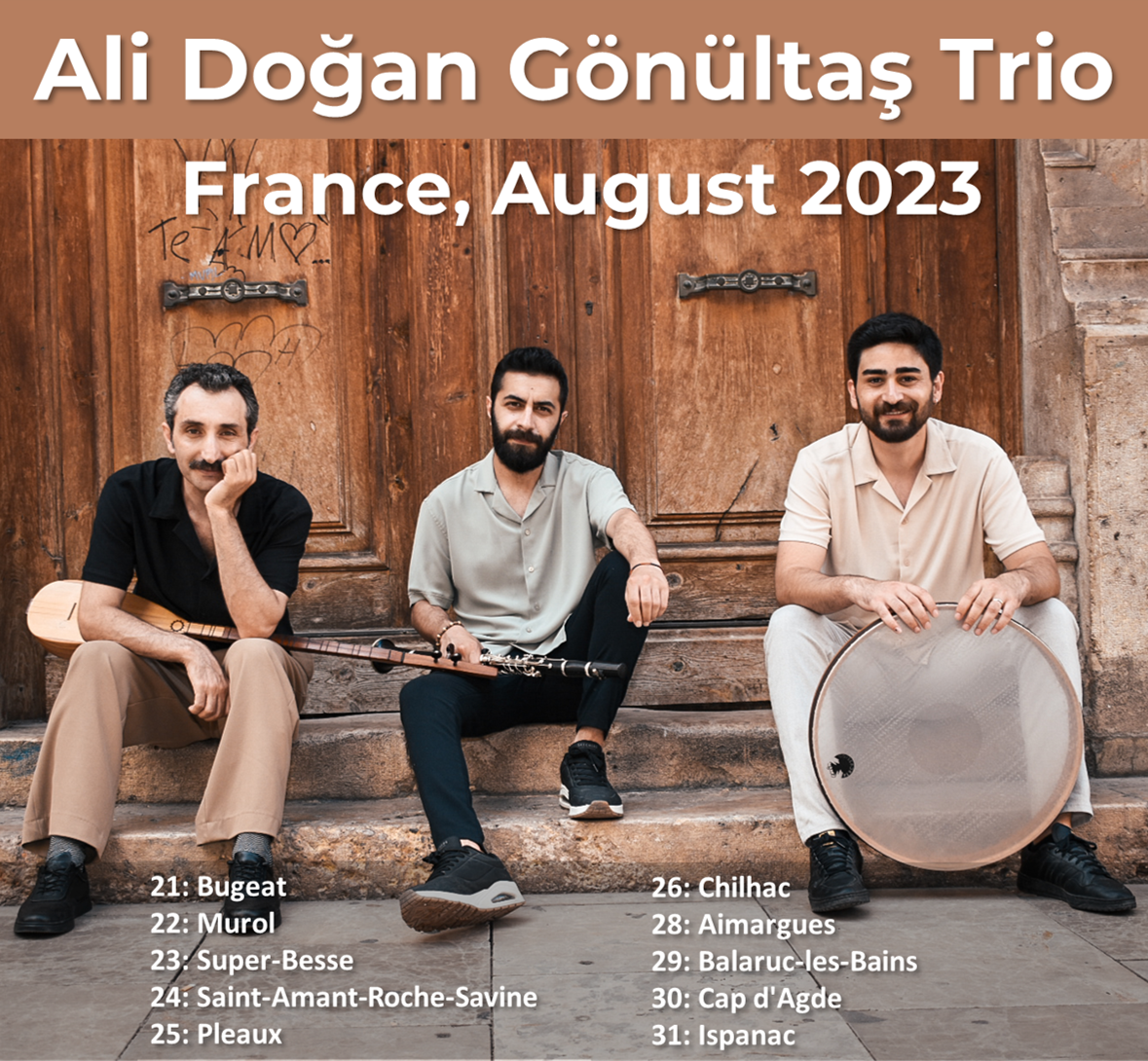
On Sunday 20th they travel to France for a tour of 10 concerts, until September 1st (full schedule, here). And, after France, Ali will perform at the Fira Mediterrània in Manresa, at the Fundação Gulbenkian in Lisbon and has a tour in Germany between 7 and 27 November (thanks to alba Kultur), which includes the iconic Elbphilarmonie auditorium in Hamburg ➡️ (complete program, here).

In December, Ali will record his second album. We already have some plans for 2024 and we are working on the bookings, so contact me if you need any info!

:
All this encourages me to keep working and I wanted to share it with you. If you want more, keep watching below where you have a couple of videos. And visit the official website. Thanks for your attention.

Araceli Tzigane +34676302882


Video-summary of the Spanish premiere: Festival Polirítmia, Valencia, 5 July (GVA Cultura), video by Carles Desfilis. Click to watch it:

Tour in France, August 21-31 
 
“Inoubliable voix du musicien et chanteur kurde Ali Doğan Gönültaş… Elle vibre de tous les trésors musicaux d’Anatolie orientale, ivres de leur propre beauté; […] Un étonnant voyage intemporel, sur l’aile des innombrables mélodies nées en la mirifique ville de Kiğı, creuset des mélodies et des peuples.”
“Fa deu anys que fa treball de recerca a la seva terra natal i la zona d’influència, amb una motivació d’investigació de la tradició oral que ha evolucionat cap a un treball de memòria musical. El resultat està recollit al magnífic àlbum debut Kiğı, on l’emoció de la seva veu expressiva impregna les melodies oníriques de les cançons.”


“O seu primeiro álbum, Kiği, tem por título o nome da localidade onde Gönültaş nasceu e é o corolário de dez anos de pesquisa de campo. Uma lógica de salvaguarda da tradição da região, à qual o músico empresta a sua voz de enorme expressividade, serpenteando por melodias ancestrais de uma beleza tocante.”


Check the dates in Germany in November, HERE

Performance for the Library of Congress. Click to watch it:

I already imagined that Ali would be able to fly

Ali Doğan Gönültaş bids farewell with a musical tribute to Dr. Mehmet Yıldırım, who lost his life in Antakya in the earthquake of 6 February 2023

The losses caused by the earthquakes that hit eastern Turkey and the border area of Syria last February could hardly ever be estimated. In cases like this, there is also the loss of the unique work that Mehmet Yıldırım (in Turkish), or Memed Desîmî (in Zazakî), could have provided to the world in the years to come, of studying and collecting a culture in such a delicate situation as that of the Zaza people.

Dr. Mehmet Yıldırım was born in Dersim in 1974. He died on 6 February of 2023 in Antakya, province of Hatay, victim of the earthquakes. Yıldırım was an academic and researcher and a member of Mustafa Kemal University. He was a great connoisseur of the culture of his homeland and spoke Zazakî, the severely endangered mother tongue of Ali Doğan Gönültaş.

At the time, Ali spoke to me about this loss and how he had been impressed by Yıldırım’s interpretation in a style that is now almost non-existent and how he had been shocked to learn of his passing. Below is Ali’s tribute to Dr. Yıldırım as well as some recordings of performances by himself. The portrait is from Dersim Ekspres.


Words by Ali about the piece and the Dr. Yıldırım:

“This recording, made in the Soğanlı Valley in Cappadocia, is a tribute to the memory of Memed Desîmî.

Memed’s oral history and academic work in Dersim shed light on the cultural and sociological structure of the region. He vocalized and transmitted old songs according to the dialect of the region.

Xeze is a female name meaning “Gazelle” in Zazakî. This traditional song from Dersim tells of a deep love. This traditional song was compiled by Memed Desîmî, who died in the earthquake in February, and his is the first recording of this piece that is published on the Internet.”.

Click to watch Xeze by Ali Doğan Gönültaş:

.

Click to watch Xeze by Dr. Mehmet Yıldırım:

.

Click to watch a piece by the bard from Dersim Sey Qajî, by Dr. Mehmet Yıldırım:

Laying the ground for the future of traditions: artistic offer 2022-2023

On this occasion I share with you a brief information about the artistic offer we have for you. I will start by putting the news at the top: Xurxo Fernandes’s Levaino!, Ali Doğan Gönültaş, Di Gasn Trio and mujereson. This last one is so new that it hasn’t been premiered yet!

I invite you to click on the link of each one, where you will be able to see a video. Or listen to this playlist with pieces by all of them while you read: so beautiful that hurts.

Araceli Tzigane +34676302882

XURXO FERNANDES – Galicia

Levaino!“, that is, “take it“. “Take it, take the song of our motherland“. That is the call that gives its name to the new work of Xurxo Fernandes, the restless Galician singer, dancer and folk collector, after spreading his knowledge and his art throughout Europe with Radio Cos. He is accompanied by a line-up of four musicians and a troupe of colourfull entertainers.

ALI DOĞAN GÖNÜLTAŞ – Anatolia

After hundreds of concerts in Turkey and two albums released with his extraordinary band of postrock, collage and experiential genres Ze Tîje, the Kurdish artists from Anatolya, settled in Istanbul, has self produced his album Kiğı, a personal look at the 150-year musical process of Kiğı, his birthplace, consists of works in the regional languages of Krmancki, Kurmanci, Kirdaski, Armenian, and Turkish.

DI GASN TRIO (QUARTET) – Israel

Di Gasn Trio (quartet most of the times) is a band chiefly influenced by music of the Balkan region and Klezmer music of Eastern Europe, blending additional elements of jazz, Arabic and classical music. Gal Klein and Yanush Hurwitz met in 2013. The fusion of these two musical ‘worlds’, though seemingly far apart but which actually embrace one another, created a unique musical result.

mujereson, by Patricia Álvarez & Vigüela – Spain

mujereson is born from a question:

How can we women continue to enjoy tradition despite the message and the narrative it constructs about us?

mujereson is a dialogue between the group Vigüela and the dancer Patricia Álvarez. A dance approach to how women are portrayed in the repertoire of Castilian sones.

To be premiered at the Fira Mediterrània de Manresa on October 7th.

RODOPI ENSEMBLE – Greek Thrace

Thrace is the birthday of Dionysus. A region at the Balcans, on the Southeast of Europe, at the North of Aegean sea, splitted between Bulgaria, Greece and the European Turkey. In Trace, the administrative borders blur in a cultural continuum that is evident on the unique features of its music and its dances. From the Greek part of Thrace it comes the Rodopi Ensemble.

We have a special collaboration with Medigrecian, the agency lead by Alkis Zopoglou, qanunist of Rodopi Ensemble. Learn more here about the other proposals of music from Greece.

HUDAKI VILLAGE BAND – Ukraine 

Nick Hobbs, CHARMWORKS: “I don’t know if there is a village called Hudaki but, if there is, that’s where I’m retiring to. Their music has a lovely languidness, speaking for itself without showy display. There’s no lead singer; voices and instruments come and go in all kinds of combinations. They’re delightful; positively adorable.”

VIGÜELA – Castile-La Mancha

The unique masters of son, jota, seguidilla and fandango. The history of Vigüela is the story of a vital surrender to a cultural legacy of a wild and very ignored beauty: the traditional music of the center of the Iberian Peninsula.

I just cannot keep it in myself. I had the chance to listen to Vigüela live afterwards!!!! Wow… I really liked them… Truly amazing… indeed.” Zsuzsanna Kerényi. Cultural manager, Hungarian Heritage House

JANUSZ PRUSINOWSKI KOMPANIA – Poland

Janusz Prusinowski Kompania is the main representative of Polish traditional music, appreciated internationally both by the institutions and the public. At the same time, they are born entertainers, that combine their work in concerts in very diverse contexts, from rural parties to temples of music like the Carnegie Hall in New York, with folk dance workshops.

ENTAVÍA – Castile and León

Roots attached to the past and wings to fly towards the future… Entavía is a project born in Salamanca, made up of like-minded musicians. Entavía released their first album, Raíces con Alas, in 2017. And in Autumn of 2021 they released their second work: Arando Ñieve (Plowing Snow). They have played massively in Spain and have performed also in Portugal and Greece. This second album will be the definitive boost for their international career.

MONSIEUR DOUMANI – Cyprus

Cyprus’ most exported cultural product since Aphrodite. During their 9-year career Monsieur Doumani have received numerous awards including the ‘Best Group‘ Award in Songlines Music Awards 2019, the ‘Critics Award’ in Andrea Parodi World Music Awards and the German Records Critics Award (Preis der deutschen Schallplattenkritik) for their album Angathin (2018), which has also been awarded as ‘Best Album of 2018’ in the Transglobal World Music Chart“.

With Monsieur Doumani we work only for some regions. Feel free to ask.

Thank you for watching.

mujereson, world premiere at Fira Mediterrània de Manresa. With Patricia Álvarez & Vigüela

mujereson, world premiere at Fira Mediterrània de Manresa, Friday 7th October at 17:30 at L’Anònima

👉 And meet Araceli Tzigane, from Mapamundi Música, there. For any questions: +34676302882


mujereson,

by Patricia Álvarez & Vigüela 

mujereson is a dialogue between the group Vigüela and the dancer Patricia Álvarez. A dance approach to how women are portrayed in the repertoire of Castilian sones

As the philosopher Ernst Cassirer points out, we are symbolic animals and what we understand by cultural traditions are catalogues and manuals of behaviour constructed on the basis of symbols and they mark, on many occasions, how we see the world and how we see ourselves.

The music of the son is intimately linked to the message of the text, it speaks to us of experiences of legends, of stories that belong to the collective memory of communities and women are, on many occasions, represented in these lyrics through archetypes and characters full of clichés and corseted in forms of behaviour.

This spectacle brings together different songs that portray different archetypes of women, which could reconstruct the biography of our grandmothers and mothers: What is expected of a woman at the age of 20, what happens when she gets married, and if she doesn’t get married…? The choices of many women in the Iberian territory, the shortcomings, the longings, the prohibitions are portrayed in this corpus of knowledge that make up our musical tradition.

Symbolisation as a shape

Vigüela is a group with a long and strong link to tradition, their many years of research into singing, their styles and manners make them an international reference. They live tradition not as an artistic challenge but as a daily action, integrated in their day to day life.

Patricia Álvarez is a dancer specialised in traditional dances and folklore of the Mediterranean area, from a contemporary vision of dance that distances her from specific languages, although she relies on this corpus of traditional and folkloric information to navigate the performing arts.

All of them are united by this interest in the tradition that goes beyond the artistic fact, how the tradition is integrated in our subconscious, the experience itself that is linked to forms of expression through voices, sound or the body. Those symbols that take shape through music and dance.

mujereson is born from a question:

How can we women continue to enjoy tradition despite the message and the narrative it constructs about us?