November 25. Talk with Sabina Smailagic; a follow-up on Unbounded Sounds, Case Study on the Impact of Showcases and + #89

Summary  

Editorial
▫️And farewell to Érik Marchand

A follow-up on Unbounded Sounds, with Sofia Labropoulou 

A follow-up on the annual conference of the European Folk Network

Talk with Sabina Smailagic about “World Corner”, a listening-sessions project

Results of the Case Study “The Impact Of Showcase Festivals On The Development Of Their Participants. WOMEX 2024”, by Zone Franche

Brief news from the media, charts and sister projects

Open calls and professional events:  Fira Mediterrània de Manresa, Babel Music XP opens accreditation, Sicily  Music Conference still open

Meet me at ✈️

➡️ This is the link for subscription


Hello, how are you?

I am well. The photo accompanying this text today was taken at Sarajevo Airport with Francesco Martinelli. We had already met at the hotel, where I was staying for Ali Doğan Gönültaş’s concert at the Sarajevo Jazz Festival. Francesco had given a lecture at the festival, which we couldn’t attend because we were not yet in the city. Over those couple of days, we learned that Francesco speaks Turkish and had been teaching in Turkey. His area of expertise is the history of jazz.

At the airport we had a spontaneous conversation about concepts such as folk, about how he entered the field of jazz studies, and about the work each of us does, while we waited for our flight to Frankfurt. As someone deeply involved in jazz in Europe, Francesco knows Nod Knowles, dear friend of mine, coordinator of the European Folk Network and board member of the Europe Jazz Network since 2003.

It was a very warm ending to Ali’s tour, organized by Rok Rošir / MOST Music Agency in Zagreb, Ljubljana and Sarajevo, which was a pleasure from start to finish. My face clearly shows exhaustion, but it was an absolute joy. Ali and his group surpass themselves every day, and the collaboration with Rok and everyone involved at each venue was impeccable, including the many hours spent driving and talking with Rok from Ljubljana to Sarajevo, as well as meeting Damir Imamović in person.

I hope you find the reading interesting. If you enjoyed any part of this newsletter, feel free to share it with someone who might like it too. Thank you in advance.


A farewell to Érik Marchand

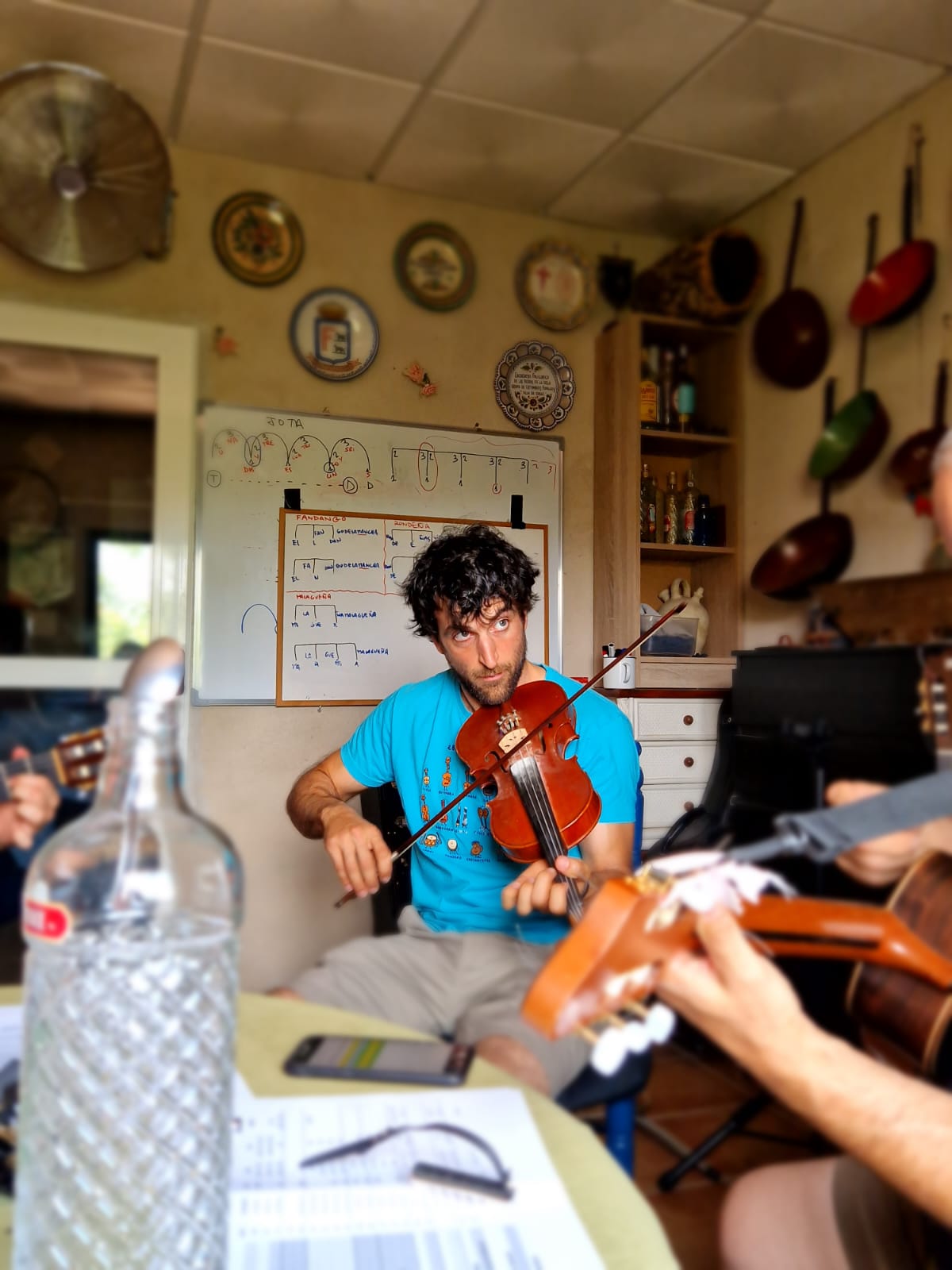
The picture is from Babel Med in 2017. Juan Antonio Vázquez and me met Érik Marchand there for the second time. The first one was at the FMM Sines festival, in Portugal, a few years before.

This newsletter is not focused on the artists themselves but on what happens behind the stage. But why do I do this? Because there have been artists whose work has made me so happy that I felt compelled to work in music to help spread it—first in written media and radio, and later through management and booking. Érik was one of those artists, especially because of his work with Taraf de Caransebeș, which I discovered through the album +Dor. Mr. Marchand passed away on October 30. I still think the album is a marvel. I chose this piece as I could have chosen any other, because it is incredible from beginning to end.


Remember: if you have any news of interest for our community, let me know. Thank you very much for your attention.

Araceli Tzigane | Mapamundi Música | +34 676 30 28 82 


A FOLLOW-UP ON UNBOUNDED SOUNDS, WITH SOFIA LABROPOULOU 

In the edition of April of this newsletter (available here) I shared a conversation with Sofia Labropoulou about Unbounded Sounds, the initiative she launched in Vienna, the city where this Greek kanunist and composer has been living for several years. I invited you to read that interview if you haven’t read it yet, before reading this follow-up.

Sofia provided me with several pictures of the concerts that already took place in this program. This one is from the concert with Sokratis Sinopoulos (lyra), Sarvin Hazin (kamanche), and Sofia. You can also watch a video with some insights from the artists and highlights of this concert, here.

Araceli Tzigane:  What is the program already planned for 2026? Please share what you can announce. Perhaps the full program isn’t confirmed yet, so feel free to share whatever works for you.

Sofia Labropoulou: Before I mention the 2026 edition I need to say that there’s still one more concert and workshop in the 2025 edition:

  • 4 December: Shabnam Parvaresh – Sofia Labropoulou – Matthias Loibner at Sargfabrik;
  • 5 December: Workshop: Exploring Presence and Communication in Improvisation (mica – music austria Seminarraum)

As for 2026, the full program is still evolving — much depends on pending funding. What’s certain is that the new edition will feature four concerts, each in trio formation, continuing the spirit of deep artistic exchange.

The first concert is fully confirmed:

  • 13 February 2026, ORF Radiokulturhaus (Studio 3): Savina Yannatou – Christian Reiner – Sofia Labropoulou
  • 14 February: Workshop with Savina Yannatou, open to all singers and instrumentalists.

Three more concerts are planned for autumn, the lineups are almost set, but I’d like to keep some mystery for now.

AT: After the experience of 2025, will you make any changes to the model you have developed?

SL: Yes and no. The core concept remains the same: I invite exceptional artists from abroad to collaborate with equally outstanding musicians from or based in Austria, with a strong emphasis on improvisation, experimentation, exchange, and shared exploration. This meeting point, this dialogue, is the heart of Unbounded Sounds, and that will never change.

What evolves is the format of each edition. In 2025, each concert started as a duo that became a trio. In 2026, all performances are conceived from the start as trios. There is also a geographic expansion this year: I am including artists not only from Vienna but from other parts of Austria as well. So the essence remains, but the structure shifts and that evolution is something I plan to embrace with new every edition.

AT: Will the venues remain the same in 2026?

SL: I’m deeply grateful to the people of Sargfabrik and their collaborative spirit, and I treasure the experience of 2025. But for 2026, I felt the need to explore new spaces. Each venue brings its own audience, atmosphere, and artistic context, and I find it fascinating to see how different listeners respond to the same musical experiment in different surroundings.

Thanks to Martina Laab and the ORF Radiokulturhaus, two concerts will take place in Studio 3, a beautiful space with excellent acoustics. One concert will be in February, the others between September and December 2026.

I’m also in conversation with Echoraum and other potential partners in Vienna. Choosing the right space for each performance is part of the artistic process. I really care not to close the spirit of the series inside a space or idea of any music subculture.

AT: What lessons have you learned from what has already been done?

SL: So many. The deepest lesson begins with a Greek word: Utopia, οὐ τόπος, “the place that does not exist.” Unbounded Sounds is, for me, an attempt to give shape to such a place. A space I imagined for so long, and then slowly began to build in real life. A universe of listening, generosity, and artistic freedom. Not because what we do has never happened before, nothing in art is ever entirely new, but because we dare to ask what if?
What if people listened more carefully?
What if respect came before genre?
What if collaboration and openness to the unknown mattered more than categories?

This “what if” has guided me more than any fixed structure. Realistic intentions the way our given society dictates is not an issue here. We create our own realism.
In the attempt to answer all these I have the honor to have the best companions with me.

I saw the people in the audience respond with real curiosity and emotion to “unfamiliar music”, even when it was complex, unexpected, or outside their cultural references. The human connection made all the difference.

Also, musicians need these kind of collaborations. Collaborations that bring you to a point to rethink and remember the reasons why you to became a musician and to do at this the first place. Music and art is not just a job. In all traditions the role of music was always deeper than just to gain our living. It was the center of the community in many powerful ways. We really need to focus on the importance of it. We all need it more than we think.

Organizing a concert, not just performing, is a completely different universe. You become curator, communicator, administrator, mediator. You learn to stretch yourself, sometimes to the point of leaving your own body. But even in exhaustion, there’s a sweetness: “I’m doing my thing and it’s truly mine.” And there is a truly meditative power to all that.
And if this space I imagined begins to belong to others too, then the dream is coming alive.

I’ve also realized how artificial genre boundaries are. For me sound is sound, love is love. Of course, the market needs categories, and we all need it in order to be active in the given society, but artistically, I think we need to move beyond them. That openness has been one of the most affirming elements of this journey.

I’ve made “mistakes”, many. Some showed me clearly what needs to change. Others are still unclear. For instance, why did the workshops not go that well? Was it timing? Communication? Audience? Do we need them, and if so, in what form? Shall I do them in the next edition?

These questions are part of the work. Doubt and self-doubt is also part of it too. Each misstep has taught me more compassion, more patience, and a more nuanced understanding of the artistic ecosystem that evolves around all this.

And finally, this, above all: There is nothing impossible. If you create a space with honesty, curiosity, and courage, people will find it. And they will step into it with you.

I’m deeply grateful.

AT: Anything else you’d like to share?

SL: Unbounded Sounds is not just a concert series. It’s a long-term commitment to reimagining how we listen, how we collaborate, and how we build cultural spaces that are inclusive, fearless, and alive.

I’m endlessly thankful to the artists, venues, collaborators, sponsors (MA7, 14. Bezirk Penzing, mica-musicaustria) and supporters who have made this journey possible.

And I can’t wait to share what’s coming next.

Thank you, Sofia! All the best for the new steps of Unbounded Sounds! 

As an example of what has happened in Unbounded Sounds so far, here you have a free Improvisation with Michel Godard, Tahereh Nourani and Sofia Labropoulou:


A FOLLOW-UP ON THE ANNUAL CONFERENCE OF THE EUROPEAN FOLK NETWORK

This year we had the joy of having Dave Francis as a reporter and he made a report which is available, here.


SABINA SMAILAGIC ABOUT “WORLD CORNER”, A LISTENING-SESSIONS PROJECT… AND MANY OTHER THINGS

I have crossed paths with Sabina Smailagic on several occasions over the past few years. At the last edition of WOMEX we met briefly and agreed to do this interview. She wanted to tell me something and, being very curious, of course I didn’t say no.

The initial topic of this interview is Sabina’s listening-session initiative, but throughout a fairly spontaneous conversation we revisited her professional journey, paused to reflect on certain aspects in more depth, and even talked about terminology and how the future of the artistic field we work in might look.

I noticed several things we share, such as an interest in the more roots side of music, as she calls it, as well as an educational intention behind much of what we both do, and also an understanding that we work with something deeper than an aesthetic expression, since we deal with music distilled over long stretches of history.

I hope you find the conversation interesting. If you are a colleague working in booking or management, you may see yourself reflected in some of the ideas. If you are a programmer for a venue or a festival, it may spark your interest in inviting Sabina to lead a listening session before the concerts you offer your audience. And whatever your profile, I hope it engages you and prompts some reflection.

You will see in the interview that Sabina announces some future plans. I hope to follow her journey and witness many successes! Two links will be useful for this:


Araceli Tzigane: Sabina, I have some fragmentary information about you during the last years. So, let’s begin. What are you doing now? I learned recently you quit a job as a teacher and you will be only working in culture and music.

Sabina Smailagic: I quit my job last year, in June, and I’ve worked as a school pedagogue, because in Denmark, the pedagogues are also working in schools with the teachers, in the afternoon.

I was working as a booking agent and manager for some bands, then I quit also that. And I’m working as a DJ and a freelance culture facilitator. Right now, I’m DJing, and I’m working as a volunteer on some boards of associations in the music sector. And I’m making a project called, “World Corner.” It consists of listening sessions. It is taking place in a venue called Turkis in Aarhus town.

The goal of the listening sessions is that… When I’m DJing, people always come and ask me which is the name of the band, which country are they from, which kind of instruments they are playing… And then I realized that we need some listening sessions where I can tell the story, because I’m also a pedagogical anthropologist, and I’m working with the music from a socio-cultural perspective. I’m always interested in the stories behind it, and how they’re showing culture through the music, and, when they’re on the stage, what they are showing. So, I saw the need to make listening sessions at the venue Turkis, with those subjects.

For example, I have had 9 listening sessions. There are two per month, on Sundays. And the subject is from Cumbia, Balkan, roots and hybrid, Nordic folk music, bands from the diaspora, psychedelic rock… So, I’m making as a subject, and every Sunday it’s something about them.

Turkis is a very nice venue. We have carpets on the floor. I’m making Turkish tea, Bosnian coffee and ordinary coffee, and some sweets from Bosnia. So, the audience, when they come, they’re sitting on the floor. I’m presenting the subject, and I’m presenting the term “roots and hybrid”, like the “world music” term, and then we are listening and talking about. So it’s not like a lecture. The audience are also involved, because we are reflecting about the music, what is there, how they experience the music which I’m playing, and what they feel, what they think, what they can hear, what they can see on the covers of the albums. They’re very interesting to see the covers. So that’s what I’m most busy about right now about it.

AT:  Are you from Bosnia?

SS: I’m from Bosnia, and I was raised in Bosnia, and I lived there for 17 years, and we… I escaped during the war with my family to Denmark 30 years ago. I have good life in Denmark, and in Bosnia, there are still big consequences after the war. It’s not the same Bosnia anymore, and I’m not the same Sabina, you know, I’m the mix of everything. I’m the global Sabina now, I’m not just Bosnian, because I’m living in Denmark, I have friends from around the globe, so I have good life here.

AT: So now you are making these world sessions… 

SS: And I’m working as a DJ. It’s a freelance work. And I’m in the board in the two associations in Aarhus.

AT: So you are not working as a booking agent now, but you did it in the past. So, when did you start to be a booking agent?

SS: In 2016, with the band Hudna. That name means ceasefire. I was in Budapest for WOMEX as an audience. I was not in the music industry. And I knew in that band, I was DJing for them, and then I asked them, can you give me some visit cards? I can give them to some people who I met in Womex. And I was meeting people just outside, because I didn’t have a Womex accreditation, I just had tickets for the concert. It was in Budapest, near the water, many people were sitting outside, so I made the networking outside, actually.

And then they asked me if I wanted to be their booking agent. And I said, “What is booking agent?” And then they explained me, and I said “yeah, I can try to help”. And it went very well.

So I worked with Hudna and the Afrobeat Addis Ababa band, from Denmark, and İpek Yolu band, which means Silk Road in Turkish and it’s Cumbia with Turkish folk music. And I collaborated with Rok Košir and his bands. I made a tour twice for Damir Imamovich, with Derya Türkan and Greg Cohen. And I made one with Damir Imamović’s Sevdah Takht. I made a tour for the Croatian Ben Afyon. And I made a tour for Chris Eckman Trio. And it was my last one.

I had a lot of work, and I couldn’t share my love for so many bands. That’s why I quit, actually. It was hard, because when I want to book one band, I really need love, you know? I really want to love them… like a child, you know? I can’t… I can’t share my love with so many bands. That’s why I quit.


The truth is that it’s a coincidence that Sabina appears in these lines shortly after my first visit to Sarajevo, where I met Damir Imamović in person — someone Sabina has worked with, as she has just told us. So, as a tribute to him and to the aforementioned Rok Kosir, I’m going to share here a performance by Damir, which you can listen to while you continue reading the conversation.

AT: So you preferred to quit instead of keeping less bands?

SS: Yeah, and I was also tired of it. And I had a bad period, because in 2020, I lost my both parents. Not because of corona, but during Corona. And then it came some things after that. I was… I didn’t feel very well, and I was actually sick. Sick from work. And I needed a break… I needed a break from everything.

And then I wanted to try to go by my own, as a culture facilitator and a DJ, and it’s going okay, but it’s… I miss, you know, I miss tours, I miss those victories: when you’re booking, when you book a concert, and “yeah”, you know, I miss tours. I realised in WOMEX and I have plans to come back. In WOMEX I realized that I miss to work as a booking agent.

AT: So, you said, you were missing the, let’s say, the success when you make bookings, when you make a deal. But I think, in this work, there are more times not success than success.

SS: There are more times without success. That’s why I’m celebrating always. I had the tradition, when I book one concert, I’m not doing anything the rest of the day. I’m celebrating that booking.

AT: That’s great, because sometimes I think, “OK, I have achieved this wonderful thing, I made this amazing event in somewhere very wonderful, and I feel I don’t have time for tasting the moment.”

SS: Yes, exactly, exactly.

AT: You take your time to savour the moment of the achievement?

SS: And I don’t care who is writing, who is calling, I’m celebrating that moment. I’m enjoying that moment, and that’s what is giving me energy to go move on.

AT: So, you have worked with these bands, you have mentioned, I think, in total, like, 4 or 5. And you said you want to start again to work as a booking agent. What are you searching for in advance? Of course, you said love. You have to love them as a kid, but you know, sometimes you and me and all of us, we receive proposals that are bands that are nice, they sound great, and they look more or less professional, but what would you investigate, to consider if you could really work with them?

SS: To begin, if I feel that they are good, I need to think… If I don’t feel the band, then I will not book them. I need to be in love with that band, with their music, to book them. And there must be… quality? I don’t know how to explain that quality… That there is dynamic in their music… I like roots, you know, like your artist from Turkey, the guy, Ali Doğan Gönültaş. I love him. That kind. For example, I worked with Damir Imamovic because I wanted to show, first, Balkan music. Music from, Ex-Yugoslavia: I wanted to show another story of Balkan music. From Ex-Yugoslavia there is not just Balkan kitsch and Balkan beat. There is also Sevdah music.

Then, I’m listening to the albums, I’m talking with them, I need to see how serious they are. I don’t like unserious musicians. For instance, they didn’t play for 5 years, and now they are coming back, and they need 7 bookings. I don’t believe in that. They need to invest in the music. And the music, it must be good. And it must be something with roots and a good story.

So the first thing I need is to have love for their music. And then, when I think, “oh, this is so beautiful”, this is something I want to promote. I’m not promoting because of jobs or money; I’m promoting because I want to promote them.

To make success, to make something good, because when you know you have great band, you need to be pure, you need to be honest, and you need to show that love. When I’m showing that love, you know, with the band, I’m shining, and I’m booking them because I’m shining.

AT: And do you think it makes sense that a band that you don’t know at all contacts you by email and searching for a booking agent? Can this work at any moment? I ask you because I received many, many artists who sent me an email searching for a booking agent or manager.

SS: If I already have few artists, I’m opening all these emails, and I’m listening to their music, and I’m always telling the truth. I said: “I have so many bands, I don’t want any more, but I like your music, and I will come back if I see it is interesting.” I’m also saying the truth in other case: “I don’t like your music, no. You are good, but I can’t feel it”.

AT: If you have to give some kind of tips to the bands who are thinking about contacting you by mail, what do you think they must have before contacting you? What do they have to include in this contact? 

SS: In this contact they must have good PR material, a good video where I can see a live concert, and the short story, and their history. I’m always interested in what is the history? What is the behind the band? The history and good presentation of 10 sentences. I don’t need whole history, but you can take the most important things out.

As a not good example: “we are from Spain, and we are playing ska with Afrobeat…” No. They need to present it on a cultural way for me. They don’t need to describe the music to me music, I can listen, I can hear.

They can’t say which genre they’re mixing, how many albums, what is their success, and what they need. Not just, for example, “we need to tour in Denmark”. Okay, but maybe you should explore a little bit Denmark. If they say, “Hey, we are in Sweden, and we are playing that, we think we can fit in Turkis, because Turkis…,” they need to be prepared for what they are searching and where they are searching. Make research on which kind of bands do they like. Like us, we propose bands to the festival. We go and make research in the website.

So, make research in my profile, which kind of bands I’m working with. Be prepared, as we booking agents are prepared when we are making proposals of our brands.

AT: Sometimes I receive messages from artists that I realize they don’t understand our point of view, because they consider they are good, and for them, it’s like logical that I would like to work with them. 

SS: So they’re not giving you a reason why you need to work with them.

AT: Recently, I received one. I tried, as you said, to be sincere, and also didactical. I explained… I received an email from a trio, they were very raw, let’s say. They just had a picture. In this picture, you saw them little here and you didn’t even see the instruments or whatever. That’s all the image they had. And the person contacted me, saying, “we are searching for a booking agent, and we will have an agreement of 15%, and there won’t be a fixed fee for you. And that’s what we offer.” And I answered her, “Look at this from my point of view, I have dozens of artists proposing themselves, more mature. So you don’t have the position of putting the conditions, let’s say.” I was super didactical, and she appreciated, and she thanked. Sometimes some people don’t take it so well. Sometimes they feel they are personally refused when you are not interested in them. I feel the art is so personal… They feel that there is totally their identity, and it is very difficult sometimes, to reject them in a way that they don’t feel attacked.

SS: Yeah, that’s true. But there’s no other way. I want to say the true instead of, “Okay, you sound interesting, I’ll come back to you”. I hate those messages, also from a festivals or other venues. “Although, it sounds interesting, if it’s going to be relevant, we’ll come back to you.” It’s so non-personal. I like personal things, as you said, personal. Be personal. That’s what I also really like. Be personal. Don’t just say, we need booking agent. Research which kind of booking agent do you want.

I’m also considering what Denmark needs. I’m also thinking, “do they need one more Afro band? Or do they need one more Balkan band?”. I’m also thinking also about the audience. I have a big network in the Balkan and ex-Yugoslavian audience, and also international audience. So I’m thinking, “Okay, Damir Imamovic, yeah, it will be great. I can bring audience to venues, and I know where they are. I can help venues with the PR, because I know where people are and what they need.” And if after Imamovich, there is another Balkan band coming, then I would say no, because you need to be strategic, also. If Damir Imamovic had a tour in April, I will not book new band in May, because people will not come, they need a break.
And maybe this sounds snubbed, but it’s not… I’m trying, really, to work with a few things, but quality things.

AT: And why did you work with this? Have you always been interested in music with roots? 

SS: Yeah, for example, I danced folk music when I was young. And that dance music is, especially, Turkish. Because everything we have in Bosnia, it’s from the Turks. And their tradition, the dances, it’s history… it was so mysterious for me. It was so strong and mysterious. And then I began to have love for roots. And then, while I was dancing folk dances, I began to listen to punk. And I became a punk. And it’s not good for a punk dancing folklore music, so I stopped, because it was a shame, you know?

But for example, in WOMEX, I’m always searching for roots music, I love it. Of course, I love crossovers, and modern music…, but me, I’m roots. I’m a roots girl.

AT: And you see the relationship with this music with history.

SS: Yeah, and music with history. And then the roots bands, they have stories and they are from the past. It’s a mystery what they bring, the tradition, which is formed from the past, formed with the present. But they also… they present tradition as it was in the tradition, many of them.

AT: Okay, so you are interested on this, but your history of your life has been very diverse, with different works and different styles of music. And everybody in our field says something that world music is not trendy, this kind of things. And I visualized the path in the way that, these labels have to end, but because those musics, more roots or more fusioned, they must become just music in a landscape of diverse music. Do you think this is going to happen? I have some obsessions, and you see, one of them is the accessibility of the diversity of the population to the creation of music in Europe. In Denmark, you have… you have had compilations of war music from Denmark for years. They included the immigrant musicians. But always, somehow, in the label of world music, separate from the general music, let’s say. And people say, world music is not fancy, whatever. So, what shall we do in the near future about this? I feel music is music. Do you think this enter into the general idea of music, not in the label of “immigrants’ music”, “world music”, “music from the third world”?

SS: They will keep the label, because, “world music”, the world music term is a marketing’s term. It’s from England, from 1987, when those people from record labels had a meeting in a pub and they wanted to make a term for that music from Africa and from around the world, not from the Europe. Not to give them the name, but to make the category to promote them and to sell them.

So, I don’t think so. When you’re looking in the record stores, world music is mostly African music. But it will never be music as music. I don’t think so. It’ll always be ethno, roots, something traditional, old… Gold for anthropologists.

AT: You mentioned this venue, Turkis in Aarhus. Over there, there is world music but also other kind of generalistic music.

SS: Yeah, in Turkis, we are not saying world music. We are saying roots and hybrids, and that’s because of that: because world music, it’s not a natural category. And in Turkis, we are calling roots and hybrids to give them place, because, in Turkis, it’s not a shame. Music needs to have a place, for example, for the roots. Open that box for the new music, for the world music, and give them a place for the different musical cultures, Gnawa, cumbia, Balkan, Turkish, Anatolian folk music… So, when we’re saying roots and hybrid, that means that our music profile is roots and hybrid. Roots is a place for tradition, for traditional music to be as a tradition, and the hybrids is for the mix of crossovers of the musical genres, musical cultures and traditions, and also when tradition is changing form. So we’re giving the place for roots to be roots, and to hybrid to be mixed. To open that world music box and give a focus, give place for that music, so people can see and hear, not just world music.

AT: And in this concept of roots, you include also roots from Denmark.

SS: Yeah. It includes world roots from Denmark. Of course, that’s also interesting. For example, we are collaborating with the Aarhus Roots Festival. And in Turkis they do all kinds of things—from Gnawa band concerts to club nights—and their musical profile also includes Danish and Nordic folk music. They collaborate a lot with local communities, and there is always something happening at Turkis: from tango and Afro dance and yoga to different roots and hybrid activities. It is a real venue, but it also functions as an active cultural house, because of all those activities.

That’s also an interesting thing, because, for example, in Sweden, if a venue is of world music, you can hear everything else, but not Swedish music. But that’s not correct, you know, the venue Turkis is also booking that music from that country they are in. And especially in folk music, it’s so popular in the last 10 years. It becomes more and more popular.

And I forgot to tell you that I also was working with the school concerts. I was in a jury for the school concerts in Denmark, where we were six persons. It’s like an award. Every year, we’re listening around 250 bands and there are also some bands from last year. And then we needed to pick up from 30 to 40 bands per year, which will be making tours in the schools. There’s also lots of roots in hybrid music, pop, metal… And every third year, the jury changes. I’ve been also working there. I put myself forward because I was working for 15 years as a pedagogue in a school, and I was working with music. So they took me, and when you are working, you need to think how they can fit in the school, because when they’re playing in the school, it’s typically in halls where they have the gym. And they need to do in the pedagogical way.

It is a company called LMS (Levende Musik i Skolen). They’re talking with schools and offering bands, and the schools buy the bands. And they have a tour for two seasons. They’re talking with the bands about how they can make it so kids can understand their music and how they can do their concerts in a pedagogical way. They need to have a lot of story to tell about their work with music, what it’s about, about instruments, involve the kids in the concerts… The goal is to present quality music for the school kids.

AT: The language is important in this for kids.

SS: Yes. The bands from outside of Denmark have translators from English. They’re talking in English, but it’s a little bit hard, because kids feel that it’s not 100%. But they are trying. It’s also important also to present routes and hybrid bands for the kids, because we have also many kids from many countries in Denmark. And all kind of bands.

AT: Yes, in this program you are talking about, I see realised my idea of the future. Music is music, of course, they’re genres, but you have in the same environment, in the same program, you have, world music, or blues and hybrid music, and metal, and all the other kinds of music. So, these kinds of music, they are treated equally. 

SS: Exactly.

AT: It’s not that we have classical music mainly, and two or three little things of world music. No, it’s treated equally.

SS: It’s equally, and that’s the goal. For example, we need to think about bands with the women, if there are enough women bands, enough men bands, enough metal, enough rock…

And we also had that the schools want concerts for the big kids in the 8th, 9th degree. They want more electronic music, pop music… So you need to fit the needs from the teachers and what we think that the kids need.

It’s very interesting. It’s a Nordic thing, they also have in Norway. I think they have in Sweden as well. The kids are experiencing music before they are old enough to get to the venue.


Sabina mentions Tamikrest a couple of times throughout the interview, so it’s interesting to include something from them here:


AT: So, Sabina, what else do you want to tell to the people, or what else do you want to talk about?

SS: About the listening sessions, I want to highlight how important it is. Two times in the month is the pilot project. But I think I will continue now and propose it to other venues and also to libraries, because there is a need for the listening session, especially for the world music, because people are afraid. They don’t know, especially in the small towns, they don’t know the music, so they will not come to the concert. And the listening sessions can open a new perspective to you, they can show you a new perspective of the world music, roots and hybrid music.

When I run my listening clubs, people tell me that they learn new things about genres or bands they didn’t know before. I once hosted a listening club about desert blues and rock, where I talked about Tamikrest. One of the participants even bought a ticket to a Tamikrest concert a month later—he hadn’t heard of them before the session. People often tell me that I share knowledge about bands and genres in a curious, engaging way that sparks their own curiosity.

AT: Yeah, it’s interesting also, because during the concert, you can’t expect the artist to explain anything.

SS: Yeah, they are playing, so I wanted to give a voice for a listening session. There is a reason… I know it’s not a new thing, but it’s opening so many perspectives about world music, what people can expect. And then, world music, becomes more “music”, you know, than a strange thing.

AT: Yeah, that’s a great idea. So, if someone wants to book you for making listening sessions, they can contact you.

SS: They can contact me, and it will be great to book me. For example, one festival can book me, I can talk about the lineup before the festival. It’s a great idea to make small listening sessions before a festival, or before one band you really want to sell the concerts.

And explain about that musical culture. Invite people, make something extra to sell the tickets, because world music is not selling so well as other genres. It’s always been like that. It’ll begin now, but it’s not enough. We are still on the way. There are a few banks, you know, Altin Gun, Tinariwen, Omar Suleyman, you know, he is selling, he’s mainstream.

But especially roots bands, and those working in roots and hybrid forms, deserve to be here, to be seen, and to put real creativity into their promotion. It’s not enough for a venue to say they “need to book some world music,” pick one act, and check the box as if the requirement were fulfilled. Make something, respect them, make noise about them on another way, be creative, not just promote on Facebook. Give them some love, they deserve it.

For example, I asked the venue of Voxhall if I could be a DJ, the support for the Tamikrest concert. I had supported Tamikrest as a DJ many times, and the venue booker agreed that I could do it again.

I make a great party as a DJ, but people came and came. “Hey, what band you are playing? Can I see that record you are playing now? Where are they from?” So I took a microphone and said “God damn it, people, come to Turkis to the listening sessions, you need it. I can’t explain right now, I’m playing a set, you know, I can’t just talk. It’s confusing me.” There is a need. People are coming and asking, so there is a need for listening sessions.

AT: And how can they find you? In your Facebook, Instagram, website…?

SS: As DJ Sabs. I’m on Instagram (@smailagicsabina) and Facebook.


FIRST CASE STUDY: WOMEX 2024 THE IMPACT OF SHOWCASE FESTIVALS ON THE DEVELOPMENT OF THEIR PARTICIPANTS

A very interesting study has just been published by Zone Franche, titled First Case Study: WOMEX 2024 – The Impact of Showcase Festivals on the Development of Their Participants. At that edition of WOMEX in Manchester, Ali Doğan Gönültaş performed. It’s true that even now I keep receiving comments from people who attended, and I know it helped strengthen his positioning on the European and global scene. I took part in the survey carried out to produce this Case Study and received the document last Wednesday. It is available here.

I’ve looked to see if WOMEX itself has published anything like this. I haven’t found it. On their website I don’t find any information about the ROI for the exhibitors or the delegates. On the one hand, it makes sense that they wouldn’t conduct the study themselves because they wouldn’t be independent, unless they commissioned it to a truly independent third party. In any case, now Zone Franche has done it, and they call it First Case Study, and this study is intended to be a multi-year project.

Every time I go to a showcase — and even more so if I have an artist performing — I ask myself, like everyone else, whether it will be worth it. On several occasions I’ve asked showcase organizers if they have a formal way of tracking the impact of participating in their event. This is something I discussed, for example, with Davide Mastropaolo from Napoli World in this interview last June. Davide explained how they do it and noted that UpBeat, the platform that brings together many showcase events, monitors the results. It’s also true, as I mentioned at the time, that it’s not easy to determine whether a booking is due to a specific showcase, because sometimes it comes two or three years later. Peter Van Rompaey shared this idea with me in a conversation a few months ago and he’s right.

I will quote Sébastien Laussel, Director of Zone Franche, who explains that the aim of this Case Study is “to lay the groundwork for a more systematic evaluation of trade fairs and thus build a broader vision of how our music ecosystem works.

Michaël Spanu, the scientific director of the Case Study, is not unfamiliar with this complications, as he states in the Introduction:“While this cooperation opens up real opportunities for artists and professionals from non-hegemonic markets, it is not without its tensions, particularly in relation to the difficulty of measuring its impact.”

I am so thankful to Zone Franche for had done this work. Now that we’re witnessing an explosion of showcase festivals everywhere, and given that criticism of the model is both common and justified, it becomes essential to shed light on this issue. We need solid arguments that show whether attending is truly useful — and to what extent — considering the significant investment it usually requires, especially when you bring an artist who is programmed to perform.

I will quote Sébastien Laussel again, in the Edito of the Case Study: we felt that this financial investment, as well as the human energy involved, deserved to take the time to assess the impact of these trade fairs on the development strategies of professionals.

How much is that investment? According to the Case Study: “Among the 17 respondents who had a showcase, the average artistic budget reached €4,464 (median: €4,500).” And “more than half of respondents received no subsidy.” How much is the return? The Study explains that: “Sales directly linked to WOMEX 2024 averaged €13,250, but the median stood at €4,000, a more representative measure of the typical experience. This discrepancy illustrates the effect of a small number of highly successful outliers that significantly raise the mean.” And if you have an artist showcasing? Then: “In median terms, showcase participants reported €6,000 in sales, compared with only €1,750 for non-showcase participants.” 

But if you are interested in the role of showcases, read the page 8. The conclusions of the data are meaningful: “Overall, the showcase effect creates a dual reality: it amplifies sales potential but increases financial risk. For most, the immediate ROI is negative, but for a minority it can be transformative.

Also, I believe showcases help create or maintain the conversation around an artist within a network of professionals who are potential clients or other stakeholders. Let’s say that it strengthens the brand.

Another benefit of attending showcases is meeting new colleagues and potential clients, and reconnecting with those you already know, even if you don’t have an artist performing. This is obviously one of the main reasons to attend. But I this Case Study focuses more on the more direct return. Indeed, I will quote Sébastien Laussel, again: “We will not dwell here on the essential role that these fairs play as key meeting places for producers, programmers, labels, distributors, agents and specialised media, or on the increased visibility, networking and creation of transnational partnerships that they offer, etc., as all this seems to be accepted by everyone.

I’ve had four showcases at WOMEX, and the results have been different in each case. It’s also true that at WOMEX, the artists who are selected usually have some degree of established trajectory and the support of management, booking companies or record labels, which in some way legitimises their professionalism. That’s why I think it’s unlikely for WOMEX to have a dramatic impact on an artist’s career, given the type of artists that are usually selected. They haven’t come out of nowhere. They’re not usually newcomers; they’re typically artists who already meet the conditions to perform internationally.

In my case, some of the artists I presented were already on an upward path, and the showcase helped to some extent. I can’t claim any spectacular impact, although as a professional attending showcases I have booked artists, and I find it a very good way to discover many artistic proposals in a short time. At Napoli World I saw around 20 concerts and later booked one of the groups. I will attend Napoli World for the second time this next week and it may be really useful because I have clients specialiced in Mediterranean music.

Beyond the measurable outcomes and the usual metrics of visibility, bookings or international reach, there is another potential benefit that is rarely discussed and even harder to quantify: the role of showcases in stimulating artistic creation within a specific region. Let me illustrate this with an example. A very particular showcase is the MUM fair, the professional music days of Extremadura. I mention it because in this case I believe the showcase provides something beyond potential bookings and collaborations: it creates a yearly moment in which artists from the region know they will have a space for visibility to professionals, even international ones. In a region historically economically disadvantaged (I must mention that it’s where my mother is from, and although it has immense landscape, culinary and historical value, it remains quite rural and somewhat isolated), I find it especially relevant to create spaces for showcasing and professionalisation, even for proposals that may not yet be ready to go beyond their borders. What matters most is that these spaces exist, giving meaning to the effort required to build an artistic project.

From this perspective, some things make more sense. For example, at the MUM I have seen artists performing who are not really interesting to book unless you are a city council from the region and need to fill a slot with reduced costs. I understood that there is an objective aimed at strengthening the regional artistic fabric. Those specific artists may not be interesting for me, but they are part of the artistic landscape of the region.

So, when a showcase is designed not just as a market platform but as a cultural development tool, it can play an essential role. In territories where the professional ecosystem is still fragile, where opportunities for visibility are limited, or where the music scene remains geographically isolated, a showcase can act as a catalyst. It can encourage emerging groups to take their work more seriously, motivate new artistic proposals, and give meaning to the creative effort by offering an annual moment of visibility and recognition. In these cases, the value of the showcase lies not only in its capacity to generate bookings, but also in its ability to build a sense of artistic purpose and community. This developmental dimension is difficult to measure and rarely appears in impact studies. Yet, in certain regions, it may be one of the most meaningful contributions a showcase can make.

I should also highlight that at MUM this year there were several very useful talks for artists, including mine — ahem — I think I worked really seriously and put everything I had into it.


BRIEF NEWS FROM THE MEDIA, CHARTS AND SISTER PROJECTS 


🔸#1 for Transglobal World Music Chart in November of 2025 is: Radio Tarifa’s La Noche (Buda Musique)


🔸Mundofonías: the favourites of November have been The Secret Trio’s Old Friends (Anderson Audio New York), Murmurosi’s Svitanok (self-released) and Carl Petter Opsahl & Johannes Opsahl’s Folkcore (Visions and Dreams)


Do you have a call of interest for our community that you want to share? Let me know asap


OPEN CALLS & PROFESSIONAL EVENTS

This section is open for news. It is free of charge. You can let me know if you have any open call of relevance to the community.

The following call is new in the newsletter:

🔸Fira Mediterrània de Manresa

The call for proposals for the showcases is open until 22 January 2026 at 23:59. The 29th Fira Mediterrània will take place from 15 to 18 October 2026 in Manresa. Check the conditions and apply, here.

This is one of the events I attend almost always and every year I send proposals. I have talked about the Fira on many occasions before in this newsletter. It is a multidisciplinary event, including music, dance and “Memory, legacy and oral storytelling”.

This phrase is specially meaningful: “Fira Mediterrània works with what we like to call 360 degrees of roots, starting with the first level, intangible heritage; continuing through folk and traditional culture associations, which take that heritage and work to connect it with society; and ending with the professional sector, the artists whose creations are based on that tradition. At the Fira, we place particular importance on the interchange, interrelation and intersection of all of those elements.

What do they offer? Fira, as a performing arts fair attended by sector professionals (1,234 registered delegates), will agree a financial contribution with companies and groups.” They also provide meals and accommodation for artists that reside outside Catalonia. All the details are very well explained on the website.

🔸Babel Music XP: accreditation and stand bookings for Babel Music XP 2026 are open 
This is another of the events that I have attended since they revived from Babel Med. It will be in Marseille from 19th to 21st of March.

The following call was already in the newsletter of October:

🔸 Sicily Music Conference 2026: Call for Artists

The call for proposals for the showcases is open here, until 31 January 2026. Artists to be announced in February 2026. This is the official page for the call. I will bring some infos here:

  • It will take place in Palermo – Catania, from 13 to 16 of May 2026.
  • It provides access to professionals, to the workshops and all the events of the conference, for the artists and their representatives.
  • Practical needs covered:
    • Transportation: transfer from airport or ferry terminal to/from the hotel/venue(s)
    • Accommodation: twin rooms for show night(s)
    • Catering on the show day(s) …Sicilian food and hospitality
    • Support to reach out to export offices or similar organizations with official invitations to apply for funding
    • Support to connect with additional venues in Italy – I highlight this because some other events like this —showcases— require artists to maintain exclusivity in the surrounding region for some time before and after. This Sicilian conference, however, aims to support artists in getting more gigs. I don’t know yet if they have any restrictions regarding performances in the area around Palermo, but it’s really nice that they’re thinking about facilitating contacts to help organize other concerts around the showcase trip.


MEET ME AT

  • 27-29th November. Napoli World.
  • 10-14th December. Tour of Ali Doğan Gönültaş in Luxembourg, Lublin and Innsbruck
  • 23rd January-1st February. With Vigüela in India for Sur Jahan festival and workshops and collaborations

WHO WE ARE AND SISTER PROJECTS 

Mapamundi Música is an agency of management and booking. Learn more here. Check our proposals at our website.

We also offer you our Mundofonías radio show, probably the leader about world music in Spanish language (on 50 stations in 18 countries). We produce the Transglobal World Music Chart with our partner Ángel Romero from WorldMusicCentral.com.

Feel free to request info if you wish. For further information about us, get in touch by email, telephone (+34 676 30 28 82), our website or at our Facebook

October 25. After Fira Mediterrània de Manresa & EFN conference, So Alive Music Conference and WOMEX, new calls and + #88

Summary 👇 

🔸Editorial
▫️After Fira Mediterrània de Manresa, panel about diversity and inclusion and associated reflections
▫️So Alive Music Conference
▫️WOMEX

🔸Brief words about FIMU with  its director, Julian Catusse

🔸A little something from me: Xabi Aburruzaga’s 1st single from Bask

🔸Brief news from the media, charts and sister projects

🔸Open calls and professional events:  Sicily Music Conference, Professional Days of Music in Extremadura, FIMU Belfort

🔸Meet me at ✈️

➡️ This is the link for subscription


Hello, how are you?

I am well. The picture of this edition was made still in September. On 27th it took place the 12th SON Estrella Galicia Spanish Guitar Conference and 3rd Flamenco Guitar Awards “Maestro Paco de Lucía – Molino del Manto”. In the picture I am with the guitarrist Pituquete (whose interesting Youtube channel is this), the singer Encarna Anillo and Juan Antonio Vázquez. For more information, in English, about the event, you can check this website.

Molino del Manto is a wedding estate in the town of Chinchón (province of Madrid) that also hosts musical projects like this one, which included both the concert evening, with the award ceremony, and a prior artistic residency. I chose this photo because I’m unable to pick just one moment from October. Shortly after this event, I travelled to Germany for Ali Doğan’s tour, then to the Fira Mediterrània de Manresa (at the same time as the annual conference of the European Folk Network), then to the So Alive Music Conference in Sofia, and finally to WOMEX. It feels like that photo was taken six months ago… So much has happened this month. I’ll pull on the thread of memory to give shape to some of those moments in these lines.

Many important things will slip my mind. On the other hand, I’ve been so busy traveling (before all this, I was on an international tour with Ali Dogan) that I don’t really have an interview as such. In future editions, I’ll pick up again with Ultranesia, because we talked much more than what I’ve already published, and I have several people in mind —for instance, Sabina Smailagic and Mariana Bondarenko, with whom I spoke at WOMEX— to share a conversation. In any case, you won’t be short of content, and I hope that some of it moves you, attracts you, or even annoys you.

I hope you find the reading interesting. If you enjoyed any part of this newsletter, feel free to share it with someone who might like it too. Thank you in advance.


Remember: if you have any news of interest for our community, let me know. Thank you very much for your attention.
Araceli Tzigane | Mapamundi Música | +34 676 30 28 82 

Fira Mediterrània de Manresa and the Annual Conference of the European Folk Network

One of my highlights of the conference was the panel I moderated. The topic was broad, and the speakers were able to talk for a few minutes at the beginning, presenting their activities related to the theme: diversity and inclusion. Some of the ideas reminded me of the enriching panel from the previous year in Kaustinen, with the participation of Birgit Ellinghaus (whose full speech can be read here) and Alan Ibrahim (with whom I had an eye-opening interview about several issues, available here).

I am unable to find who made this picture but I need this one specifically because we are all relaxed and look happy, even when the discussion was dense and deep. From left to right, Imed Alibi, Laia Canals, Peter Van Rompaey, Kutay Kugay and me:

Alan Ibrahim spoke last year and also in that interview about the label refugee, which is often placed above one’s artistic abilities (he is a classical guitarist), overshadowing them. Imed Alibi, the Tunisian percussionist, composer and cultural thinker, in his intervention at this year’s panel, spoke about the term cliché in the same line. Peter Van Rompaey explained that the group promoted by MuziekPublique, Refugees for Refugees, decided to change its name to “Refa” precisely to avoid maintaining that cliché, so that what was put in value for the public was their art, not their status. He explained that once they changed the name, since the word “Refugee” no longer appeared on the poster, some programmers refused to book the group.

This, among many other ideas, came up regarding inclusion related to ethnic origin. Another topic we discussed was ageism, and how there is an age when artists are not young anymore but not old enough to be considered legends. The general agreement was that such ageism does exist. I believe this will become a hot topic in our sector in the near future.

The truth is that this is a subject about which I have strong opinions, and I couldn’t — nor did I want to — limit myself to merely moderating. Fortunately, we had an hour and a half in the context of a packed two-day conference, with activities from morning until the start of the evening. Some of my ideas I had already shared last March at Babel Music XP, in the panel “The New Narratives for Traditional Music in the Face of Current Political Challenges”, to which I was invited as part of the EFN by FAMDT. The full panel is available here.

My point then and now is that Europe’s demographic reality is what it is: the population is diverse. In Ireland, 21.8% of the population was born abroad; in Austria, 21.6%; Sweden, 20.4%; Germany, 19.5%; and in my country, Spain, 17.1%.

At that moment in Babel Music XP, I mentioned Sofia Labropoulou, a Greek kanun player based in Vienna, who runs in her adopted city the music series Unbounded Sounds (there is an interview about this, here, and here it is the program for 2025), where she performs with one artist living in Austria and another from elsewhere. The last concert of the year will feature Shabnam Parvaresh, an Iranian artist living in Osnabrück, Germany, and Matthias Loibner (Austrian). By the way, Unbounded Sounds will be done again in 2026. Bravo! I gave it as an example of the facts, of the current reality in Europe’s music scene — at least in the field of music connected in some way to the traditions of peoples. I’m not sure if pop music is different in that sense.

Returning to this year’s panel in Manresa, two other important ideas also emerged. One was the need to collect data that supports the demands we make from this sector to institutions. On this point, Laia Canals explained what they are doing through Tempi, the organization she leads in Denmark. I am sure that from our field of the art, we can improve much in this matter. For my part, I defended the idea that even though there are artistic expressions that are and will likely remain minority ones — for example, a concert of classical Persian music — we are supposed to have certain shared values in Europe, and we pay taxes for a reason. Pay attention now:

  • In Germany, there are 129 orchestras professionally financed with public funds (source).
  • In France, 26 public opera houses received in 2019 a total of €360 million in subsidies from central and local governments, compared with just €147 million generated by ticket sales and commercial activities (source).
  • In Spain, according to the Teatro Real’s annual report, between 2019–2023 the total public contribution rose from 26.0% (2019) to 36.8% (2023). In 2023, the total budget was €75,187,672, meaning that nearly €30 million came from public funding — paid with our taxes.
  • The Liceu of Barcelona, in 2024, had 48% of its €54.8 million budget covered by public administration subsidies (source).

I don’t think there’s even a need to look for more references to prove that classical music in Europe is not economically self-sustaining. We all know it. Thousands of millions are invested (I was about to write “spent”) to maintain an artistic legacy made for the high classes, 300 and 200 years ago, from a very specific part of the world (Central Europe and Italy), performed by hundreds or thousands of orchestras around the world. Yet, on the other hand, we have to provide endless arguments, plead, and justify why support should be given — hoping for crumbs — to, for example, the art of Iranian women in Europe or that of persecuted peoples, whose artistic heritage is a wealth for humanity as a whole and, if it has any future, it will be in Europe. It is truly frustrating that we have to put these things in black and white, and I feel like a drop in the ocean regarding the impact I can have from here.

Returning again to the panel in Manresa, Kutay Kugay also took part — a festival producer, label manager, and music promoter of Laz ethnicity (from the Black Sea region of Turkey and Georgia), who has lived in the United States for much of his life and is now based in Istanbul. He explained how he managed to create the San Francisco World Music Festival, featuring artists from the Middle East (for instance, Aynur made her U.S. debut at his festival), with private funding. The model in the U.S. for this kind of project is entirely different from the European one (they also pay much lower taxes). I’m not sure if it’s better or worse, but in any case, for this kind of music, both systems are subject to political, ideological, and economic — and sometimes electoral — interests. It was a pleasure to have Kutay and to benefit from his experience and vision in the panel.

I ended up talking about this in the section about Fira Mediterrània de Manresa. It’s somewhat comforting that initiatives like this exist. It’s always a pleasure to attend the Fira. This year I saw only a few concerts because the conference was very intense, but I did get to watch the full concert by Krama, from Valencia, featuring the Greek musician Spyros Kaniaris and one of my favorite singers, Rafel Arnal. They are the ones in the picture with me. You can see a short clip of the concert here.

There will be a report of the conference of the EFN soon. You can sign up to receive the emailing news from the EFN for free, here.


So Alive Music Conference

I attended this event for the first time. We had a showcase by Ali Doğan Gönültas, as part of a program that mostly features indie, electronic, and similar music. It’s always very interesting to see the reaction of professionals from other areas of the music industry, because I see Ali simply as a musician — not specifically as a world or traditional music artist. For two reasons: because I see that people are fascinated by his performance, regardless of their personal musical background, and because I know what he is capable of, and what he will achieve in the coming years.

Picture by Ivana Barova

The program of activities is very focused on the industry, with practical workshops, like the one we attended about TikTok for artists. Also, it included several rounds of speed meetings, talks and, of course, showcases. Ali closed the opening day with his trio.

I hope I will have chances to delve more into this event in future editions.


WOMEX

The WOMEX Award Ceremony turned out to be a very sad moment. Syrian Cassette Archives declined the Professional Excellence Award. Here is the full statement they gave on the morning of Sunday, October 26.

WOMEX had the wisdom to give them this space, even though it directly questioned their programming decisions, and did so for a reason that left no one indifferent, in a context of deep pain. Ben Mandelson came on stage after the speech by Mark Gergis and Yamen Mekdad to explain the reasons that led WOMEX to choose Syrian Cassette Archives for this award. Afterwards, WOMEX responded in its press release closing the 31st edition.

I would like to share part of the text written by Nick Hobbs in this public Facebook post, which I believe reflects what many of us think:

“They’re a mixed 5 piece. I’ve seen Liraz a couple of times before and wasn’t sold. Too showy, too much surface, too many clichés, and I find the 4 square rhythm section musically ugly – a travesty of Persian rhythms. But today it was the political context that was under scrutiny. As far as I know, the bleeding contradiction of gushing (and wholly warranted) support for the oppressed women of Iran versus the utter deprivation and wanton slaughter of Palestinian women (and children) went uncommented on by Liraz during the concert which seems to me to be a great pity. I wish I’d had had the presence of mind and gall to shout out ‘Yes! But what about the women of Palestine?’ after she’d spoken about oppressed women in Iran.
[…]
Later, the recipients of the Womex excellence award – The Syrian Cassette Archives – refused their award with an eloquent, coherent speech (in good grace, permitted by Womex) at the award ceremony. Saying that Liraz should simply not have been programmed and that Womex should admit that it was a mistake – something which Womex declined to. Not programmed because she’d participated in an event supporting the IDF in 2024 and for other things that she’d said in public. I wonder if the same call not to have programmed her would have happened had she not had any connection with the IDF and had she not said anything pro the actions of the Israeli government in Palestine.”

Read it completehere.

In their statement, Syrian Cassette Archives explained that their decision to decline the award “is not about singling out individual artists because of nationality or background; it’s about recognizing the imbalance and the ethical implications of showcasing Israeli state-linked artists in the midst of a genocide.” I completely believe their words. But it is also true that, in many other contexts, artists are rejected simply for being from Israel.

To end on a smoother note, the concert I enjoyed the most at WOMEX this year was Gordan, with Svetlana Spajić (vocals), Andi Stecher (drums & percussion), and Guido Möbius (bass, feedback, electronics). Here you have a little video. Some people might think I only like acoustic music or that I’m a purist. Well, that’s not the case. What I like is good music. Unfortunately, I missed Handover, who I also find very interesting. The Sounds from Spain stand hosted its cocktail right at the time of their daycase, and the rest of WOMEX was hectic for me, as it usually is.


BRIEF WORDS ABOUT FIMU

A couple of months ago, I discovered FIMU through Instagram. I read “Open call for artists. World, Classical, Jazz & World Music.” It caught my attention mainly because they explicitly mentioned “world music” in the announcement. It was a paid ad, if I remember correctly. I didn’t know about FIMU before, but it has been held since 1987. In the October edition of the newsletter, I shared the participation conditions for artists:

  • FIMU do not pay artists but partially refund transports fees. The amount of financial participation will be communicate at the end of selections. No advance can be considered. They have a calculator for the aproximate refund. I tried with the example of a 5 members band from Spain and the result was “between 600 and 720 €”.
  • FIMU takes care of the accommodation and catering of the invited artists.
  • FIMU can offer several concerts during the weekend (duration between 30 and 75 minutes maximum)
  • FIMU provides backline. Light and sound system are managed by professional technicians of the festival.

The call is “for amateur musicians or those in the process of becoming professional musicians.” And this is the official website.

Julian Catusse, the current director of FIMU, attended WOMEX, and I took the opportunity to ask him a few questions. I’m sharing his answers here. I took the portrait from his LinkedIn profile. Neither Julien nor I are native English speakers. I’ve tried to keep it as close as possible to what he explained and how he expresses himself, and I think it’s perfectly understandable.

Araceli Tzigane: Then please explain two things. What has been the change that made that now I know about FIMO and I never knew about this event, when I coming to WOMEX every year since 2011 and I am involved in many other things. So, first, what has been the change for the communication? And why do you think the artist should apply to FIMU or why is it worth it for them to apply? 

Julian Catusse: It’s because I’m a new director for 2 years of the festival and I found a very interesting festival for professional of the music, for every kind of professions, for media, for promoters, for tour managers… for everyone. Because we have a unique lineup in all France for sure. Because the main part is a lineup built on a call for application and we received last year, for example, 1,400 applications from 87 countries. So it’s very huge. And then I asked 60 music professionals from France to select 130 bands. So last year it represented 40 countries, with 130 bands from the international emerging scene. It is selected by lovers of each kind of music. We have a selected jury for jazz music, another one for world music, another one for classical. So each time we have a very accurate selection of people who are famous for their type of music.

So when I took the direction two years ago, I thought I was too bad that the professionals in Europe didn’t know about FIMU, that for two years now I communicate a lot, to businesses and to artists to come to play
Why should the artists apply? To play in front of a large audience, because at FIMU we welcome from 30 to 40,000 people a day on three days. We have 16 stages, from 200 to 9,000 people. So, each artist, each project is in a good place to extreme their art. If you need more intimacy, we have a stage for that. If you need more space, we have it too.

The artists are applying to FIMU because they want to build a fan base in France, to be known in France. So that’s why they apply. And now I add the “pro” thing. It’s just at beginning of it. I won’t say if you come to play to FIMO you will have some shows booked, because I can’t promise it. What I can promise is to play in front of a large audience and we do the job to welcome more and more professionals each year. And what I say is the professionals who came to the festival work. So last year there were many programmers who came and booked shows. There was a promoter who booked an artist in their rooster. So the pro who came worked. Each year we get more and more professional because each time it’s a very unique lineup with emerging scenes from all around the world: 40 countries, 130 bands, all kind of music. And in fact, the artists love to play and, even if the conditions are tough, we know about it, we don’t are blind, most of the artists who played, apply again to come back, because it’s a unique experience, to share a festival feeling. Because we work to mix the artists. We have a big artist area where artists can meet from all around the world and play together. And it’s not really common in a normal tour, where you come, you play, you go. A lot of artists stay one, two, three, four… days in Belffort to live the festival and to share music with other artists.

AT: And for these artists you cover them the accommodation and the meals? 

JC: Yeah. Accommodation, meals, and technical needs, with light engineer, sound engineer, backline music instrument we can provide too. And a part of the cost of the transport: you can have an estimation on our website. We can’t pay for booking artists.

AT: And for the professionals who attend, do you invite them somehow or do you cover them the accommodation or something? 

JC: For the professionals we give them free accreditation, so it’s not expensive to come to the festival. We take care of transport from the airport and from the train station to the city center. So it’s easy to come to the festival. We have the Basel Mulhouse Freiburg airport so it’s easy to come or by TGD by train. They have access to artistic area to make business and to pro area to make business between pro. For now, we don’t afford the accommodation. But for special projects, special events, we can talk. We welcome already so many pros, so it will be difficult to say we pay for pros’ accommodation, but we don’t pay the artists. So we have to balance, and I think the professionals don’t need accommodation because they will do business for sure. The fact is not to give the desire to pro to come. It’s just to show FIMU exists. And once they know about the project of the FIMU, they already want to come. So we try to help with the transport from the airport, which is already not easy. We help but for the rest we can share our contacts and our fees for accommodation, which is cheaper for sure. So we can share it but we can’t pay for.

AT: And is it easy to find accommodation in Belfort at that time? 

JC: Yeah. We have a lot of hotels and if you compare it to other big festivals, it’s fair enough.


A LITTLE SOMETHING FROM MY THINGS

The first single of Bask, the new album by Xabi Aburruzaga, Beroa amesgai, is now launched! Beroa amesgai, in Euskera, means “Dreameable heat”. The lyrics, by Xabier Paya, include this strophe:

If in the north there were
nests from the south
there the birds
would live in winter.
Ai, oi, ai
in winter, the birds…
But fortune
has no compass.


BRIEF NEWS FROM THE MEDIA, CHARTS AND SISTER PROJECTS


🔸#1 for Transglobal World Music Chart in October of 2025 is: Cheikh Lô’s Maame (World Circuit)


🔸Mundofonías: the favourites of October have been Radio Tarifa’s La noche (Buda Musique), Anna Sato × Toshiyuki Sasaki’s Life goes on (Primitive Voice) and Guillaume Latil & Matheus Donato’s Hémisphères (Matrisse Productions / L’Autre Distribution)


🔸 LIMúR, Iberian Roots Music Chart for the third quarter of 2025 has been published by Juan Antonio Vázquez. This is the top 5:
1. Radio Tarifa · La noche · Buda Musique
2. Lina & Marco Mezquida · O fado · Galileo Music Communication
3. Matthieu Saglio & Camille Saglio · Al alba · ACT Music
4. Rodrigo Leão · O rapaz da montanha · Galileo Music Communication
5. Germán Díaz & Benxamín Otero · Outras trece cancións bonitas · Producciones efímeras
Check the complete chart, here.


OPEN CALLS & PROFESSIONAL EVENTS

This section is open for news. It is free of charge. You can let me know if you have any open call of relevance to the community.

The following call is new in the newsletter:

🔸 Sicily Music Conference 2026: Call for Artists

The call for proposals for the showcases is open here, until 31 January 2026. Artists to be announced in February 2026. This is the official page for the call. I will bring some infos here:

  • It will take place in Palermo – Catania, from 13 to 16 of May 2026.
  • It provides access to professionals, to the workshops and all the events of the conference, for the artists and their representatives.
  • Practical needs covered:
    • Transportation: transfer from airport or ferry terminal to/from the hotel/venue(s)
    • Accommodation: twin rooms for show night(s)
    • Catering on the show day(s) …Sicilian food and hospitality
    • Support to reach out to export offices or similar organizations with official invitations to apply for funding
    • Support to connect with additional venues in Italy – I highlight this because some other events like this —showcases— require artists to maintain exclusivity in the surrounding region for some time before and after. This Sicilian conference, however, aims to support artists in getting more gigs. I don’t know yet if they have any restrictions regarding performances in the area around Palermo, but it’s really nice that they’re thinking about facilitating contacts to help organize other concerts around the showcase trip.

The following calls were already in the previous edition:

🔸 Open call: Jornadas Profesionales de la Música en Extremadura (MUM) (Professional Days of Music in Extremadura) 

The call for proposals for the showcases is open here, until 17th of November of 2025 at 14h (CET). The 11th edition will take place on 15th-17th of April of 2026 in Mérida (Badajoz province).

On some occasions, artists from outside Spain and Portugal have been programmed, mainly through collaborations with other similar events. However, the call is open to proposals from all countries. They cover €200 per musician, plus one technician, to cover costs. To receive payment, it is necessary to provide the required documentation for Social Security registration or its equivalent. They also provide accommodation and dinner on the night of the concert, as well as accreditation, accommodation, and meals for one manager throughout the event.

It doesn’t sound very straightforward for artists coming from outside Spain, and the website is not available in English, but I still wanted to share the announcement. To participate as a delegate is a very pleasant experience. The program is very complete but not overwhelming, and there are always very interesting proposals. This year, several flamenco performances stood out for their outstanding quality. Depending on the year, there has been more or less international presence in terms of delegates, and there are always some from Spain who may be of interest. You can check all the official information here.


🔸 Open call: Festival International de Musique – FIMU de Belfort 

This Belfort is in France, very close to Basel. What called my attention is that they mention specifically “world music” as one of the styles included in the program.

I have no experience at all with this event. Somehow it appeared on my Instagram. It presents the call, here, as for amateur musicians or those in the process of becoming professional musicians. 

The call is open, like for MUM, until 17th of November. But in this case, all the information about the call is in several languages, here. The edition of 2026 will take place from 21st to 24th of May and the results of the call will be published in March. Therefore, there won’t be time to react and book more concerts of your band around that date if you are selected.

These are the conditions:

  • FIMU do not pay artists but partially refund transports fees. The amount of financial participation will be communicate at the end of selections. No advance can be considered. They have a calculator for the aproximate refund. I tried with the example of a 5 members band from Spain and the result was “between 600 and 720 €”.
  • FIMU takes care of the accommodation and catering of the invited artists.
  • FIMU can offer several concerts during the weekend (duration between 30 and 75 minutes maximum)
  • FIMU provides backline. Light and sound system are managed by professional technicians of the festival

I see they have a form for professionals to apply but I don’t find if there is any program with panels, workshops or speed meetings for the artists.


MEET ME AT

  • 1st November. Malzhaus, Plauen, Germany. Folkherbst. Concert by Vigüela
  • 5th – 8th November. Tour of Ali Doğan Gönültaş in Zagreb, Ljubljana and Sarajevo. In collaboration with MOST Music Agency.
  • 14th November. Zurich. Folk Club Züri. Concert by Vigüela


September 25. Talk with José Luis Espejo & Rubén Coll (Ultranesia),10th anniversary of TWMC, new calls and + #87

Summary 

🔸Editorial
    ▫️After the World Music Festival Bratislava and about what is invisible

🔸Talk with José Luis Espejo and Ruben Coll, from Ultranesia

🔸Transglobal World Music Chart, two news: 
    ▫️10th anniversary
    ▫️Best of the 2024 – 2025 season

🔸Brief news from the media, charts and sister projects

🔸Open calls and professional events: Professional Days of Music in Extremadura, FIMU Belfort

🔸Meet me at ✈️  Ali Dogan Gönültaş’s tour, Fira Mediterrània de Manresa, SoAlive Music Conference, WOMEX, Mundial Montreal


➡️ This is the link for subscription

Hello, how are you?

I am well. The picture of this edition was made in Tavira (Algarve, Portugal) by Thanos Stavridis after his concert with Drom at the Mediterranean Diet Fair. He specifically told me he would do it and send it to me for my next newsletter. And here it is. Thank you, Thanos.

But my most recent international trip was to the World Music Festival Bratislava, held from September 19 to 21. I’d like to highlight two things.

First thing. Jana Ambrózová gave a talk titled “Tradition, Fusion, Hybridity: Contemporary Romani Musical Landscapes in Slovakia.” I enjoyed it from beginning to end. She illustrated her words with video examples, some recorded in the intimate settings of musicians’ families, others publicly available on YouTube as showcases for their services.

Jana pointed out that the current complexity in how musicians adapt to what their clients want makes life harder for academics conducting research. She didn’t say this regretfully, but rather as a reflection of a reality that demands rigorous thought. She explained that in the past you could study the evolution of music in a single village. Now you have to go musician by musician, because each has their own way of responding to the need to secure work and provide for their family. We are talking about professional musicians, with no other profession. Some come from traditional musical families, but she also gave examples of people who deliberately entered this world without any family background. I recorded Jana’s talk in audio — if you’re interested, let me know and I’ll share it with you.

Today’s interview is closely connected to all this. The two protagonists are also academics as part of their professional lives, at Universidad Carlos III de Madrid (their work as curators is independent from the University). Rubén Coll is a part-time instructor at the Communication and Media Studies Department. José Luis Espejo teaches Sound Studies for the musical industry in a Master’s program at the University, and since this September he is also a substitute teacher of Informative Radio at the Communication and Media Studies Department. Further down, you’ll see how Rubén explains the concept of LIMO in relation to the name they gave to a concert series we discuss in the interview. I believe they too face and embrace the same complexity that Jana spoke about.

The other thing I want to mention about the Bratislava festival is something I discussed with Jarmila, the director, last Monday morning before returning to Spain. She explained how it was the process of selecting the Spanish artist and finding the funding to make the performance possible. From her story, I imagine it was like putting together a very difficult puzzle, even having to paint and cut some of the pieces herself. Jarmila was featured here back in December 2019, when her festival had already celebrated 5 editions. The interview is here. In 2025, it reached its 10th edition. Jarmila told me that this behind-the-scenes work is invisible. The work of talking to many potential partners to finally create the conditions that make such an event possible goes unseen. And it’s heroic. Making that effort more visible is precisely one of the aims of this newsletter.

In the past few weeks, I’ve organized flights, hotels, trains, ticketing, advertisements… for Ali Doğan’s tour, which starts on the 1st in Cologne and ends with everyone involved returning home on the 16th. All of that is behind the scenes so that they ultimately make it onto the stage. In the meantime, I’ll be on part of the tour, then heading to the Fira Mediterrània in Manresa, and afterwards to Sofia for the SoAlive Music Conference. At times it’s a bit dizzying, but experience is a reassuring calm.

There is a lot of invisible work in the Transglobal World Music Chart too. This October marks its 10th anniversary—almost at the same time as my limited company. After working as an independent professional since 2006, in 2015 I decided to set up the company in order to be able to take part in more activities. I knew it would increase administrative costs and bureaucratic commitments, but it was a necessary step. On September 29th it will be 10 years since the notary entered my registration in his book.

I hope you find the reading interesting. If you enjoyed any part of this newsletter, feel free to share it with someone who might like it too. Thank you in advance.

Remember: if you have any news of interest for our community, let me know. Thank you very much for your attention.
Araceli Tzigane | Mapamundi Música | +34 676 30 28 82 

AND NOW THE FLOOR IS FOR:
JOSÉ LUIS ESPEJO & RUBEN COLL, FROM ULTRANESIA (MADRID)

I first came across ULTRANESIA’s work in 2022, during the sixth edition of the Archipelago festival, which they curated at the Reina Sofía Museum of Contemporary Art in Madrid, my city. You can check out the program here. I remember with particular pleasure the concert by the Egyptian collective Mazaher, held in the museum’s inner courtyard.

In 2023, I was able to attend part of the program again. Check the activities, here. That year they brought Tenores di Bitti, and chose a striking setting for their performance: a stairwell, with the singers placed at the bottom and the audience spread out along the steps over several floors. It wasn’t about whimsy or originality for its own sake. Knowing their approach, I’m sure they only made such a decision to create a very specific kind of experience or to take full advantage of that space’s acoustics.

Archipelago hasn’t taken place since June 2023. But in 2024, ULTRANESIA came back with LIMO, a cycle hosted at CentroCentro, the cultural center and City Hall headquarters in Madrid’s Plaza de Cibeles, inside the stunning Palacio de Comunicaciones. It ran from May 2024 to June 2025, with one concert a month (except July, August, and September). Honestly, that program blew me away. It felt uncompromising, restless, and daring—quite surprising in a city where spaces for such proposals are scarce or even nonexistent, and risk-taking is usually absent. You can see the program here.

I truly hope ULTRANESIA will bring back one of these projects or launch something new, with the unique vision that is so much their own. It’s a huge pleasure for me to share their words here. The interview will have more than one installment, since our conversation was long and packed with fascinating content. For now, I encourage you to follow them on Instagram.

Thank you, José Luis and Rubén!

Picture: Archipelago 2023, Reina Sofía Museum, Madrid.

“We sometimes joke about what curating really means… mostly endless research, of course, but sometimes it also involves carrying a religious statue of the Virgin of Urkupiña— thanks to a loan by the kind priest from the San Lorenzo church in the neighbourhood of Lavapiés —into the Reina Sofía Museum’s courtyard. This was because Grupo Folclórico de Sabinosa is only allowed to perform the Virgen de los Reyes dance as an offering. That way, we managed to listen to that amazing rhythmic structure outside the island of El Hierro.”
Picture from a video by Javi Álvarez and Irene de Andrés.


Araceli Tzigane: The first time I heard about you was with Archipelago, which you did from 2017 until 2023, at the Museo Reina Sofía. And then, LIMO. Before all this, what had you done, what was ULTRANESIA? Or was it born for Archipelago?

Rubén Coll: Archipelago started, indeed, in 2017, but it was a proposal that José Luis launched completely on his own. And I, already in 2018, joined the programming, let’s say, as a guest curator. After that 2018 edition, I ended up staying in the project.

José Luis Espejo: Yes. In 2017, the Museo Reina Sofía called me to do the annual music programming. With that first edition I realized what it meant to do something like that and to be responsible, with everything that working in a public cultural institution that is giving you money implies. I didn’t want to do that alone. So, even though I did all the programming, I did the festival with Rubén. As the years went on, I ended up doing all the programming in collaboration with others. Also, because of a question like: “Well, and why am I the one who’s here?”

RC: But we didn’t formalize ULTRANESIA until 2023, precisely with the last edition of Archipelago. At that moment, we didn’t know what was going to happen with Archipiélago, because we were in a kind of institutional limbo.

AT: So, ULTRANESIA was born after Archipelago already existed. And what form does it take? Is it a company, an association, or a brand that brings together your activity?

RC: ULTRANESIA is a way for people who followed Archipelago to continue following us after Archipelago disappears. We created ULTRANESIA to continue developing projects. We had been working together since 2018, indeed, even earlier, with other projects not related to music programming, but related to audio. But it was at that moment, when we had already thought that we were going to have to bring Archipelago to a close or, at least, one line of work we wanted to end and not repeat ourselves. Partly because we also wanted to explore other lines of interest or lines of research.

AT: Is it like a brand? A concept?

JLE: We can call it a collective.

RC: It’s a unit.

JLE: In 2021, Ana Longoni and Mabel Tapia secured a three-year contract and a budget for the living arts programme at Museo Reina Sofía. But then we realized that Manuel Borja-Villel’s directorship was very likely not going to continue. And we knew that the topics we were working on were not easy… We didn’t know who would be coming in, but it was likely they wouldn’t be interested. New leadership and teams might come in, so in 2021, we planned to close the cycle. This implied a series of things: we decided to produce two videos telling the story of Archipelago (2022 & 2023), culminating in a publication that the Museo Reina Sofía was unwilling to publish, and we are still working on it. However, I believe the text’s theoretical and musicological complexity will prevent us from completing it in our free time.

RC: We need time, and we don’t have free time.

JLE: Absolutely. Everybody is telling us: “Why don’t you study for a civil service exam?” (as a way of achieving a kind of stability). And we said: “Look, when I’m not working, I’m either sleeping, zombie-like watching films or I’m here in our spare time after the concert.”

Picture: LIMO, CentroCentro Madrid, ULTRANESIA presenting Elshan Ghasimi. Photo by Pablo Sanz

JLE: Regarding ULTRANESIA, it’s a name we gave ourselves as a collective. It’s ULTRANESIA, because “nesia” is an archipelago in Greek, but it’s “ultra” because “ultra” in Latin means “beyond” in geographic terms. Like plus ultra. And since we were working on the trade winds, ocean currents, and musical mutations, we liked that, even though the meaning was “incorrect,” to keep two words about geography. ULTRANESIA would be something like “the archipelago beyond the archipelago.” So far, we’ve made progress with Archipelago; now comes the rest. It’s what comes afterwards.

Why do we keep the “nesia”? Although the narrative we initiated between 2020 and 2023 concluded with the publication of El Hierro Will Once Again Be the Centre of the World, our lines of research opened up, both within musical aesthetics and to the geological, climatological, and ideological questions involved in the mutations that make music change. So to speak, our interests were far from being concluded as a field of study. That’s why we kept that link. All of a sudden, it doesn’t make sense to start talking about German electronic dance music now. We’re going to continue with the same topics, more or less. And we’ve done so in articles for academic journals, in audio essays — the latest Musical Mutations: Radical Materialism and Deep Time —, and also with a radio show, Músicas Corrientes, on the community web radio Radio Relativa, and with LIMO, our latest project, which is a concert series of “current musics” (current in the sense of present time but also as a movement of water).

RC: Getting back to the concert series, LIMO. LIMO is the term we use in Spanish for silt, which is the mineral sediment that travels suspended in river water. It is thinner than sand but thicker than clay. It was very useful for conceptualizing the concert series we programmed between 2024 and 2025. Like silt, music travels driven by geological, meteorological, and migratory flows. When people move, willingly or not, they carry the music with them to another place. Then, it germinates new concepts, which resemble the previous ones but include new mutations.

So we thought of the red silt of the Nile River, which travels from Uganda, through Tanzania and Kenya, to the Mediterranean Sea. The Nile’s course through Ancient Egypt covered the banks with red silt. In Egypt, it seems that wheat plantations grew almost on their own. In the mid-20th century, Egyptian leader Gamal Abdel Nasser embarked on a project to electrify his country by building the Aswan Dam. However, an idea that seemed to bring “modernity” proved unfortunate. Concrete and electricity halted the sedimentation of silt, paving the way for irrigation and electricity planning, but also eliminating the water’s fertilizing properties.

That is why LIMO is both a way of talking about music in constant motion, and as part of a flow, and also a way of questioning the relationship between the modern and the traditional. Carme López, Adrián de Alfonso, Tarta Relena, Asmâa Hamzaoui, Pankisi Ensemble, Garazi Navas or Lukas de Clerck, to name a few of the participating artists at LIMO, are good examples.

AT: Earlier, you mentioned an idea that caught my attention, and that characterizes Spain: someone told you, José Luis, “Why don’t you study for a civil service exam?”

JLE: In a conversation about job precariousness in the cultural world, someone asked us why we didn’t become civil servants.

RC: As Thelonius Monk put it: “Nice work if you can get it” (laughs)

JLE: In our situation, there are two recurring questions asked by your friends and colleagues. One, “Why don’t you become a civil servant?” And the other, “Why don’t you leave Spain?” Answering the first question, I’m working and I don’t have time to study for a Public Service exam.

RC: Even if we always consider our projects a public service (laughs). Regarding the question about leaving the country. If you have a life here — family, friends, network — it’s not easy to uproot yourself.

JLE: And then, indeed, you feel a certain loneliness in our context, but you also feel a lot of gratitude from the public. People who are enthusiastic about the music we program here in Madrid.

RC: Music by artists that is often neglected by mainstream media, particularly in a city where affordable venues are scarce.

JLE: That’s why we talk about public responsibility. Some of our public may not have time or money to travel abroad to attend a kindred festival to Le Guess Who? And you’ll rarely find artistic direction or curators speaking about it. We are glad to work “for” an audience that truly values the opportunity to enjoy a quality concert by an artist performing for the first time in Madrid, plus, at an affordable price. Public institutions should have that responsibility, since the mainstream music industry only seeks to benefit a chosen few, without challenging the public’s expectations.

RC: Araceli, have you ever been asked about moving abroad?

AT: I don’t think anyone has asked me about the Public Services exams, but I have thought about leaving to another country on my own. I’m in contact with many people abroad, and I compare myself to them, assuming I have the same capacity. However, in my context, it’s incredibly challenging to achieve something like this. If I sell a concert with one of the artists I work with, it’s because I’ve had years of contact with the person that organizes the concert, earning their trust. And if that person is no longer there, I have to gain the trust of the next one who comes. And many times, these people are civil servants. One retires, and the new one who comes in, who knows if they’re interested in this or not. And it’s not just that they might not be interested; it’s that they have their own social circle. And in these things, there’s a lot of inbreeding. So, I think, for example, that if I were in the Netherlands, for instance, it would probably be much easier for me to do anything than here.

JLE: We will never know.

RC: Indeed, we are truly privileged. We have always done our curatorial work in cultural institutions with people who support us. Archipelago existed because of the support of committed cultural managers like Mela Davila, Ana Longoni and Mabel Tapia and hard workers like Elvira Quesada, Mariona Peraire and Daniel Fortanet. Still, also, truth be told, because it was sponsored by a famous brand of beer. And the concerts are part of its partnership strategy. In the case of LIMO, which takes place at CentroCentro—another public cultural institution run by Madrid City Council—it’s happening thanks to the efforts of another restless cultural worker: Ángel Gutiérrez.

JLE: But again, when we are speaking of the context we work in, we are speaking of contemporary art institutions, whose main priorities are the preservation, research, and exhibition of art, accompanied by programmes of seminars and living arts, which, luckily, include music and sound art. But what about contemporary music institutions? They seem very traditional and closed to proposals. Why don’t we even consider sending a proposal to the major classical music auditoriums? Because at that level, we’re no longer talking about social circles or even about artistic inbreeding — we’re talking about pure elitism. And not even the kind masked as favoritism; it’s openly elitist.

A prominent historian of contemporary music once shared this anecdote: he was asked to curate a program on a famous contemporary composer, and the organizer’s first question was: “And which family do you come from?” That says it all.

What’s worse is that once that man, with his aristocratic mindset — stopped programming contemporary music, we also stopped having regular monthly contemporary concerts at some public cultural institutions.

When you work in large cultural institutions, many of them related to monarchy and state politics, it feels like we’re still trapped in a Lazarillo de Tormes* mindset — having to flatter the “lords” just to be allowed to do our work. Or like in Velázquez’s paintings of court jesters: you’re lucky if you’re near the king, but you’re not really there as an artist — you’re there as a curiosity. A dwarf, a cripple, a “strange one.”

RC: Someone tolerated, not fully recognized. And that’s ok with us. We don’t need to get a VIP invitation for a private dinner after the opening. We want to be fairly paid and continue working, with both artists and the public in mind. But why does someone have to ask you to leave the country?

JLE: Because there’s a social structure where a chosen few, mostly wealthy people, who practically decide who can earn a living with music. And again, we must consider ourselves lucky. We have had the chance to work on music for a while now. Plus, are contemporary art institutions truly committed to championing a sonic contemporary identity? I wonder…

AT: I think with flamenco it’s already enough… (ironic)

JLE: Exactly. You go to Utrecht, at Le Guess Who?, and Estrella Morente is there performing with the Amsterdam Andalusian Orchestra. However, can you imagine the Amsterdam Andalusian Orchestra performing here with a local flamenco artist?

RC: We never delved into programming flamenco because there are great experts, and we certainly aren’t among them, even if we love it. There’s a solid and interesting circuit, but we prefer to explore other, lesser-known musical traditions.

* Lazarillo de Tormes is a 16th-century Spanish novel considered one of the earliest examples of the picaresque genre. It tells the story of a poor boy, Lázaro, who survives by serving various masters — often flattering or tricking them — in order to get by in a rigidly hierarchical and unjust society.

Picture: Interviewing Kaspar Vanags in Riga, Latvia, as part of the mid-casting project in 2017, RRS. Photo by Sara Buraya
AT: I don’t want to settle… Look, Ali Doğan is going to be at Amare in April, which is like a super institutional venue; he’s been at the Philharmonie in Hamburg, at Fundação Gulbenkian in the big hall of a thousand seats in Lisbon. And here, in equivalent institutions…RC: Well, here, be thankful some institutions let you enter into the café (laughs). I’m being sarcastic, but it’s evident that some venues are reluctant to other music genres.

AT: I don’t want to exclude myself, even though I feel that way. But I don’t settle. I have proof that this can be done and is being done in other European countries.

JLE: In 2019, we received funding from the Madrid City Council, which was intended for music festivals. We aimed to achieve a bigger projection for Archipelago, in the vein of other kindred small European festivals. The institution that hosted Archipelago, the Museo Reina Sofía, could have demonstrated that this is possible by hosting events more regularly, where music serves as more than just entertainment. But it wasn’t on their agendas.

RC: COVID in 2020 didn’t help either.
It may be that we are on entirely different lines of thinking. Perhaps we spend too much time analysing the meaning of popular, and indeed, we miss the commercial visibility. However, there are plenty of examples of very sophisticated popular music.

JLE: For sure. Film music by famous composers has a great reception. But, for whom are those concerts programmed? Do the organizers put the same care they have on Grigori Sokolov performing Schubert? There are these John Williams, Hans Zimmer and Ennio Morricone programs…

RC: To be honest, it’s a pity that these orchestras always play the same famous Morricone “greatest hits”. When there are hundreds of equally appealing compositions that remain unknown to the general public. Plus, don’t forget that he was part of the Gruppo di Improvvisazione Nuova Consonanza with composers like Franco Evangelisti, Domenico Guaccero, Roland Kayn or Egisto Macchi.

JLE: Exactly. They are programming these “young orchestras” to perform the works of a great composer like Morricone. However, that timbral richness is missing… It seems neither the conductors nor the performers understand Morricone, and that richness disappears completely. But okay, it’s well-orchestrated (laughs).

RC: I remember more than 20 years ago listening to this John Zorn album, The Big Gundown (1986), where he radically rearranged Morricone’s compositions. After that, his soundtracks sounded to me in a completely different way. And it was music that you could find anywhere, even in gas stations, on cheap cassettes. Maybe it’s asking too much, but why don’t they approach Morricone as the gifted and experimental contemporary composer he was? Why do they programme him along with a cheesy composer like John Williams? For whom are they programming these shows with no care, no heart and no quality?

JLE: Those people live apart, detached from the world. For example, they may play some Christopher Nolan soundtrack composed by Hans Zimmer. That’s great. But why not by Ludwig Göransson, the composer of the soundtrack of another Nolan film, Tenet? A living soundtrack composer who is much more interesting. And what about other stuff? They could programme a series of Romanian spectral music if they wanted… I mean, sometimes, it’s as if they were skipping the last 100 years of music history. Are we truly accepting that there’s only room for academic music, some famous soundtrack composers and from time to time some flamenco, jazz and pop? And that’s all? They could program music that no other venue in this city has the technical and acoustic capabilities to host. To me, it seems unfair.

RC: Making friends… (laughs)

JLE: It doesn’t matter. We’re underdogs… (laughs)

AT: I feel exactly the same, huh (laughs)

Picture: Radio Relativa, Madrid. Friday Funday with Alex Cosmos and Beatriz G Aranda. Photo: Radio Relativa

MORE TO COME SOON!


TRANSGLOBAL WORLD MUSIC CHART:
▫️10 YEARS OLD


For this news I will share the official press release:

“It was 10 years ago, in 2015, when we launched the Transglobal World Music Chart. This global initiative immediately became a reference in the world music scene, for fans and musicians, and other professionals.

After much reflection and many conversations between the founders and other colleagues, we concluded that an initiative like this was not only possible but necessary to connect, in the most immediate way, artists, creators, professionals, disseminators, and the audience.

One of the main goals of the Transglobal World Music Chart has been to pursue the greatest possible plurality, representativeness, and global inclusiveness. To achieve this, we invited renowned panelists from the five continents and seeking to reflect the music that is bubbling up in every corner of the planet, beyond the predictable circuits. All of this has been done while facilitating and democratizing the submission of musical works, managing everything digitally and entirely free of charge.

After just two years of its journey, in 2017, the TWMC began collaborating in determining the WOMEX Top Label Award. From 2019 onwards, it would become the selection of the 20 Top Labels of the Year, in combination with the veteran World Music Charts Europe.

The Transglobal World Music Chart was born from the idea and commitment of Juan Antonio Vázquez and Araceli Tzigane (Mundofonías), and Ángel Romero (World Music Central). It is a source of pride to see, 10 years after its creation, the strength, and power of an idea born out of absolute independence, nurtured with care, dedication, knowledge, and conviction.

For more information, interviews, or anything else you may need, please contact info@transglobalwmc.com.

Please find below the Best Albums and Labels of the 2024–2025 season.

The Transglobal World Music Chart’s administrators: Juan Antonio Vázquez, Ángel Romero, Araceli Tzigane.
www.transglobalwmc.com “


▫️BEST OF THE 2024 – 2025 SEASON

I will share the best of each cathegory. You have also the list of the Best 100 albums, here.

· Best album: Buzz’ Ayaz · Buzz’ Ayaz · Glitterbeat
· Best label: Glitterbeat Records
· Best of North Africa & Middle East: Buzz’ Ayaz · Buzz’ Ayaz · Glitterbeat
· Best of Sub-Saharan Africa: Trio Da Kali · Bagola · One World
· Best of Asia (Central & East) & Pacific: Nusrat Fateh Ali Khan & Party · Chain of Light · Real World
· Best of Europe: Justin Adams & Mauro Durante · Sweet Release · Ponderosa Music
· Best transregional album: Al Andaluz Project · The songs of Iman Kandoussi: Traditional Arabic Andalusian · Galileo Music Communication
· Best of South America: Nidia Góngora · Pacífico maravilla · Positivo
· Best of North & Central America & Caribbean: Jake Blount & Mali Obomsawin · Symbiont · Smithsonian Folkways Recordings
· Best compilation: V.A. · Super disco pirata: De Tepito para el mundo 1965-1980 · Analog Africa


BRIEF NEWS FROM THE MEDIA, CHARTS AND SISTER PROJECTS 


🔸#1 for Transglobal World Music Chart in September of 2025 is: Hawa & Kassé Mady Diabaté’s Toumaro (One World)


🔸Mundofonías: the favourites of September have been Minyo Crusaders’ Tour of Japan, Alaa Zouiten’s Aficionado: Flamenco moro and Gennadi Tumat’s Ay Kherel’s Aldyn dashka / Golden cup


Do you have a call of interest for our community that you want to share? Let me know asap.

OPEN CALLS & PROFESSIONAL EVENTS

This section is open for news. It is free of charge. You can let me know if you have any open call of relevance to the community.


🔸 Open call: Jornadas Profesionales de la Música en Extremadura (MUM) (Professional Days of Music in Extremadura) 

The call for proposals for the showcases is open here, until 17th of November of 2025 at 14h (CET). The 11th edition will take place on 15th-17th of April of 2026 in Mérida (Badajoz province).

On some occasions, artists from outside Spain and Portugal have been programmed, mainly through collaborations with other similar events. However, the call is open to proposals from all countries. They cover €200 per musician, plus one technician, to cover costs. To receive payment, it is necessary to provide the required documentation for Social Security registration or its equivalent. They also provide accommodation and dinner on the night of the concert, as well as accreditation, accommodation, and meals for one manager throughout the event.

It doesn’t sound very straightforward for artists coming from outside Spain, and the website is not available in English, but I still wanted to share the announcement. To participate as a delegate is a very pleasant experience. The program is very complete but not overwhelming, and there are always very interesting proposals. This year, several flamenco performances stood out for their outstanding quality. Depending on the year, there has been more or less international presence in terms of delegates, and there are always some from Spain who may be of interest. You can check all the official information here.


🔸 Open call: Festival International de Musique – FIMU de Belfort 

This Belfort is in France, very close to Basel. What called my attention is that they mention specifically “world music” as one of the styles included in the program.

I have no experience at all with this event. Somehow it appeared on my Instagram. It presents the call, here, as for amateur musicians or those in the process of becoming professional musicians. 

The call is open, like for MUM, until 17th of November. But in this case, all the information about the call is in several languages, here. The edition of 2026 will take place from 21st to 24th of May and the results of the call will be published in March. Therefore, there won’t be time to react and book more concerts of your band around that date if you are selected.

These are the conditions:

  • FIMU do not pay artists but partially refund transports fees. The amount of financial participation will be communicate at the end of selections. No advance can be considered. They have a calculator for the aproximate refund. I tried with the example of a 5 members band from Spain and the result was “between 600 and 720 €”.
  • FIMU takes care of the accommodation and catering of the invited artists.
  • FIMU can offer several concerts during the weekend (duration between 30 and 75 minutes maximum)
  • FIMU provides backline. Light and sound system are managed by professional technicians of the festival-

I see they have a form for professionals to apply but I don’t find if there is any program with panels, workshops or speed meetings for the artists.


🔸 Reminder: European Folk Network Annual Conference

It will take place during the Fira Mediterrània de Manresa, that is hosting the event for the second time (the first one was in 2022). The full program is available on the website. I will happily moderate the conference panel on Diversity and Inclusion on Friday 10 October, with these panelists:


MEET ME AT

  • 1st – 6th October. I will join Ali Doğan Gönültaş in the tour of October
  • 9th – 11th October. Fira Mediterrània de Manresa + Annual Conference of the European Folk Network
  • 13th – 15th October. Sofia, Bulgaria. For SoAlive Music Conference. It includes the performance by Ali on the opening evening on 14th October.
  • 20th – 26th October. WOMEX. Tampere, Finland.

In November I have some international dates with Ali and with Vigüela, I will attend Mundial Montreal and perhaps some more things that I will talk about in the next edition.


August 25. Talk with Gigi di Luca about Festival Ethnos, EFN annual conference, new calls and + #86

Summary 👇 

🔸Editorial
After Urkult and Jeonju Sori Festival and the meaning of art

🔸Talk with Gigi di Luca, from Festival Ethnos

🔸Brief news from the media, charts and sister projects

🔸A little something from my side: Xabi Aburruzaga’s new album coming soon!

🔸Open calls and professional events: Annual Conference of the European Folk Network announced the program; Noura Mint Seymali Will Receive the WOMEX 25 Artist Award; Visa for Music 2025 – Professional Accreditations & ExpoStand Booths Now Open

🔸Meet me at ✈️  World Music Festival Bratislava and more


Hello, how are you? I hope well!

I am well and exhausted and full of recent memories and great expectation for the new season. Since the last newsletter I travelled with Vigüela to Urkult in Sweden and to Sori Festival in Jeonju in South Korea. In the picture, I am with Juan Antonio Torres and with the other two men who I talked about in the previous newsletter: Antonio Mirón and Eduardo Gómez-Olmedo. It was the last night there and the relaxed one, as we had already made a workshop and a concert the days before. Two days earlier, we had the chance to attend the thrilling opening show.

This year, the opening show was a production by the National Changgeuk Company ‘심청 of Pansori theater “Shim Cheong”, written and directed by Yona Kim. Pansori is a traditional Korean form of musical storytelling in which a singer narrates long epic tales with drum accompaniment and powerful vocal expression. In this production, however, it was conceived as if it were an opera, with more complex staging, countless artists on stage, and dozens of musicians. It was marvelous—beautiful, dark, heartbreaking. When it ended, my legs were trembling. I imagined the immense amount of work, the countless hours of people’s lives, and so much concentrated talent coming together to create that magic. It seemed to me an example that encapsulated the best of humanity.A couple of weeks before we were in Urkult, Sweden. A festival in the middle of the forest that gathers thousands of festival-goes and hundreds of artists. Totally different challenges and still so meaningful. That is what art is. Its usefulness is abstract. Its impact, unquestionable and unforgettable.

In the previous edition I announced an interview with Ultranesia. It will have to be in the next edition. I haven’t been able to edit it in time to make it into this August issue. So I’m announcing it again, hoping the hype will grow even more. I believe the ideas they share open up very important reflections.

Another example of the best of humanity is what we are going to talk about further below with Gigi di Luca: the Ethnos Festival, in Campania, the region around Naples. This year it celebrates its thirtieth edition, which begins on September 6.

If you enjoyed any part of this newsletter, feel free to share it with someone who might like it too. Thank you in advance.


Remember: if you have any news of interest for our community, let me know. Thank you very much for your attention.
Araceli Tzigane | Mapamundi Música | +34 676 30 28 82 

AND NOW THE FLOOR IS FOR:
GIGI DI LUCA
, FOUNDER AND DIRECTOR OF FESTIVAL ETHNOS IN CAMPANIA (ITALY)

I had the chance to learn about the history of Ethnos and the vision of Gigi di Luca during his presentation at Napoli World in 2022. I talked about it briefly in this previous edition. He explained some situations in which the festival has responded to complicated events that have taken place in and around the Naples community.

~ Check the program of the 2025 edition, here. ~

He mentioned, for example, the two occasions when Miriam Makeba performed at the festival, as a statement specifically against racism. And that the second time, she ended the concert early because she felt unwell and shortly afterwards died in Castel Volturno, a town 30 minutes from Naples. Gigi recalled how, ten years later, at the tribute concert to Nelson Mandela and Miriam Makeba, a dove remained on stage throughout the concert, suggesting that the soul of the South African artist was accompanying them on that occasion.

Now, just a few days before the beginning of the 30th edition, Gigi shares some thrilling insights about Ethnos.

Thank you, Gigi, and happy 30th anniversary of Ethnos!!!

AT: The festival was born in 1995, which means it is already 30 years old. Congratulations. Please tell me why you started it and what aspects came together at that moment that made it possible to begin this initiative.

GDL:
 Ethnos was born right from the beginning with a precise vision, that of recovering the memory of Vesuvian popular culture and making it meet with the traditions and music of the world. In 1995 the folk revival in Italy was already surpassed and forgotten, and Africa was seen only in a negative light for migratory flows, as was the case with other immigrants arriving from Albania, Romania, North Africa. Thinking of a contemporary festival that would bring world music to historical places in the cities at the foot of Vesuvius to create cross-pollination, beauty, and raise awareness towards the knowledge of the other was for me necessary and today I can say it was successful after 30 years of achievements.

AT: I understand that your festival has a discourse towards the world, which you illustrate through the programming. How do you choose the artists for each edition?

GDL:
 The festival takes place in an itinerant form in marvelous cultural sites of different cities ranging from Naples to the entire Vesuvian coast. The selection of the artists therefore responds to the need to create a relationship between the music and the space. It is important to offer the audience an experience that passes through emotions and perceptions, like an act of deepening life and not as mere entertainment. I dedicate a lot of time to creating a program that meets all these requirements and that above all I like, that gives me emotions, that transfers to me a richness in listening, in sight and in the mind, as well as infusing positive vibrations into the soul.

This is the program of this year’s edition. Below, the conversation continues:


AT: Do you have other activities apart from the concerts?

GDL: Yes, the festival with a multidisciplinary program develops naturalistic itineraries, guided tours in the cultural heritage sites that host Ethnos, and in the historic centers of the partner cities. Furthermore, workshops, conferences, thematic panels, exhibitions. A separate section is dedicated to emerging music with a contest called Ethnos Gener/Azioni and one for schools, named Ethnos for Schools, which continues for several months and brings young people closer to the music of other cultures. I want to recall that the territory where Ethnos takes place, that of Naples and the Vesuvian area, is rich in history, archaeological parks, and natural beauties, a peculiarity and I would say a privilege of the festival, but it is also a duty to valorize them and make them known to the widest possible public.

AT: What difficulties do you face that are particular to the land where you are making the festival? I believe your region has a special scourge, which is the mafia. If you want to comment on this, it could be interesting. On other occasions when I have attended your public lectures, you have given some hints. How do you deal with it?

GDL: The difficulties are linked only to the uncertainty of public funding, to the technical timing with which the funds are assigned. Even though the commitment of the Campania Region has guaranteed with financial resources throughout these years an important continuity and stability. To the Region is added the Ministry of Culture, which supports Ethnos as a Historic Festival, and the partner municipalities. Criminality has never interfered or created any problem. It is not a business sector they look at and moreover, the situation has greatly improved thanks to the work of law enforcement.


AT: In a previous edition I explained the very moving anecdote you had with Miriam Makeba. It is here. Would you highlight any other moment? One in which you noticed how that discourse you want to send to the world was especially strengthened, perhaps?

GDL: Ethnos has a poetic and political vision. Music has the task of narrating, denouncing, opposing. And behind the artists there are stories, painful and beautiful at the same time, there is humanity. It is natural that we are aligned for peace and against war and at the side of artists who have made of their art a resistance in life. Along this line there are many episodes to remember, such as the embrace of the Neapolitan people to Mercedes Sosa with the audience arriving at the concert with Argentine flags. Grandchildren, great-grandchildren of generations of emigrants to Buenos Aires.
Or the inspections during the sound check of Cheikka Remitti, threatened by Islamic fundamentalists.
Or the enchantment of Sakamoto who in silent meditation observes the Spanish quarters of Naples.
There would be many to recall, but above all the courageous artistic choices of the festival that no longer looks at the big names, but that has created a relationship of trust with its audience, has created a community.

AT: Another important aspect of your festival are the locations. What is special about them and what are the criteria for choosing them? Does this festival have any permanent place in these locations?

GDL:
 I always tell my international colleagues how difficult but exciting it is to organize an itinerant festival that unfolds in 8 cities, in places so beautiful and important. Spaces from 200 to 1000 people that deserve respect above all: The Vesuvian Villas of the 1700s, The Bourbon Palace of Portici, The Archaeological excavations, the Museums, the Churches, the Trails of the Vesuvius National Park. Once I organized the concert of Kamilya Joubran at the historic cemetery of Fontanelle in Naples, a marvelous mystical experience. They are places that evoke, that live of imaginations, and in these places I, with the eye of a theatre director that I have, create the contrast with contemporaneity, make music be born from the spaces more than containing it in the spaces.

I was thinking how may it be to attend a concert in one of thouse Vesuvian Villas. Perhaps with this picture you can have an idea. Picture: Di Angelo – Villa CampolietoCC0Collegamento

AT: Ethnos prioritizes one single concert per night in historical places that are unconventional for festivals. What challenges and opportunities does this choice imply in logistical and creative terms?

GDL: It is complex and important to offer the audience a program that is mainly of deepening, of cultural knowledge. The audience that Ethnos has formed is cultivated, curious and the programming is free, not conditioned by business factors. The audience comes to the festival for the festival, for its proposal. They follow the stages in all the cities. For me it is a great satisfaction and pride the total trust that I have from them. But I also know that the choice of the artist who performs every night must necessarily be of a high level. The proposals I make are almost all in national exclusivity, the artists arrive in Naples for Ethnos and leave. There is a great work behind the programming and the realization of every single concert.

AT: Italy is a land with very diverse and I think very strong musical traditions. How important is it for you to include local expressions along with international proposals?

GDL: It is important to give space to young people and to projects that year after year are being formed. For this reason I wanted to create the contest Ethnos Gener/Azioni, which receives about 150 applications every year from artists who want to play at the Festival. To the winner, after a careful selection by a jury of experts, the opportunity is given to hold concerts in other festivals and for the following year also at Ethnos. The local, regional, and Southern Italian scene I instead place within a section called Le Terre del Rimorso, which however is not held every year, and which is an observatory on popular culture and on its present and future.

AT: If you could make one wish regarding the festival, whatever it may be, what would you ask for?

GDL: That of giving the festival much more life. We have reached the thirtieth anniversary and it is a historic milestone, an achievement in a territory where everything changes quickly from administrations to fashions to language to communication. The history of the festival and of what it has been able to build can be enclosed in 5 themes: Resistance, Diversity, Territory, Community, Generations. I would like to add for the future the theme Research, intended as a return to origins, research of one’s own identity and research of one’s own happiness through the encounter with the other.

AT: For any other idea you want to share with the readers, here is your space.

GDL: One can choose to make commercial or pop music; Ethnos has chosen world music, the music of other worlds where the stories of difficult territories make themselves heard.
One can choose, in the panorama of the so-called world music, to make entertainment, parties, parades. Ethnos has chosen deepening.
One can choose squares for concerts, Ethnos has chosen cultural heritage, historical sites, even sacrificing available seats.
One can change course, follow fashions, Ethnos after 30 years is faithful to itself and proudly claims its projectual and artistic line.
Ethnos is a magnificent journey into an inner world. A sensing more than listening. An observing more than seeing.


BRIEF NEWS FROM THE MEDIA, CHARTS AND SISTER PROJECTS 


🔸#1 for Transglobal World Music Chart in August of 2025 is: Mustafa Said & Asil Ensemble’s Maqam pilgrims (Mapamundi Música). Once again I will say that I am not voting in TWMC since April 2024, when I released an album with Mapamundi Música as a label. The quality of Mustafa’s work, who had already the support of the Aga Khan Music Program (he was winner of the Aga Khan Music Awards 2019) well deserved. 


🔸Mundofonías: in August we made holidays 🙂 


A LITTLE SOMETHING FROM MY SIDE:
Xabi Aburruzaga, about to release his new album

Xabi Aburruzaga has been pushing himself to the limit for months to produce his new album. It will be the seventh in his career. In May he had to pause this effort for a few days: he was participating in the Universal Expo in Osaka, selected by Acción Cultural Española. He and his musicians came back thrilled by the audience’s reception.

While the album is being finalized, Xabi has shared this beautiful video of a tribute concert to Kepa Junkera, where he performs with the Cobla Sant Jordi and the dance company Kukai Dantza.


Do you have a call of interest for our community that you want to share? Let me know asap

OPEN CALLS & PROFESSIONAL EVENTS

This section is open for news. It is free of charge. You can let me know if you have any open call of relevance to the community.

🔸 The Annual Conference of the European Folk Network announced the program
The 2025 EFN conference will take place in Manresa, Catalonia, Spain on Friday 10 and Saturday 11 October, alongside the Fira Mediterrània de Manresa, combining two days of debate, networking and artistic showcases. Check the details and register, here. The EFN Conference 2025 will take place

The programme focuses on topics like diversity and inclusion, minority languages and cultures, the Ethno movement, and the Balkan folk scene.

Breakout groups will explore EFN’s future priorities in areas like dance, festivals, education, and equality. The event also includes networking lunches, a reception hosted by local wine producers, and access to Fira Mediterrània’s wide range of music and dance showcases.

🔸 Noura Mint Seymali Will Receive the WOMEX 25 Artist Award
I wanted to congratulate the Mauritanian artist Noura Mint Seymali and also Glitterbeat Records, who have already supported her on two albums and will soon release another one with this label.

🔸 Visa for Music 2025 – Professional Accreditations & ExpoStand Booths Now Open 
For more details, check this link.


MEET ME AT

This year I will attend for the 3rd time the World Music Festival Bratislava. In the link you have the program, which includes a dance workshop (flamenco) and a couple of interesting conferences: Tradition, fusion, hybridity: contemporary Romani musical landscapes in Slovakia, by Jana Ambrózová, and Innovations in connection with traditional music, by Mgr. art. Ján Šicko, ArtD. And two of the delegates attending this edition have been protagonists of this newsletter. Click their names to visit those editions: Said Chaouch and Christian Pliefke.

  • 5th-6th September. With Thanos Stavridis & Drom in Tavira, Portugal.
  • 19th-21th September. World Music Festival Bratislava, as a delegate.
  • 23th September. Almería. Celebration of the European Folk Day by Clasijazz, with a concert by Vigüela.
  • 1st – 6th October. I will join Ali Doğan Gönültaş in this tour →
  • 9th – 11th October. Fira Mediterrània de Manresa + Annual Conference of the European Folk Network
  • 13th – 15th October. Sofia, Bulgaria. For SoAlive Music Conference. It includes the performance by Ali on the opening evening on 14th October.
  • 20th – 26th October. WOMEX. Tampere, Finland.

In November I have some international dates with Ali and with Vigüela, I will attend Mundial Montreal and perhaps some more things that I will talk about in the next edition.


July 25. About elitism, identity and belonging, new calls and + #85


Summary 👇

🔸Editorial
About elitism, about who you are and where you belong

🔸Brief news from the media, charts and sister projects

🔸A little something from my side : Vigüela’s tribute to the 150 anniversary of Manuel de Falla, Falla: voices of a time

🔸Open calls and professional events: Sauti za Busara festival, open call for artists; Hide & Seek: free concert access for professionals; Summer rate for WOMEX and conferences announced

🔸Meet me at ✈️


➡️ This is the link for subscription


This edition of this newsletter is the number 85. The previous one completed 7 years 🥂


Hello, how are you?

I hope you’re well. I’m doing fine, though I’m in one of the busiest periods of work I’ve had in years. The picture is in Palma de Mallorca, with Thanos Stravridis and his colleagues of Drom, who performed there on 16th of July. It was our first concert together and it won’t be the last. We have a date in Tavira, Portugal, on 6th of September.

There’s no interview in this edition. I have a very interesting one to edit, with the team of Ultranesia, whose work is extraordinary. The raw transcript is 24 pages long and touches on —or even crosses into— painful territory regarding how things work in the cultural field in my country (and probably not just in my country). It will be part of the August edition —at least a portion of it, as it’s long but very insightful— and I may publish it in several parts. Here’s a sneak peek:

Why don’t we even consider sending a proposal to the major classical music auditoriums? Because at that level, we’re no longer talking about social circles or even about artistic inbreeding — we’re talking about pure elitism. And not even the kind masked as favoritism; it’s openly elitist.

A prominent historian of contemporary music once shared this anecdote: he was asked to curate a program on a famous contemporary composer, and the organizer’s first question was: “And which family do you come from?” That says it all.

What’s worse is that when that man, despite his aristocratic mindset, stopped programming contemporary music, that meant also missing out regular contemporary concerts at some public cultural institutions.

When you work in large cultural institutions, many of which are related to monarchy and state politics, it feels like we’re still trapped in a mindset akin to the novel El Lazarillo de Tormes — having to flatter the “lords” just to be allowed to do our work. Or like in Velázquez’s paintings of court jesters: you’re lucky if you’re near the king, but you’re not really there as an artist — you’re there as a curiosity. A dwarf, a cripple, a “strange one.”

Tomorrow —well, in just a few hours, since I’ll be leaving home at 4:30 in the morning— I’m traveling to Sweden, to Urkult, with Vigüela. Below you’ll find a new project I’ve developed with them. It will be their second time performing there. They were there in 2016. Since then, many things have happened. Over the past nine years, different people have passed through the band. Two of the musicians who came with us to Urkult left the group that same year. Shortly before playing at Urkult, during another festival —the kind any band would dream of attending— a situation came up that surprised me. These two people didn’t want that path. They weren’t interested in traveling the world, sharing the music of their homeland and the joy of their art with audiences. They told us they preferred not to travel so much and to live a more, let’s say, normal life. Honestly, it was a learning experience for me —seeing that people with the talent to make art, which they had, didn’t view that path as the one they wanted to follow. Years later, I’ve been reinterpreting it. I think the demanding path of excellence and artistic depth wasn’t something they were willing to commit to. They were content with what they already knew how to do, and that’s where they’ve stayed. They’re still active in more locally-based groups. I think that’s fair. But me? Tomorrow —well, in a few hours— I travel to Urkult.

Joining us is Antonio Mirón, whom I’ve written about in this edition. I spoke about his work teaching music to children in tiny villages in the province of Almería. Antonio has a deep understanding of the traditions of his region —not just musically, but also in terms of what they mean, or perhaps meant, as a social fabric. Antonio will leave his garden for a few days to come with us to Näsåker. I’m truly grateful. How does he perceive all this? I don’t know —but I’ll ask him.

Also coming is Eduardo Gómez-Olmedo, from Candeleda, Ávila (in the picture, in yellow, playing the Spanish lute). After a few years away from our activities due to personal reasons, he is traveling with us again to perform. Eduardo has spent years playing informally with the elders of his village, which is known for its strong traditional arts. Several times a year, the elders still gather in the town square, around a bonfire, to sing and play music. Here you can see Eduardo playing with Vigüela before the concert in Okarina Festival in 2019.

I grew up in Alcorcón, a commuter town 12 km from Madrid. We’re so close to the capital that I believe the city never really developed its own cultural identity. My father is from Madrid. My mother left her village (Helechosa de los Montes, Badajoz, 562 current inhabitants) as soon as she could. She doesn’t even have the accent from her region. She brought nothing of folklore with her. She wanted to leave —like the young women who had already moved to the city and returned home on vacation, beautiful, well-dressed, and free from the fieldwork. What is my folklore?

My company is legally based in Castilla-La Mancha, and the reference city for both Helechosa and El Carpio de Tajo, the village of Vigüela, is Talavera de la Reina, in the province of Toledo. If there is any traditional art that truly feels like my own, it’s this one.

Traveling back to Urkult with Vigüela, nine years later and after everything that’s happened, inevitably leads me to reflect on the paths we take and how identity is built. Those who chose not to continue traveling didn’t choose wrong —they simply chose differently. And in that choice lies a deep gesture of identity. Sometimes we think being true to ourselves means sticking with what we do, but it can also mean letting go, redefining, or prioritizing something else.

Antonio leaves his vegetable garden to join us. Eduardo resumes something he had paused. What does that say about them? And what does it say about me —still here, getting up at 4:30 a.m. to once again cross Europe with a traditional music band?

Perhaps identity is not only a reflection of our roots, but also of our willingness to return to them again and again —or even to forge connections with some that brush past us. Every decision —to stay, to leave, to return— speaks not only of what we do, but of who we are at that moment.

If you enjoyed any part of this newsletter, feel free to share it with someone who might like it too. Thank you in advance.

* Lazarillo de Tormes is a 16th-century Spanish novel considered one of the earliest examples of the picaresque genre. It tells the story of a poor boy, Lázaro, who survives by serving various masters — often flattering or tricking them — in order to get by in a rigidly hierarchical and unjust society.


Remember: if you have any news of interest for our community, let me know. Thank you very much for your attention.
Araceli Tzigane | Mapamundi Música | +34 676 30 28 82 


In 2019 Vigüela performed in Bled, for the Okarina Festival. The following year the Covid came. The festival didn’t take place again. We keep a great memory of this event and of Mr. Leo Ličof, its founder and artistic director.


BRIEF NEWS FROM THE MEDIA, CHARTS AND SISTER PROJECTS 


🔸#1 for Transglobal World Music Chart in Julye of 2025 is: Värttinä’s Kyly (Rockadillo)


🔸Mundofonías: the three favourite of the month are Kraffft’s Kraffft (Vlad); Hawa & Kassé Mady Diabaté’s Toumaro (One World Records) and Mustafa Said & Asil Ensemble’s Maqam pilgrims (Mapamundi Música).


A LITTLE SOMETHING FROM MY SIDE:

Vigüela’s new program, tribute to Manuel de Falla on his 150th anniversary

On November 23, 2026, we will celebrate the 150th anniversary of the birth of Manuel de Falla. His work highlighted traditional music and brought its inspiration into the realm of classical music.

To commemorate this milestone, the group Vigüela is creating a special program dedicated to his work. It is a ’round-trip’ project in which the band will adopt pieces by Falla and translate them into the language of traditional music: Falla: Voices of a Time.

Get the dossier with more background about Falla and the band, here.

OPEN CALLS AND PROFESSIONAL EVENTS

This section is open for news. It is free of charge. You can let me know if you have any open call of relevance to the community.

NEW IN THE NEWSLETTER:

🔸 Sauti za Busara festival, open call for artists

Deadline on midnight (EAT) on 31st July 2025

“The Call for Artists is now open for the 23rd edition of Sauti za Busara festival, set to shake the walls of Stone Town, Zanzibar during 5 – 8 February 2026. Sauti za Busara showcases unique and diverse music, primarily from the African Continent, music that is connected to Africa and diaspora.”
Check the official website for more details, here. The application must be done

It called my attention in the list of “Preference is given to:” that they will give preference to “Music that is performed ‘100% live!’

The festival offers a modest honorarium (performance fee), per-diems for meals and incidentals, accommodation in Zanzibar, and all local transport related to the performance. It also covers Tanzanian visa costs and provides festival passes with access to all shows throughout the event. Artists will receive invitations to networking events like Movers & Shakers, press conferences, and other official activities. Their profiles will be featured in the festival programmes, press releases, website, and social media platforms. Additionally, the travel sponsor’s logo will be displayed with a link on the festival website, in programmes, and across social media channels.

But note that “Artists from outside the region are usually required to find their own travel sponsors and the festival will support where possible.”

🔸Hide & Seek: free concert access for professionals

If you happen to be in Brussels from 17 to 23 August 2025 and you are a professional, Muziekpublique offers you one free ticket to the concert of your choice for Hide & Seek. I talked about the festival in the previous edition. All the details of this offer are here.

🔸WOMEX Summer rate and conferences announced

Until 29th of August you can get the Summer Rate for WOMEX: 360 € net (VAT appart). Also, they have announced the conference program. You can check it here. There is one that I don’t want to miss: Sync: How to Start? “This session offers a clear and practical introduction to sync licensing for artists, songwriters, and rights holders”. Moderated by Eugene Galushchenko (Ukraine/Spain/USA), onestop music; with Leo Niemi (Finland), Freelance / Sync Sauna; and Patricia Carrera (Mexico/Spain), Control Freaks Music.

For two years now, I’ve submitted a proposal to the panel program titled “Entry Barriers in the Professional Circuit”. It features two very experienced speakers from two different continents (both from each other and from mine). I hope to present it at another edition of WOMEX or in a different context. There are topics that I believe don’t occupy the space they should within our global community, and which are critical both ethically and artistically. This reminds me of the very interesting conversation in the program of panels at Ritmo this past April between Chris Eckman from Glitterbeat and Ian Brennan, called How Music Dies (or Lives): De-colonizing international music, whose theme was related.

Anyway, see you at WOMEX if you attend.


MEET ME AT

  • 1st-2nd August. With Vigüela at the Urkult Festival.
  • 13th-16th August. With Vigüela in South Corea, International Sori Festival. Our participation has the support of Acción Cultural Española.
  • 5th-6th September. With Thanos Stavridis & Drom in Tavira, Portugal.
  • 19th-21th September. World Music Festival Bratislava, as a delegate.

June 25. Talk with Davide Mastropaolo about Napoli World and much more, Hide & Seek Festival by Muziekpublique, Mustafa Said’s album release by Mapamundi, new calls and + #84

Summary 👇

  • Editorial
    Losses, European Music Day and a few words about Muziekpublique
  • Talk with Davide Mastropaolo about Napoli World, Agualoca Records and much more
  • A little something from my side: Mustafa Said‘s new album Maqam Pilgrims
  • Two Venues for the Hide & Seek Festival 2025 Highlighted by Peter Van Rompaey
  • Brief news from the media, charts and sister projects
  • Open calls: Babel Music XP, Napoli World
  • Meet me at ✈️

➡️ This is the link for subscription

Hello, how are you? hope you are very well. I can’t complain. I’m doing well, although, as I imagine you are too, I’m closely following the situation in the Middle East. And I’m thinking, among others, of the people from Iran I know who are in exile. A couple of years ago I spoke here with Behzad Pournaghi, the manager of Rastak, about their exit from the country and their move to Turkey so they could continue making music, especially due to the presence of women in the group and all the complications and persecution that this was bringing them.There are dozens of women musicians we feature on Mundofonías quite frequently, because they are prolific and outstanding artists, but of course, all of them whose music reaches us are outside their country. We always point this out on the show. I hope that in the near future we will be able to feature Iranian women musicians creating and recording music from within their own country.

Mentioning these critical situations that are so present in the global conversation shouldn’t make us forget about other peoples who don’t receive as much attention, like Sudan, Yemen, Myanmar, Haiti, Ethiopia, the Congo — and surely there are others I’m not even aware of. The other day, I was reflecting with a musician I collaborate with on what place people like us could have in all of this. I remembered a quote — I don’t recall who said it or where — that suggested if people know the music (or art in general) of other peoples, it becomes harder to go to war against them. Someone who wasn’t me (but I share the insight) replied that Putin wouldn’t have been stopped by hearing a beautiful Ukrainian folk song.

About the losses

Everyone dies, sooner or later—we know that. This past week I learned about the passing of two musicians I don’t want to leave unmentioned. Both lived long lives and left behind a legacy of recordings that is a true treasure. I got the cover of two old albums from Discogs.

Petroloukas Halkias, a Greek clarinetist, passed away at the age of 90 a few days ago. I first heard him about five years ago, thanks to the album The Soul of Epirus, with laouto player Vasilis Kostas. The full album is here. Two years ago they released Volume II, which you can hear here. On some tracks, Kostas Tzimas sings. I feel like I melt listening to this. I honestly feel drained of all strength.

The other is Aharon Amram. He passed away on June 2 at the age of 91. I found out on Friday. I had posted this recording of the piyut Kirya Yefefiya on Facebook, wondering where Aharon Amram might be, and someone told me he had passed away a couple of weeks ago. He was a Yemeni Jew who was brought to Israel at the age of 11 during Operation Magic Carpet. His role and his legacy related to the Yemenite Jewish music is huge.

About the European Day of Music

I am working on this newsletter on day 21st of June, the European Day of Music. And an idea came to my mind. I feel such sadness for people who are unaware of so much music. Although right now, anyone with a bit of curiosity has everything at their fingertips. I’m sure there are people who feel sorry for people like me who are totally ignorant when it comes to cinema. Or literature. Or series at the digital platforms. And even I have such a limited knowledge of music. I know little about Western classical music. I know nothing about British pop music from the 1970s. For some people, that might be a cornerstone of life. For me, this cornerstone in mine keeps opening new or deeper perspectives on the world, time and time again. I have this playlist on YouTube, it’s called Música Maravillosa. Not everything that’s wonderful is there, but everything that is there is wonderful. I’ll keep adding more.

About Muziekpublique

In the photo I’m with Peter Van Rompaey in Brussels. I travelled there once again this year, this time to attend the European Forum on Music, organised by the European Music Council. I attended the Lab on the 11th of June, as a board member of the European Folk Network. The 12th of June was open to anyone who wanted to register.

With Peter, I had a very long and fascinating interview, which you can find here. He is the driving force behind Muziekpublique and a key figure in our field, both personally and in terms of the organisation he leads. It’s always a great pleasure for me to spend time with him. If you’re not familiar with their work, make sure to visit their website.

And you can also subscribe to their newsletter at the bottom of their website. Muziekpublique has been hosting hundreds of concerts at the Théâtre Molière, which is currently under renovation. In the meantime, they continue organising events in other venues, such as the Hide & Seek Festival, which celebrates its 10th edition this year from August 17 to 23. Its motto is “Concerts of traditional music in unusual places in Brussels.” I asked Peter to tell me two of the venues he finds most special among those hosting the festival this year. You’ll see them further down. I am happy for Peter also because they have two artists selected for WOMEX 2025: Toasaves and another one that is not announced yet.

If you enjoyed any part of this newsletter, feel free to share it with someone who might like it too. Thank you in advance.

Remember: if you have any news of interest for our community, let me know. Thank you very much for your attention. Araceli Tzigane | Mapamundi Música | +34 676 30 28 82


AND NOW THE FLOOR IS FOR:
DAVIDE MASTROPAOLO, FROM NAPOLI WORLD AND AGUALOCA RECORDS

The portrait of Davide is by Riccardo Piccirillo

I don’t remember when I first met Davide. I think it was in Spain. He has lived in Spain and speaks Spanish quite well. But I couldn’t say for sure — I’ve seen him in so many places! At first, I associated him with his label, Agualoca Records, which has released albums by Flo, Vesevo, Ilaria Graziano & Francesco Forni, Fanfara Station, Maria Mazzotta and, most recently, Ra di Spina. And more recently, his flagship project — at least from the perspective of our community (as he’s also active in the field of music for audiovisual media) — is Napoli World. The recently opened call for showcase proposals, which welcomes international artists, was the trigger for this interview. But, as you’ll see below, we talked about many other things as well.

Davide’s journey is truly fascinating. He brings experience from several angles and shared some insights that are nothing short of remarkable. I’m sure you’ll find the interview just as inspiring as I did.


☀️ While I am editing this interview I am listening to Orchestra Joubès, the band of Davide. In this enchanting album, he played the upright piano and other instruments and co-composed the pieces (except one by Pascal Comelade) with his partners Ernesto Nobili and Antonio Fraioli.
Listen to it, here🎶

About Napoli World Napoli World will take place from 27th to 29th of November. The call for applications for showcases is open until 15th of July. It is organiced by Italian World Beat, lead by Fabio Scopino e Davide Mastropaolo. The artistic director is Enzo Avitabile.

It is part of the platform UpBeat (The European Showcase Platform of World Music).

On the website you can download the rules and conditions and fulfil the form with the proposal of a showcase. “Musical projects belonging to the World Music, Ethnic and Folk Music, World Jazz, World Electro and Global Beats genres will be considered eligible.” Candidates who have not received any communication by 31th August 2025, will be considered “not selected”, a communication will be sent only to selected candidates.

Sixteen showcases will be scheduled.

The showcasing artists will receive a fee, per musician:

  • regional project: 150 €;
  • national projects: 200 €;
  • international projects: 300 €;

all amounts + VAT where applicable; national and international will have one in hotel + local transport where required).

If you are going to apply, check the official website.


And here is the interview.

ABOUT NAPOLI WORLD

AT: The initial reason for the interview is Napoli World, but I’d also like to know a bit more about you. About Napoli World. In 2022, but you did another similar event in another place. This year will be the fourth edition in Naples.

DM: The fourth in Naples, which is the fifth of that MusicConnect project, because in 2021 we organized it in Pistoia. It was like a first attempt to see if something could be set up, because after Covid there were some funds that could be applied for to organize events. And we tried, because we already had in mind the idea of, in the future, organizing a showcase festival in Italy, because there was nothing. Many years ago there was Medimex, but it was a very large structure with stands… Old style, let’s say, which I loved. I was at Medimex in 2012, in Bari. But the size I liked was another, it was more informal, with fewer delegates. Well, maybe someday… I don’t know if we’re going to have so many people. But the idea has always been to remain informal, on the one hand, but very professional with the artistic proposal and the quality of the guests.

“The idea has always been to remain informal, on the one hand, but very professional with the artistic proposal and the quality of the guests.”

But we’ve always liked that kind of special showcase, different from the big one, which is a bit anonymous. Because mainly in Womex, you basically go to meet the people you already know. And everything goes fast and there are lots and lots of people. I, the first time I went, felt completely lost.

Well, for the type of idea I have and that I share with Fabio Scopino, who is my travel companion in that type of proposal, which is an artistic proposal, we wanted to make it small. For years together, we’ve had that experience of being delegates at different kinds of fairs, the big ones, the medium ones, the tiny ones… And as Italy, we always arrive last, so we had the advantage of trying to take what we liked from each fair to make our own. And we started in Pistoia.

This is Fabio Scopino’s LinkedIn profile.

DM: And the following year the opportunity came up to do it in Naples, which is clearly a city that has returned to being at the center of culture. It got lost for a while, but now people like to come. There’s a new wave of cultural tourism too. So we decided to keep MusicConnect, but we gave it the name Napoli World, because it’s dedicated to the city of Naples, which is a brand that is easily recognized.

HOW NAPOLI WORLD WAS BORN

The project was born in Cape Verde in 2018, when we got together with some Canadians who invited us to Canada to make a first idea of that MusicConnect project, which was international, but very free. Each one brought an idea of making a group of professionals in their country and exchanging projects, but, above all, organizing 2 or 3 days of fair. And we did it in Paris one year, in 2019. It was organized by José da Silva with his daughter Elodie, who at that time still worked in the music sector. And in the end Fabio stood up and said: “Well, the following year we’re going to do it in Italy.” He took that risk. And then Covid arrived and nothing was done.

So, when we came out of Covid, with a one-year delay, we did that first edition, very small, in Pistoia, which is a city in Tuscany, very close to Florence, but is a size more, let’s say, of cultural province. And from that moment, the idea was to do it in different cities. Because Italy is very diverse, also in terms of its musicians. And the delegates like to see different parts of Italy.

And it turns out that I lived in Naples for a good part of my life and never had a euro of subsidy to do anything. And magically, in 2022, a new city administration arrived that accepted new projects. And I proposed that project and they liked it, because they saw it as an opportunity to open the city to an international context and, above all, the professional part. Because the festival has a public part, open to a general audience, and at the same time it is a work opportunity, of connections and of networking. That concept pleased the city council a lot and they gave us the possibility to do a first edition in 2022.

And already the second in Naples was very successful because we had a historic theatre, one of the most important ones, the Teatro Bellini. And we started with the artistic direction of Enzo Avitabile, whom we already knew as an artist, and he was the only known artist whose manager went to the fairs. Because Italy is a bit strange, there has always been a somewhat divided presence in this type of events, not so structured. And he appreciated the work and we proposed to him to be our artistic director and that clearly gave us a more important profile at national and local level. So, since that 2023, we have the artistic direction of Avitabile. And the formula changed a bit, because in 2022 the idea was to focus above all on artists from Naples. In 2023 there were nationals with some international guests, because the collaboration with the fairs with which we are in network is also an opportunity to connect. These are similar fairs, with which we share an attitude.

“Above all, in the city of Naples, now the festival is known. It’s known that, at the end of November, there is a festival where I’m not going to find big names, but I’m going to discover projects from all over the world, which are going to be of quality.”

And in 2024, it was a disaster, because the City Council didn’t finance us. So we decided that we had to do it anyway. It was a personal investment. And we were supported by UpBeat, which is the platform of showcase festivals. With the UpBeat system basically we covered the expenses, but it was a very barricade-style edition because it was, really, without any local public financial support. And people liked it a lot. New musicians also came, new delegates… And, above all, in the city of Naples, now the festival is known. It’s known that, at the end of November, there is a festival where I’m not going to find big names, but I’m going to discover projects from all over the world, which are going to be of quality.

Despite the complicated situation that Davide has explained, the program of 2024 was very interesting. You can check it here.

Well, the normal audience is going to discover a new project. The local musician comes to listen to other musicians and they meet each other. The international delegates meet here. Napoli World turns out then to be a place where things happen at all levels: artistic, cultural, for the city, for the delegates, for the artists.


HOW THIS EDITION OF NAPOLI WORLD WILL BE

DM: And this year for the first time we have made an open call to the whole world and we will do a promotion with an official campaign when we have the selection of the artists. For the first time in 4 years we will have a program 3 or 4 months in advance. This for me is a dream, because never in my life did I have that opportunity to have the program so many months before… (Italy…😊)

This year we will have 16 showcases: 8 international and 8 national. We will have a special event on Thursday, in collaboration with the City Council of Marseille. And we will organize some activities, but also leaving free time, so that the delegates don’t have an impossible schedule from 8 in the morning until 10 at night. There will be time to go out into the city. For me, professionally, it is much more interesting because informal relationships are created outside the fair.

At the fair we will have 3 hours of speed meetings on Saturday morning and some panels that also serve us to gather everyone together in the morning.

The venues are more or less all close. I think that is the problem of big events of that kind, having to decide because you have to move around. I prefer a smaller venue for the day, with day case, and a bigger venue at night, but so that people don’t have to run and sacrifice one they want to see, because you really can’t see everything.

WHAT NAPOLI WORLD BRINGS TO THE ARTISTS

DM: Clearly, our intention is to be the center of an international network, but the effort is toward promoting the presence of Italian artists. For a long time now Puglia has supported artists and they have an important presence. But there are many independent professionals who don’t know, don’t find their place. They don’t understand anything. I was also one of them. So I said to myself: “Well, I want to do something that nobody did for me.” So, to help the artists to meet people who can be relevant for their career.

For example, now a Neapolitan group that played last year – they are called PS5 – is a jazz, world, a bit funk quintet, fucking great musicians who are very successful here in Naples, they’re going to Sunfest because Alfredo Caxaj liked them and they also have a date in Toronto. And in the previous years, groups like Ars Nova Napoli and, above all, Suonno D’Ajere, entered the international world music circuit through this.

Besides, we have established a payment for the artists. I am very sensitive on this subject, but clearly, last year we couldn’t. Many of the delegates even paid for their own trip because we had no money for anything. But we did cover the on-site expenses.

This year we have established a fixed fee. For the internationals we have more support because they have to travel here. And the idea is that it doesn’t have to be an expense for the musician, but an opportunity, at least you cover expenses, but you play your card, it’s an opportunity. That is very hard to explain to the groups, especially in Italy, because we are very talented, but we are a bit lost. And, above all, because there is no continuity. In our case, the city council supports you one year and the next year, who knows. But the festival improved. It’s not that they don’t support you because no one came. No: about 2000 people came in two days, the theater was full. We have fantastic images. And in response to this, the logical thing would be for them to keep financing it. But last year it wasn’t like that.

So it’s like a game of chance…

This is the story of Napoli World and MusicConnect Italy. This year we also have a small support from the Ministry of Culture for the first time, in addition to the city council.

AT: So, this year, as new elements, there’s that open call for international artists. And I wanted to ask you something. You mentioned that you report back to the city council. If the groups from Naples are performing abroad after their participation in Napoli World, do you have any formal way to gather that information about the result? Or is it informal? Until now, you have been very much in contact with the artists who have performed, quite directly. But do you have or are you thinking of establishing some way to collect that information in a more formal way?

Indeed, artists say “how am I going to go if I’m not getting paid.” And then they say, for example: “in the showcases, the waiter gets paid, the sound technician gets paid, and the musicians, who are the main figures, don’t get paid.” I, obviously, from my point of view, perfectly understand what a showcase entails. But the artists, as you say, complain that they’re not being paid. So, if we had a way from your side to show that if you do a good showcase, look, the results are worth it. This was the outcome from last year. And this over the last 2 years. These groups did this concert, this collaboration, etc.

DM: That can be done not only for the Italians, but also for the internationals, the UpBeat platform also monitors this. Because here international artists have been shown to international professionals. So, we discovered that it makes more sense for it to be an international showcase, because here relationships are formed on the Neapolitan stage, but many opportunities have emerged beyond that.
So, we’re going to prepare a list of the artists who have participated from 2021 to today, and what festivals and experiences they’ve had.

AT: I’ve already made three proposals for NapoliWorld. And I have experience in other showcases that did result in concerts for me afterwards.

But a professional recently pointed out to me that sometimes you don’t know that the concert you’re being hired for came from that showcase, because it’s 2 years later, or 3 years later. I understand that it’s really difficult to keep track of these things. But I think that if there isn’t even the intention to collect this information, then you really are lost. You have no data to hold on to. That’s why I find it very important to have data in order to make arguments to the musicians and also to institutions, of course. You now have to fight every year with the city council of Naples. To obtain this support you will need strong arguments, right? And in the end, numbers are what are understood most easily.
I sometimes miss in these kinds of events that formal intention to collect that information about the results. From what we’ve talked about, I understand that you are indeed going to make that specific effort to track the results.

DM: Without a doubt, without a doubt.

AT: And regarding the panels, how do you select them? Are there any particular topics you are interested in?

DM: Each year it depends on the type of delegates. Last year we had an important delegation from Asia because people came from Korea, Taiwan and India. So, we focused on how to present oneself to the Asian market in those different countries. It’s a way for people to get to know it, including myself. I didn’t know, for example, that there are those 5 festivals in Taiwan, for example. So, on an informative level, a presentation is made of what the delegates do.

The first year, in Pistoia, we did a panel on performers’ rights. We had a small support from the society that manages them in Italy and we did a panel about those rights.

But what I see, especially in the last fairs where I’ve been, is that maybe the topics are too generic. For example, the digital in music dissemination. That cannot be a topic. What’s it about? Because this kind of music doesn’t follow the reasoning of playlists on Spotify. Of course, it also has to be on Spotify, but those are topics that are too scattered.

So, our idea is to do panels that have a concrete focus and, above all, that the delegates are introduced. Last year Joan Rial came, the new director of MMVV, who replaced Marc Lloret *, whom we miss a lot, he was a friend and a wonderful person, and he told me, “Thanks, because it’s the first time I’m here as director, nobody knows me, and I’m meeting the people I’ll be dealing with in the coming months, so you’re introducing me not only to the public and the participants, but to the delegates.” I find this very useful both for the musician who is listening and for the professional.

As for the speed meetings… They are very controversial as a concept. I think it’s important that there is a moment of direct interaction. They are open to everyone and we do them very informally. Since I know the type of festivals that are coming and I know the musician, I tell them to talk to certain people with whom their work might fit. Because you can be a very good musician but maybe a certain person is not going to be interested in what you do, because they have a different editorial line. So I try to do it, in a slightly informal way, in the moment, because no one ever did it for me when I was there, and I would go talk to festivals that would never have looked at me for anything, because they did completely different things.

And so, it is also a moment that, if well managed, is not so exhausting for the delegate who has to sit there. And it has been important for many musicians. I’m sure Joan might like a project by some very good musicians from here who do like electronic indie, and I saw that it fit in MMVV, so I told them to talk to him, because I think that’s the place where they could present themselves. I’m sure that, if not this year, it could be next year. But I’m sure they will remember that conversation.

“You have to think in the long term. With a global perspective, because you can work with a long timeline, but with the whole world. That’s a characteristic of this type of music that I think other styles don’t have.”

And you have to think in the long term. With a global perspective, because you can work with a long timeline, but with the whole world. That’s a characteristic of this type of music that I think other styles don’t have. A festival might pop up in Kazakhstan… anywhere in the world, the world is big.

AT: Yes, I agree. It’s niche music, but the niche is all over the world. It’s not music that’s a bit niche, but it’s a niche for everyone.

WHAT IS DAVIDE’S BACKGROUND IN THE MUSIC WORLD

AT: Besides Napoli World, you’ve already talked several times about how you’ve taken these steps before, going to speed meetings and so on. I want you to tell me about your label Agualoca and also, why do you do all this? What’s your origin? Are you from a family of musicians, did you study music, or how was it?

DM: Well, that’s the question my therapist also asks me. (Laughter)
Since I was little, 15 years old, 16 years old, 20 years old, I had the dream of being a musician. I played piano and keyboards in pubs. I studied classical music, but always in private institutions, I studied jazz for a few years, composition and orchestra conducting with composers. At the same time, I was doing my degree in modern literature, in philology. I lived in Madrid doing a degree, because I was studying Spanish philology of the Middle Ages. So, I had those two lives. And at one point I realized that what I liked the most was music for images, because I really liked the idea of making music that related to the emotions of the video, of cinema. And I started working professionally very young. I did soundtracks for films.

I went to the Venice Festival, the Berlin Festival… I started, also with luck, we were like a group of artists from here and with a director. We did the music for like a new wave of the new Neapolitan cinema. I’m talking about the years 1996, 1997, up to about 2000.

And from then on I started doing it professionally. I’ve lived from music, always making soundtracks for documentaries, independent films, mainly, also a bit experimental… We did like electronic music mixed with played instruments. At that time it was something new. We carried computers to the stage, which were big. It wasn’t like now. Powerful laptops didn’t exist.

We also did the Romaeuropa Festival, we played at the Venice Biennale… I had a good resume, but I was alone and I never found someone to help me. Because I worked as a musician, I didn’t handle other aspects of the professional side, I didn’t have tools to strengthen my career. So I realized later that I missed a lot of opportunities because I didn’t know how to manage them. And there came a time when I started working less, but I knew musicians, here in Naples. I had the opportunity to have my own studio. So I said to myself, “Well, let’s see: we’re musicians from here. We have ideas, nobody helps us. How can we help ourselves?

THE BIRTH OF THE LABEL AGUALOCA

DM: So I thought about starting a record label. Why? Because when I was a professional musician, I also worked part-time at FNAC, selling records. That gave me experience of the “market.” And I saw with my own eyes how people bought, what they bought, what they didn’t buy, what the perception of music was like. But at the same time I told myself there was a niche and I decided to talk to these people at FNAC, because out of every 10 records, one is of this kind of music not necessarily “commercial.” Perfect. I want to be there.
“I saw with my own eyes how people bought, what they bought, what they didn’t buy, what the perception of music was like. But at the same time I told myself there was a niche.”
So I opened that label and started producing unpublished projects. The name was born in Madrid; that year I was on Erasmus and lived in Lavapiés, which was an extraordinary neighborhood, and in the afternoons we went out to listen to music; on Sundays, friends came to the house of the Italian who cooked 🙂 and one day I prepared a fish “all’acqua pazza,” which is a way of cooking it in Neapolitan style. An Argentine friend asked me what that recipe was called and I gave him the literal translation into Spanish: “al agua loca”…

Often, at night, we went to concerts and listened to fabulous “world” selections at Suristán, a venue that I’m sure you know and have been to… I was so impressed by that style that I told myself: one day I will open a record label and I will call it Agualoca Records, and it will produce music like this. Thirteen years later, my prophecy came true…

Within that, there was a project of mine, Orchestra Joubès with Antonio Fraioli, the violinist of Spaccanapoli, a historic group from Naples produced by Real World, and now violinist of Vesevo, whose album I just released and that was also in our catalog. And with Ernesto Nobili, who is the artistic producer of Maria Mazzotta and Flo. I started with Flo. And I also published Ilaria Graziano and Francesco Forni. There was a moment when I was so excited and so happy that I took on a lot of productions. And then there came a moment when I realized I didn’t have time to play. Everyone was asking me to release their records, I put myself in the most uncomfortable position in the world. But in the end I started or helped in the career of many people. I liked that because it was like the support I hadn’t had when I was a musician and looking for someone like me. I did more or less the same path in cinema, because I am above all an audiovisual producer. I am a producer of documentaries, of an independent film… Because, with my experience in post-production, music, sound… That also grew.

“There came a moment when I realized I didn’t have time to play. Everyone was asking me to release their records, I put myself in the most uncomfortable position in the world. But in the end I started or helped in the career of many people.”

And it was in those years, when I was with the label, that I started attending markets, like Medimex. I went with my idea of an editorial line production, with some artists… And I met Fabio. He had all his experience with Eugenio Bennato, he had had his club in Naples for years… He was older than me, more experienced. So, I really liked him. The relationship was very easy. And he told me: “I’ve listened to Flo, I really like her. I want to be her manager.”

So I put them in contact. I sent Fabio everything I had of Flo and he told me: “Look, I’ve seen everything you have: Flo doesn’t need a manager because you are the manager.” (Laughter)

I had no idea. I just did the things the project needed, but I never positioned myself as a “manager.” So he taught me what it meant to be a manager. So, Fabio wanted to do it but together. I realized he was the person who knew things I didn’t and, also, we are very complementary. That’s how the relationship with him started. There was a moment when Flo went with another manager. Well, she changed her direction.

THE SEED OF THE IDEA TO CREATE A NETWORK

DM: And Fabio and I for a year went to markets, thinking about what to do, but we didn’t have an artist. But what we always noticed was that there were no Italian stands. Italians who aren’t from Puglia are scattered… So we started that idea of creating a network. We took charge of bringing everyone together. At the beginning, we set a minimum fee that each one paid. And we had the possibility to say, “WOMEX: we’re Italians, we are 40, give us a discount.” And then thanks to our work, many Italians who hadn’t spoken to each other until then started talking. We had the Italian stand up to Tampere, in Finland, 2019. And that year I was also invited as a panelist at WOMEX.

That year SIAE came, the Italian authors’ society, to see what was happening. There was a new agency that was investing in the internationalization of Italian projects around the world. And from then on, they took control and started managing it themselves. So Fabio and I weren’t going to be competitors of SIAE, so we went back to being delegates, now within a group managed by SIAE.

But something was still missing. At that moment, the stands were bought by SIAE and the Italians already had a discount and had structures. So that was solved. At the beginning, even the Italians weren’t in the same place. Puglia was in one place, a festival in another… So, if there’s one piece of work I can say was our idea and that gave results, it’s that one. Now, an Italian who goes to a fair, WOMEX, Babel Music XP… whatever it is, has a structure that you didn’t have before unless you were from Puglia.

So now that that’s solved, there’s no showcase in Italy. Medimex became a more mainstream festival, with incredible concerts. I saw Iggy Pop in Bari, the Chemical Brothers… but it had nothing to do with the original spirit, which was MEDIterranean Music EXpo. But they do f***ing great concerts.

“But the dream has always been to do a showcase ourselves and the possibility of doing it in Naples, for me, was a total surprise”

But the dream has always been to do a showcase ourselves and the possibility of doing it in Naples, for me, was a total surprise, because I had never had support in my city in my life.

Davide has a relevant career in the audiovisual world. One of his recent works is the film Querido Fidel, of which he was executive and associated producer. It is available for instance in Filmin.

Apart from this, now I’m also working on 2 documentaries that are about to be finished. But now, in this part of the year, we are going to work mainly on Napoli World, because we have time, we have the chance to spread it as much as we can.

What I like most about all of this is that now the festival is known in the city. People know, people come to discover concerts. And that is very important to me, it’s like a cultural vehicle for a city where there is a lot of tourism, a lot of interest. It’s a clearly very sectoral cultural proposal. In Naples there are very mainstream proposals, and a lot of classical music, there’s a very important baroque music tradition… But something like this didn’t exist in Naples. I’m very happy and proud of this.

The latest release by Agualoca Records is Vocazioni, by Ra di Spina. Here it is the playlist of the album:


THE MEANING OF A RECORD LABEL TODAY

AT: And you’re still releasing records with the label.

DM: Yes. Now, after many years that I had abandoned it a bit, now, we have released the album by Ra di Spina, a project that premiered at Napoli World, whose manager is Andrea Saladino, a guy who collaborates with us, who goes to the fairs. It’s one of the projects that fits into that larger structure, which is the showcase, the international presence. And clearly now, the record label part.

“I like the idea that it can be a label that continues releasing interesting musical projects.”

Well, the numbers are very low, but there was a time when I also had distribution in all the countries of Europe, until 2015 or 2016. Through distribution, not through concerts, I’ve sold like 15,000 CDs, in 6 years, which, for me, are incredible numbers, because we’re talking about completely new projects in the time of the beginning of the definitive end of physical formats. Of course, with promotional support. But we didn’t have major label tools. But I like the idea that the label continues to live, because everything started from there. And I like the idea that it can be a label that continues releasing interesting musical projects, not only Italian ones.

Of course, it’s no longer my main activity, but now I have a bit of experience, and I know that things can be done without incredible budgets. But now, printing the discs and spreading them is a promotion. The numbers are not interesting at an economic level, but they are interesting at a promotional level.

I’m from the generation of independent labels that had their editorial line and their projects. I stick with that. That I think still makes sense. It’s harder, in my experience, to explain it to the new generations, those under 35, it’s very hard, because they have another attitude, completely. They imagine a world that… They expect things that maybe don’t exist.

AT: In relation to recorded music or what?

DM: Yes. They expect presence, numbers… Why don’t we play more? The usual things. Results in minimal time.

THE VISION FROM THE ARTIST’S SIDE

AT: I think that’s always been the case, it really depends a bit on the person. But I do think something is missing for artists. Opportunities to learn. I get proposals from bands looking for agents and managers every day, and I always try to be very didactic. They have no idea how to approach someone like me. But how could they have learned? There are no ways. It’s very hard for artists. You said it too, that you used to go to fairs and didn’t know how to do things. It’s true.

So I try to be compassionate and didactic with them. But they don’t understand everything it involves… When someone comes to me and says: “I want you to be my agent, we have a concert in France. I want you to find me concerts in Spain and so on.” They can’t imagine everything it takes to be able to do those things. I mean, “Why should I dedicate time to you and not to any other project when there are 20,000 groups like yours, that are also good? Why should it be you?” And it’s hard for them. They’re very caught up in themselves. You’re an artist too. So I imagine you understand how they’re caught up in themselves and how hard it is to step out and perceive the whole picture of the enormous competition that exists globally right now. They have to learn over time.

DM: Well, life gave me the luck of going through a role that wasn’t mine. Stepping outside of myself, from the idea where you say “Well, I work hard. The music is good. People like it. Why don’t I reach what I want?” That’s a very personal level.

“You want to go on that adventure that is like traveling on a plank across the ocean. The difference is whether you’re there with oars or without oars.”

I’m also lucky that my parents are psychologists. My father told me at the beginning: “You want to be a musician. Perfect. But remember that you have to manage yourself, there will be moments of very deep depression, moments of great exaltation. And you have to manage all this. And that’s not easy, I think. If you can manage this, maybe you can have that career.” But it’s what I always tell the musicians I work with: “If it goes very well, okay, calm. If it goes very badly, let’s not shoot ourselves because things can change suddenly.” I’ve seen that so many times, right? I think this is the hardest point of all. Because there is a moment of imponderability, when you don’t know if you will make it or not. So you want to go on that adventure that is like traveling on a plank across the ocean. The difference is whether you’re there with oars or without oars. But having oars doesn’t mean you’ll get there.

“The list of composers registered in the UK authors’ society is 5,000. Do you still want to do this? First thing: the world is not waiting for you..”

After my degree I moved to England, where I studied music for films at an English university, with a very important professor from the BBC, Stephen Deutsch, with a lot of experience. On the first day he told us: “Well, you are 10 composers. Well, the list of composers registered in the UK authors’ society is 5,000. Do you still want to do this? First thing: the world is not waiting for you.” Everyone has their own way of managing this.

AT: That quote is amazing, Davide: “The world is not waiting for you.”

DM: That’s true, because no one was waiting for me.

AT: Yes, yes, exactly, you have to find your place. But it’s difficult… I think artists, also, in their whole environment, people tell them: “Oh, how wonderful! How beautiful! How well you sing!” Everyone around them tells them that, so it’s hard to see the big picture of who you’re competing with, which is the whole world. Also, with this kind of music, it’s literally with the whole world. So it takes an effort to step out of your environment that applauds you and think that you are a drop in the ocean of art in the world.

DM: But that can happen when you have the need to step out of that, because you say “Ok, I have this now. Now I want to go further.” So I think everyone who builds an artistic career wants to go further. And at that moment they come up against reality.

What I do with films is worse. We do one of the sessions watching a cut. We show it, to whom? Choosing the producer friend, the cinephile friend, some people from the sector, a few, to get feedback. Because when you’re inside something, it may be that you don’t realize it. And so often there are like 6 people and 4 tell you the same thing, that they’re not convinced… That, for me, means it’s like that: it needs to be changed. And they are people who are completely different. I’m used to this from working in film. I took part a lot in those post-production sessions. The film is shown to the producer. “What will the producer say? Oh, the producer doesn’t understand anything.” Doesn’t understand anything, but is producing your film, so they have the right to tell you what they think. Do you know how many times I’ve seen directors fighting?

“You can’t risk what might be the only moment you have to launch a project, because the project is not ready yet. There are projects that need to grow.”

I think it’s kind of the same. I can’t sell you, I can’t propose you if I’m not 100% sure of what I’m proposing, because you can see it in my face. And it makes me look bad if the concert doesn’t go well. There will have to be rehearsals and tests. You can’t risk what might be the only moment you have to launch a project, because the project is not ready yet. There are projects that need to grow.

AT: You’ve explained a lot of things I wanted to ask you so I’ll just ask if you have anything else you want to share or any final thoughts.

WHY KEEP BETTING ON NAPOLI WORLD

DM: Well, about Napoli World, it gives me strength in the field of entrepreneurship because I think it’s a contribution, small, but one I can give, with my experience also as a musician.

AT: Yes. I think so too, honestly. Look, you were at the MUM** fair last year. I think it’s going to do a lot of good. It’s in Extremadura. My mother is from Extremadura and it’s a region that’s a bit forgotten by God… And I think that’s going to change. It’s going to make Extremadura emerge as a new relevant creation center for music in the medium term. It’s still on the way, I think, because there still aren’t so many good artistic proposals. But I think it’s necessary to give artists some spaces, even to projects that are still mediocre. But if people don’t see that there are places where they can show their art, they won’t do it. Artistic projects won’t be created and everything will stay the same.

DM: I didn’t go this year because on those same days I was in Cape Verde at AME, but I’ve been several times, both in Mérida and when it was held in Villafranca de los Barros. It’s a dimension I like because it’s the kind of place where you can make human and interesting relationships.

AT: So you’re absolutely right about what you’re saying. Also, to make other regions of Italy visible aside from Puglia.

DM: Yes, we collaborate. Now also the region of Emilia Romagna is investing money in music. So, Emilia Romagna Region, Puglia and we are the Italians who are present at the fairs. But they are institutional. It’s another story. We, as an independent company, cultural association… never, we were never in competition with them and it has taken years to explain that it’s us, Davide and Fabio. What can we do in comparison with the region of Puglia? We support. Up to this year we asked them to put us in their Puglia stand, because I don’t have one and I don’t want to go to the bar with the delegate. The following year I said to myself: “Well, this year I want a stand where there are x Italians, mixed, plural.” But I really have to say that the region of Puglia in Italy is one of the few regions that has always made a great investment in culture. In the 90s it had a regional president from the left, from a party that was born after the end of the Italian Communist Party. It was the only experience of regional government in the south in the 90s, because in the 70s there were already some mayors, but in the regions, never… And they continue doing it. The form of government changed, but they kept that idea. In cinema, in music, in culture. That has been a very important experience in the Italian cultural landscape.

* In the interview Davide mentions Marc Lloret, the former director of Mercat de Musica Viva de Vic. Marc died of lung cancer last February at his 51 years old. You can read more in the newspapers, for instance, here.
** I talked about the MUM fair earlier on several occasions. For instance, here. It is a showcase-conference-festival in Extremadura region, in Spain, that I have attended several ocasions. The website is this.

Davide sent me the links to all his releases on Spotify, so here you are:

· ALCD001 – SINETERRA – Fadisia
· ALCD002 – ORCHESTRA JOUBES self titled (Davide’s band!!!)
· ALCD003 – SULLE RIVE DEL TANGO – milonga madre SINGLE digital – physical copies to sale)
· ALCD004 – DRIVING MRS. SATAN – Popscotch
· ALCD005 – FLO – D’ amore e di altre cose irreversibili
· ALCD006 – SULLE RIVE DEL TANGO – Aniversario (physical double version)
· ALCD007 – ILARIA GRAZIANO & FRANCESCO FORNI – From Bedlam to Lenane (only physical reprint)
· ALCD008 – VESEVO – self titled
· ALCD009 – DRIVING MRS. SATAN – Did you Mrs. me?
· ALCD010 – EMA YAZURLO & QUILOMBO SONORO – self titled
· ALCD011 – FLO – il mese del rosario
· ALCD012 – ILARIA GRAZIANO & FRANCESCO FORNI – Come 2 me – (only physical reprint)
· ALCD013 – BARO DROM ORKESTAR – Genau!
· ALCD014 – FANFARA STATION – Tebourba
· ALCD015 – MARIA MAZZOTTA – Amoreamaro – (out of stock after the licence got back to Zero Nove Nove)
· ALCD016 – RA DI SPINA – Vocazioni

Thank you, Davide!!!


A LITTLE SOMETHING FROM MY SIDE:

Mustafa Said’s new album, Maqam Pilgrims

In 2019, the gala and ceremony of the Aga Khan Music Awards took place in Lisbon in 2019. Mustafa Said won. This is now history. He performed alone with his oud and his thrilling voice. For me it was a combination of freshness and surprise at every moment, grounded in his deep knowledge of classical Arabic music. By then, Said had already released four albums and had founded the Asil Ensemble. I never forgot that performance. The competition was fierce, and the artistic level was outstanding. Even so, Said’s victory filled me with joy.

It is now an honor for Mapamundi Música, six years later, to collaborate with the Aga Khan Music Program to share Mustafa Said’s new work with you. The album is produced in CD too. If you need more information, just let me know.

🎶Listen to the extraordinary Maqam Pilgrims, here.


TWO VENUES FOR THE HIDE AND SEEK FESTIVAL 2025 HIGHLIGHTED BY PETER VAN ROMPAEY

The Hide and Seek Festival brings together two things that, to me, don’t usually go together. First, it takes place in spaces that are generally closed to the public — and even more so when it comes to concerts. And then it goes a step further with the kind of programme it offers, which follows the spirit of MuziekPublique’s work. You can check out the programme here.

I asked Peter Van Rompaey to highlight two of the unusual venues for the festival on its 10th edition. He selected two venues: the Council of State and the Palace of the Academies.

About them, Peter explained this (I am sharing his words):

🔸 Council of State

(picture By User:Ben2 – Travail personnel (selfmade), CC BY-SA 3.0) ➡️
We are in two places: the ancient ballroom and the ancient court room.

▫️ The ancient ballroom
Some places are usually reserved for suits and official summonses, the ballroom of the Council of State is one of them. But this year, you are invited to an extraordinary concert in this rarely seen Brussels gem. Imagine a discreet neoclassical palace, hidden in the heart of the European quarter, built between 1858 and 1860 by none other than Alphonse Balat, the royal architect behind the reconstruction of the Royal Palace and the famous Royal Greenhouses of Laeken.

At the heart of this magnificent mansion lies a magnificent ballroom where people once waltzed all night long and where, until recently, high-level gatherings met under a dazzling XXL crystal chandelier. Framed by two large tapestries telling stories and legends from Flanders and Wallonia, the hall even hides a charming musicians’ balcony, a nod to the chamber music evenings of another era.

The Marquis of Assche once called this place home. So did Prince Albert and Princess Elisabeth, and King Lepold III was born there. American ambassadors followed. And now, for one night only, you are invited to enter this world of power and history. Come and experience a concert that is anything but ordinary.

▫️The ancient court room
Picture by Peter Van Rompaey.


🔸The palace of the Academies ⬇️

Once a royal palace, now a temple of knowledge, the Palais des Académies is one of Brussels’ best-kept treasures. Originally built for the Prince of Orange, this neoclassical masterpiece has been home to Belgium’s top scientific and artistic academies since 1876, including the Royal Academy of Science, Letters and Fine Arts and the Royal Academy of Medicine.

Behind its majestic columns, you’ll find grand staircases, opulent salons, historic artworks and period furniture, the kind of setting that whispers history and elegance. For one night only, this place of wisdom becomes a stage for music, mystery and magic.

Picture by Peter Van Rompaey


BRIEF NEWS FROM THE MEDIA, CHARTS AND SISTER PROJECTS


🔸#1 for Transglobal World Music Chart in June of 2025 is: Adrian Raso & Fanfare Ciocărlia’ The Devil Rides Again (Asphalt Tango)


🔸Mundofonías: the three favourite of the month are Marc Crofts Klezmer Ensemble’s Urban myths (Frémeaux & Associés), Assafir’s Traversées (Rakomelo) and Kaabi Kouyaté’s Tribute to Kandia (Buda Musique).


Do you have a call of interest for our community that you want to share? Let me know asap


OPEN CALLS

This section is open for news. It is free of charge. You can let me know if you have any open call of relevance to the community.

NEW IN THE NEWSLETTER:
🔸 Babel Music XP

Call for applications open until July 19, 2025. I’ve attended the past three editions. In this year’s edition, as I had mentioned in previous ones, I took part in a roundtable moderated by FAMDT, which gave me the chance to reflect on very important and deep topics, and to share that moment with the other speakers — something I truly enjoyed.

This year, all panels had simultaneous interpretation, which I deeply appreciated and saw as a strong gesture towards a more international audience.

I think I’ll be submitting several artistic proposals. For now, I’m sharing a few key points and invite you to visit the official website in case you’re interested in sending proposals or attending as a delegate.

▫️What is it about?
According to their website:
“A career accelerator and a showcase on an international scale, Babel Music XP stands out as an incredible amplifier of global musical diversity.
With 1,800 professionals, over 50 countries from 4 continents, and 10,000 spectators, the 3rd edition of Babel Music XP in March 2025 generated real excitement, drawing numerous international delegations.”

▫️What do they cover?
· Minimum wages for every artist / musician / 1 technician on stage (direct contract with Babel Music XP or performance contract with the production, minimum union wage). – I have search how much is it and I found that it is 175 € gross per person (from this source). I don’t know how much it is net.
· Accommodation in a twin room on the night of the performance for artists + 1 technician
Airport transfers / Rail transfers to the hotel and venue – only available from Wednesday 18th March and Sunday 22nd March.
· An evening meal on the night of the performance for artist and the technician and 1 representative of management. Light refreshments backstage for all groups.
· Accreditation passes for the artists and technicians + 1 representative of the group.
· Basic, shared light, sound equipment & backline (they have a backline list but I haven’t found it on the website – so check with them in case of special needs).
· Professional technical assistance (sound, lighting, stage management).
· Information on selected groups and artists on Babel Music XP communications.

🔸 Napoli World

THIS SECTION REPEATS SOME OF THE EARLIER CONTENT, PRIOR TO DAVIDE’S INTERVIEW.

Napoli World will take place from 27th to 29th of November. The call for applications for showcases is open until 15th of July.On the website you can download the rules and conditions and fulfil the form with the proposal of a showcase. “Musical projects belonging to the World Music, Ethnic and Folk Music, World Jazz, World Electro and Global Beats genres will be considered eligible.”

Candidates who have not received any communication by 31th August 2025, will be considered “not selected”, a communication will be sent only to selected candidates. Sixteen showcases will be scheduled.

The showcasing artists will receive a fee, per musician:

  • regional project: 150 €; national projects:
  • 200 €; international projects:
  • 300 €;

all amounts + VAT where applicable; national and international will have one in hotel + local transport where required).
If you are going to apply, check the official website.

🔸 MOST Sessions

▫️What is it?
It is a “training programme between 11–12 September 2025 at SHIP Festival, Šibenik, Croatia” dor emerging artists.

▫️Who is it for?
Eligible countries: Hungary, Slovakia, Slovenia, Serbia, Croatia, Bosnia and Herzegovina, Montenegro, Kosovo, Albania, Macedonia, Romania, and Bulgaria.
Criteria: emerging artists who are connected to the world music industry and are ready for international work. A good level of English is required. Applicants haven’t participated in the MOST – Bridge for Balkan Music project before.

▫️How to apply? Check the details and the application form, on the website. Deadline: 15th July


MEET ME AT

  • 16th July. With Thanos Stavridis & Drom in Palma de Mallorca.
  • 1st-2nd August. With Vigüela at the Urkult Festival.
  • 13th-16th August. With Vigüela in South Corea, TBA

WHO WE ARE AND SISTER PROJECTS

Mapamundi Música is an agency of management and booking. Learn more here. Check our proposals at our website.

We also offer you our Mundofonías radio show, probably the leader about world music in Spanish language (on 50 stations in 18 countries). We produce the Transglobal World Music Chart with our partner Ángel Romero from WorldMusicCentral.com.

Feel free to request info if you wish. For further information about us, get in touch by email, telephone (+34 676 30 28 82), our website or at our Facebook.


May 25. Talk with Chris Eckman from Glitterbeat, new calls and + #83

Summary 👇 

🔸Editorial
And follow-up on the panel at Babel Music XP

🔸Talk with Chris Eckman about Glitterbeat

🔸A little something from my side

🔸Brief news from the media, charts and sister projects

🔸Open calls: Afro Pepites, Visa for Music Forum Activities

🔸Meet me at ✈️ 


➡️ This is the link for subscription


Hello, how are you?

I hope you are very well. I can’t complain.

The photo illustrating this section captures a charming moment: at the Joy Eslava nightclub in the center of Madrid, just after the MIN Awards ceremony — Premios Min, the Spain’s independent music awards — where I’ve served as a jury member for quite a few years now. I know the photo isn’t great. In fact, it’s a low-light selfie. But I like it. It reflects the contrasts of life: shadow and light, warmth and cold. And there we are in the middle, just like in the photo.

Since the last newsletter, many beautiful things have happened. I met with Xabi Aburruzaga (picture below), who came to pick up his visas ahead of his upcoming performances next week at the Expo in Osaka. I managed to confirm the first concert of Thanos Stavridis & Drom in Spain. Vigüela performed during the San Isidro festivities in Madrid. Ali Doğan Gönültaş will make his debut in Lithuania next Monday and soon in June, in Poland. Hudaki Village Band progress on their new album and I have listened some of it and it is absolutely thrilling. All of this belongs to the bright side.

On the dark side, the feeling of being exposed to forces against which we have the same capacity to respond as a leaf falling from the tree before the wind that sways it at its whim.

Xabi Aburruzaga leaving the Paseo de la Castellana, one of Madrid’s main avenues, on the way to the airport back to Bilbao. Next Saturday they will fly to Osaka with his quartet!!! He has been selected by Acción Cultural Española for the Spain’s stand.

Follow-up on the panel at Babel Music XP

In previous editions, I mentioned the panel at Babel Music XP in which I participated, titled “The New Narratives for Traditional Music in the Face of Current Political Challenges.” It’s now available on the website — check the section “Music and Societal Challenges.”


Thanks for reading — and for being there. Our protagonist of this edition is Chris Eckman, from Glitterbeat, a true reference whose words have given me great motivation and encouragement. I am sure his words will also touch you.

If you enjoyed any part of this newsletter, feel free to share it with someone who might like it too. Thank you in advance.


AND NOW THE FLOOR IS FOR: 
CHRIS ECKMAN, FROM GLITTERBEAT RECORDS

This interview originated from a proposal by the magazine FolkGalore to conduct a conversation about the record label Glitterbeat. It will be published in German and in print, as well as in this digital format.
And although we focused on the label, I didn’t want to miss the opportunity to also mention Chris Eckman’s work as a musician. 

The portrait ↓ of Chris is by 𝚗𝚒𝚔𝚊 𝚑ö𝚕𝚌𝚕

About Chris as a musician

So, Chris Eckman is an musician, songwriter, and producer from the USA, best known as the co-founder and frontman of the alternative rock band The Walkabouts, formed in Seattle in 1984. Eckman has also explored diverse sonic territories through projects like DirtmusicChris & Carla, and The Strange. Now based in Ljubljana, Slovenia, he continues to shape contemporary world music while maintaining an active solo career, with recent releases like The Land We Knew the Best (you can listen to it, here).

▶️ For more information about Chris Eckman as a musician, check his website 


About Glitterbeat

This will be the main topic on the interview so, if you don’t know Glitterbeat yet, let’s check their website, which explains that:“Glitterbeat specializes in vibrant global sounds. The label was created to release records that simultaneously embrace evolving global textures and localized traditions and roots. Our artists are both culturally committed and resolutely contemporary.

Glitterbeat was founded in 2012 by co-owners Chris Eckman and Peter Weber and the label’s first records were released in the spring of 2013. Peter Weber was the original manager of the band Tamikrest. Chris Eckman has a long history as both an artist (The Walkabouts, Dirtmusic) and as a producer (Tamikrest, Aziza Brahim, Bassekou Kouyaté). The label is headquartered in Hamburg (Germany) and is a five-time winner of the WOMEX “Best Label Award” (2014-2018).

In 2017 Glitterbeat introduced a new label imprint: tak:til, which focuses on global instrumental music.” 

~ While you read the interview, you can enjoy listening
to the playlist Glitterbeat Records: New Releases, here 
🎶~

Without further delay, here is the interview.


Araceli Tzigane: On the website you explained that you work with a focus on “quality creativity and cultural diversity”. And there are so many great artists in the world. You work with world music. How do you choose, or which is the spark that calls your attention in such a special way to want to release their album?

Chris Eckman: It’s a very good question. When we started as a label, that’s like 12 years ago, it was a quite simple decision because, at that point, our only connections were in Mali because, even before Glitterbeat started, I already had done two records with Tamikrest as a producer. My future Glitterbeat partner Peter Weber helped with those and we offered them to a label he owned at the time, Glitterhouse. We worked with the great Lobi Traoré and also worked with Ben Zabo, a guy who only ever did one album. This was where I started working, let’s say, in global music. It was in Mali.  So, at first it was quite easy to decide, because we, more or less looked for Malian bands, because that’s where we knew people.

And one of the first records we did was with Samba Touré’s. And then we did Tamikrest’s third album. And then I had a collaboration project that I’m involved with, called Dirtmusic. Then another Lobi Traoré record… So that was basically our first year.

Albala is the first album by Samba Touré release by Glitterbeat, which Chris mentioned in the interview.
Click to listen:

After that, to try to define what the label is becomes more difficult, because we’ve done really a vast amount of music. Nearly 180 releases from all corners of the globe. And I think it’s pretty simple though still… we are not looking for certain kinds of music. I mean, we’re not really basically interested in the stuff that indie or rock or hip-hop labels would release. We’re looking for stuff that has an element of tradition too. I think this dialogue with tradition and contemporary sounds and contemporary ideas is really important to what we do. It’s not the only thing we do but I would say that that’s the center of what we do. So mostly we’re looking internationally at projects that are centered in that idea, this sort of conversation between tradition and contemporary ideas.


What makes us want to sign things, I think this becomes simpler. I think, especially at this point, it’s really this so-called “wow factor”. You just have to go “wow”. Somebody in the office needs to go “wow”. And then we all listen closely and then we deliberate and then we decide sort of collectively. But it has to start really with that very visceral physical spiritual emotional reaction to music. I think without that, we don’t have much, you know. I mean, we’ve been offered a lot of things over the years that we said “no” to. Some of them were rather big artists. Certainly, at the time that they were offered to us, we were a very small label and they were much bigger artists than us. This in itself was not interesting to us. You know, we held really strongly to the belief that if the work itself isn’t something we’re genuinely excited about — what’s ‘great’ is subjective, of course — but if it doesn’t excite us, then we’re not interested.

AT: And you started in 2012. You and Peter Weber. Why did you find the need of making a record label at that moment?

CE: I think it was this experience that I had producing records and giving them to other labels. At that point, Peter Weber owned a label called Glitterhouse, not Glitterbeat. It’s a long running German independent label. He is a friend of mine. And we ended up going to Mali together a couple times in those early years, even before Glitterbeat, and he helped somehow with those records also. It’s not that we thought we knew what we were doing — because we didn’t, we really didn’t. I think it was more that we saw that when working with global artists, especially artists from places like Africa, where the financial differences are huge, and the cultural differences are huge, you have to take a very specific approach to work on those kinds of situations. And it became clear to us that the label we were working with — even though Peter owned it — wasn’t deeply interested in navigating the complexities of all of that.So we took a risk and said “okay, let’s start”. But, to be honest, we started with a very small idea. I mean we were really thinking we would release three, two or four records a year, maybe do it for a couple years and see what happened. We had no big plans to make this a 12, 13 years project, or that we would have 40 or 50 artists living all over the world. This was not at all part of the beginning plan.

AT: And when you started, Spotify was already around, and it was growing very fast but it wasn’t the huge force that is today. Now a lot of people blame Spotify. They consider, when talking about how much the way of accessing the music has changed in more or less the last two decades, people see Spotify as the villain, they blame specifically Spotify. You have an account in Spotify, with many of your albums, like many other record labels that are in Spotify. What is your relationship with this? Because I think it hasn’t been everything bad. Also, if it was not a Spotify, there will be other options. Maybe people don’t blame YouTube and I think I use more YouTube for listening to music than Spotify.

CE: And YouTube pays less than Spotify even…

AT: So they blame Spotify. If it was not a Spotify there will be another way. What is your relationship with this?

CE: I think it’s a complicated question, but I think, to begin with, I agree with you. You know as much as I don’t like Spotify, and I’m not talking about the user experience of streaming although I have problems with that too, but that’s not really where my complaints are. My complaints with Spotify would be what they are for most people who complain about it: it has become a monopoly. It’s so large that it actually dictates the terms of the music business — even more than the major labels do now. It’s such a huge and essential player, and that in itself becomes problematic. That much power should not be placed in the hands of a single company, and that’s the main issue, I would say.

Streaming itself is not all bad. It’s a great way to discover music if you are not a passive listener. I don’t think it’s doing us a lot of favours in general when it comes to reaching new audiences. That becomes a bit of a problem. But you know, there are several aspects to this — we could spend a long time on it. I remember when Darek Mazzone (from KEXP) was speaking at Budapest Ritmo and one thing he said that’s absolutely true, and that I’ve witnessed myself, is that Spotify, because everything is available, it creates a kind of strange time elasticity. So older music can suddenly become very contemporary, very quickly — maybe through a placement in a TV show, or sometimes even with less. Something just bubbles up and boom. I’ve seen this several times going to concerts of, let’s say, indie rock bands that I knew from the early ’90s or late ’80s — ones that weren’t even that big — and the room is sold out, mostly with people under 35. And you’re standing there wondering, how the hell is that possible? Well, it’s possible because of Spotify. It’s all there. There are playlists — the kind that everyone interested in a certain genre ends up touching — and that opens up, in a way, a wide range of music, both new and old.

The problems in general are that it’s algorithmic. This is the general problem with streaming services, especially Spotify, where the algorithm is really dominant. I mean the statistics are telling, they’re clear: 50% of all Spotify music has been played less than 100 times. Some say 35% or 40% has not been played at all. It’s this huge warehouse of undifferentiated music, unless you are on editorial playlist. And the chances of the kind of music that you and I are involved with on being on editorial playlists is very small. You know we certainly have success stories with that. Samba Touré is a great example. Not somebody you would pull out of the stack of Glitterbeat artists and say “This is a guy who does well on Spotify.” Guess what Samba Touré does great on Spotify. Why does he do great? Because there are actually playlists for this “desert blues” kind of music. This is a subgenre of global music that really does have support at streaming services. Korean music like Dalum or Park Jiha plays are not so much. There’s not really the infrastructure at these streaming services for that music.

So the algorithm is the dangerous part because the algorithm tends to centralize it. It starts to look very much like late-stage capitalism: 1% of the artists get 90% of the revenues. It’s like that in the world as a whole and it’s like that at Spotify. But Spotify very much moves you to music that’s popular. You can fight against it. You know you have obscure tastes; I have obscure tastes by Spotify standards. So our algorithm will look much different. But if you’re a passive listener, you’re going to miss a lot of music. And niche musics really suffer in the streaming environment.

AT: And you work with niche music and not only niche but even more niche because you made a Tak:til, a sub-label, in 2017, specifically for instrumental music, that is even more difficult, isn’t it? Why did you consider it needed a specific sub-label?

CE: Yeah. I don’t know… It’s another brilliant business decision, I guess (laughter). You know… it’s funny, but now instrumental music, is kind of having a mainstream moment. Bands like khruangbin are mostly instrumental and they’re playing in arenas, in basketball stadiums and places like that. We’ve done quite well with YĪN YĪN. Which is basically an instrumental band from Holland. They have really strong streaming numbers. But what you say is generally true. I think this was just pure love of certain kinds of music. We saw opportunities there. We were sent some records that we really liked but they didn’t really fit into what we felt was the main flow of Glitterbeat. And it gave us an opportunity to expand. For example, we have a band from Slovenia, they’re good friends of ours, called Širom. I came across them upon recommendation of Silvij, who works at Glitterbeat. I went to see them play in a small club here in Ljubljana and I really felt like “wow, that could play anywhere in the world”. You just don’t see that kind of music. You don’t hear that kind of music anywhere. There’s no one who sounds like them. This alone is something really fascinating in this time when everything is so interconnected. So, we had this idea, well, we could we work with them. And then we realized that for Glitterbeat it would be a stretch so, in a way, we started Tak:til for Širom. But we realized that nobody internationally knew them yet. So we waited till we saw something that we could release that would make more noise and then Širom would follow. And that’s how it started.

I Can Be a Clay Snapper is the first album by Širom that Glitterbeat released in 2017. Click to listen:

AT: So you have mentioned the business side of this, because of course this is a business, and you have to earn enough money to keep on going on. I think few people buy CDs; few people buy vinyls also nowadays. So which are the incomes for a company of this? Is it not selling physical CDs? And we are talking about the revenues from Spotify, for this niche music, that are so reduced. How can a company like you make your living and which are the other sources of income for a record label nowadays?

CE: For us we have very few sources of income because of the way our contracts work: we’ve never taken publishing for the artists. We don’t touch it. We don’t even take a percentage of it. So that already limits us to some degree. I would say another revenue is streaming. And sync rights, mostly when our music is used in a film, this can bring in some extra income in a year. But generally we make our income from physical sales and streaming. And you have to be very very careful. You have to run a very very cost-conscious business to do that. Yeah, it’s not it’s not easy.

We’ve been lucky that we’ve had some fairly big successes, like Altın Gün. This helps a lot. We’re getting to the point now where our average release is starting to get stronger again. It’s a combination of things: just curating better sharper than we did in the past, also just knowing how the business works more, knowing where there are places you can save money and… yeah, how to run a really tight business.

I’m sure you can imagine it’s not easy at all. But I think you know the death of the CD is also sometimes overstated. The CD is way down from where it was of course, massively down, insanely down. But we have some artists that have very solid CD sales. And I’m not even talking about the bigger artists: some of the niche artists, the folk stuff we’ve been doing, like British and Irish folk stuff, Landless and Brìghde Chaimbeul, they have sold solidly with CDs.  Ana Lua Caiano sold very well with CDs, relative to what some artists sell. So, it’s interesting. It’s still a reasonable format to commit to. But, again, you have to be careful. When we started, our average CD run was 2 to 3,000. Now our average CD run is around a thousand. So it’s way down from where it was, but it still brings income.

AT: Is there or are any releases that you will consider particularly significant in the label’s history?

CE: Yes. I think that there are always some game changers. They’re not always the most popular. Sometimes there are other stories, other narratives that are equally important to the label. I mean all the releases are stuff we believe in or we wouldn’t have done it. But I think we have to look at Tamikrest in the beginning. I think if we hadn’t had Tamikrest, we probably would not have lasted more than a year or two. Tamikrest had already released two records, as I said, on Glitterhouse. So we got them on Glitterbeat with already a functioning touring band that we were not building up from zero. I produced the first two records and, the third, the first with Glitterbeeat, Chatma, was a big success. We sold nearly 25,000 physical copies of that. Without that, it would have been tough to keep building… Also, they gave us visibility. Forget about the money and the sales. This is important but not the only thing. It was very well reviewed — even in more mainstream rock, pop, and indie magazines, websites, and so on. It broke outside of what we might call the “world music bubble.” Yeah, that was very important.
 

Chatma is the first album by Tamikrest released by Glitterbeat. Click to listen:


And there is a lot of small things that kept us going, smaller things after that, that kept us going over the years. I remember one that’s kind of a weird story I’ve told it before. People are always like “really, I’m not sure I understand what you mean…”. But for example, the first record we ever did with Ian Brennan, it was a field recording record, and this got reviewed in the British rock magazine Uncut. And for me… I remember coming to the office and I said “This is success”. I mean that record’s going to sell very little, but we broke into this very rock, rock and roll, classic rock, mainstream mentality. We broke inside that with a field recording record. And it made me feel that Glitterbeat was making more of a difference than with some of our more successful artists. You know Altın Gün was going to be successful without Glitterbeat. Tamikrest would have been successful ultimately at some point without Glitterbeat. But fighting for these small releases like a field recording from Cambodia started to become something where it felt like we were actually helping to change the conversation a bit. 

AT: For someone who is not familiar with these kinds of music sometimes I think they see them very far and very strange and they are challenging to the listener when they are not used. What would you say to some people who may have some curiosity to encourage them to start exploring these kinds of music? And would you suggest one or two albums for them to begin with?

CE: It’s interesting. There are, let’s say, gateway kinds of sounds, that that work better than others to our, generally, westernized ears. I think that’s one reason why Touareg music has worked so well. This is not to take anything away from it. I’ve thought about it a lot because you just wonder like why that, but it already has this element of rock music. And it’s not some element of rock music that’s forced on it. So, contemporary Touareg music was made by musicians who were listening to rock music. This is not something that some western producer said “now you need to take an electric guitar and you need to… maybe a little bit more Dire Straits, maybe a little bit more Santana…” They were listening to that music. So they changed the paradigm. The market did not change the paradigm. And I think, because of that, it’s an interesting music as an introductory music. It’s not to say that it’s only an introductory or it’s watered down or light: it’s some of the most amazing music made in the last 40 or 50 years to my mind. But nevertheless it lines up with our, let’s say, general sensibilities, westernized sensibilities, because there is a continuity. I think that this is one example.

AT: So, Touareg music could be one example. 

CE: Yes. I’m not saying only push Touareg music. Another thing, Araceli, is something I saw you actually post once and I almost wrote something. And I understood what you were saying in this post. You were talking about like how do we get this music out to people. You know, like it’s so frustrating sometimes. We believe in it so much and it makes so much sense to us and we know how beautiful it is, and we know how the spirit of it is so powerful… And I think that part of it is by liberating ourselves from preconceptions about how the music can get out there. So in other words, one thing that Glitterbeat did right in the beginning, and it was not because we were so smart: it’s because of where we came from. I mean I had spent years in indie rock bands and making Americana music and so on. I knew this other media and that’s the media I knew better than world music media. I didn’t know world music media at all, actually. I had no idea even what it was. I was introduced to this once we started releasing records. And I just felt, and others like me, like Chris Kirkley from Sahel Sounds… There are a lot of people that are out there that have had the same idea: just that we should treat this music not as specialist music. We should be blind to the fact that it’s specialist music. We should put blinders on, like literally ignore that it should be classified as specialist music. We have to know that this music is on the same level as any other. It has the power to move people — if you can just get them in the room. So we need to, I think, become more naïve about how hard it is — like, deliberately force ourselves to be naïve — because we’re not naïve. We know how hard the market is but possibly we have to remind ourselves sometimes that naivety is really important. Just to say go to places where you don’t think it’s going to work. And I’m talking about venues, festivals, media. And I think one thing we can say with Glitterbeat is that we’ve shown this can happen — we show it, we do it regularly.

We went to Wire magazine, strongly, right when we started. We did see Noura Mint Seymali as some kind of experimental musician. As much as she’s grounded in deep tradition and so on, the fact that she chose to work with an American drummer — she could have worked with anyone — stood out. The American drummer learned all the different percussion patterns and incorporated them into a drum kit and electric bass. These were things that weren’t very common, even in Mauritanian music. And again, not something forced on her by some Western producer or market — she was already doing this in Mauritania. She understands what her role is, and she knows she’s different from other Mauritanian singers. And there’s no reason why experimental Mauritanian music shouldn’t be playing at experimental festivals in Holland, Spain, the UK, and so on.

Tzenni is the first album by Noura Mint Seymali released by Glitterbeat. Click to listen:

So it’s partly about, you know, just being stubborn about what we expect. And you’re going to fail most of the time — don’t get me wrong — failure is built into the attitude. It’s like, yes, we’ll fail most of the time, but then there are those days when you go to the office and think, “Actually, we succeeded”. It might have been on a very minor level, but something happened — something beyond our expectations.

Thank you, Chris!!!


A LITTLE SOMETHING FROM MY SIDE

I mentioned earlier that Thanos Stavridis & Drom will be coming to perform in Spain (and I hope this will be the first of many other gigs together). It will be in July, and I’ll share more details soon.

My connection with Thanos began a little over a year ago, when he contacted me as a mentor, with the upcoming release of his band Drom’s album in mind. The album is now finished, and it’s absolutely fascinating. The music is captivating, and they are all true masters of their instruments and their craft. No doubt, they have every reason to be as happy as they look in the photo!

🎶Listen to the extraordinary fygame, here.

The Ukrainian Hudaki Village Band, for their part, are finalizing their new album. The tracks are not mastered yet, but I have heard it. At the beginning of this letter, I said that we are “exposed to forces against which we have the same capacity to respond as a leaf falling from the tree before the wind that sways it at its whim.” When I think of Hudaki, that idea vanishes: they are creating some of the most fascinating music I have ever heard, in spite of all those forces against them. They make me feel pride in the human being. 

These are pictures from the recording sessions of the new album by Hudaki Village Band:


BRIEF NEWS FROM THE MEDIA, CHARTS AND SISTER PROJECTS 


🔸#1 for Transglobal World Music Chart in May of 2025 is: Songhoy Blues’ Héritage (Transgressive / Remote)


🔸Mundofonías: the three favourite of the month are Thanos Stavridis & Drom’s Fygame (self-released), Mara Aranda’s Sefarad en el corazón de Bulgaria (self-released) and Tsapiky! Modern music from southwest Madagascar [V.A.] (Sublime Frequencies)


Remember: if you have any news of interest for our community, let me know. Thank you very much for your attention.

Araceli Tzigane | Mapamundi Música | +34 676 30 28 82 


OPEN CALLS 

This section is open for news. It is free of charge. You can let me know if you have any open call of relevance to the community.


NEW THE NEWSLETTER:

🔸 Visa For Music Forum Activities
Visa For Music 2025 will take place in November 19 – 22 in Rabat, Morocco. The application’s deadline for the Forum Activities is on May 25, 2025 and they have three formats:

  • Conferences / Panel Discussions (90 min): In-depth talks around key issues, practices, and innovations in the music sector.
  • Masterclasses (1h à 2h / 1h to 2h): Educational sessions to pass on specific skills.
  • Workshops (2h à 3h / 2h to 3h): Hands-on, interactive sessions (max 20 participants). 

It is a not paid collaboration. Visa For Music will cover accommodation for selected speakers for two nights in Rabat, airport-hotel transfers during the festival dates and lunch and dinner catering on the day of the activity.

The application form and the terms and conditiosn are available here.


ALREADY IN THE NEWSLETTER IN APRIL:

🔸Afro Pepites Show
The online registration is open until Saturday 31 May 2025. It is open to artists from Africa, the Caribbean, South America or any other artists inspired by Africa. Organized by Le Rêve Africain, this online talent-spotting platform aims to discover and promote emerging African and diaspora artists across various genres, including hip-hop, reggae, afrobeat, spoken word, and urban music. The initiative offers selected artists opportunities for increased visibility, networking, and potential collaborations.

Application fees:
· Free for artists and labels based in Africa or South America.
· For those based in Europe, Asia, or North America:
· Independent artists: €15 registration fee.
· Labels: €23 for the first project, €18 per additional project.
· SACEM Plus members receive a 25% discount with a promotional code.
· There is also a patronage option: supporters can sponsor artists who cannot afford the fee.

Key dates:
· Application deadline: 31 May 2025
· Selection announcement: 15 June 2025
· End of public voting: 10 July 2025
· Final results (Pepites): 20 July 2025

Full info and registration links are available here.


MEET ME AT

  • 19th MayFestival Pasaulis Skamba, in Vilnius, for the concert by Ali Doğan Gönültaş.
  • 23-24 May, Albacete. Conference on Traditional Guitar Playing: Towards a Safeguard Plan. This is a very local event, in the sense that it will be entirely in Spanish and highly specialized. I wanted to mention it because Juan Antonio Torres from Vigüela will be taking part in a panel called ‘Traditional Guitar and Stage Context.’
  • 30th May, Murcia! Ali Doğan Gönültaş returns to Spain for one more concert in a referential festival: Murcia Tres Culturas.
  • 31th May, Consuegra. Vigüela will perform in the local theatre of this village with the iconic windmills →
  • 7-9 June, Poznań, for Ethnoport Festival. Concert by Ali Doğan Gönültaş.
  • 11-13 June, Brussels, for the European Forum on Music by the European Music Council.

Later in July I will travel again inside Spain for a concert by Thanos Stavridis & Drom.

April 25. Talk with Sofia Labropoulou about Unbounded Sounds, update from EFN, new calls and + #82

Summary 👇 

· Editorial
After 
Budapest Ritmo, some good news from Zone Franche and a reflection on my participation on the panel at Babel Music XP
· Talk with Sofia Labropoulou about Unbounded Sounds
· The European Folk Network announces dates and location of its 6th annual conference
· Brief news from the media, charts and sister projects
· Open calls: Afro Pepites, Premio Andrea Parodi
· Meet me at ✈️


➡️ This is the link for subscription

Hello, how are you?

I am well and I hope you’re well too. Since the last edition, I’ve attended the MUM fair (Professional Music Days in Extremadura), which I’ve mentioned on previous occasions. The photo (by Juan Antonio Vázquez) is from my talk, where I presented a list of ten key ideas for developing a music career, which I shared with Juanlu González, as part of this fair and conference that celebrated its ninth edition this year.

More recently, I went to Budapest Ritmo for the first time. In the second picture I am with Sándor Csoóri, who performed as a guest artist with the band Mordái. He was/is a singer and violinist of the band Buda Folk Band. I say “was/is” because the band split up some years ago but Silvia Winkler told me they’ve reunited. Yeah. Great news! If you don’t know them, check this link and listen to their latest album. I love especially the first piece, sung by Sándor.

I attended RItmo on the occasion of the concert by Ali Doğan Gönültaş, which was on Friday the 11th, in a venue so packed that security had to restrict access. It was my first time attending Budapest Ritmo. Aside from the pleasant setting of Budapest and the House of Music, I enjoyed not only the concerts but also the panels. I had the opportunity to listen to part of the talk between Chris Eckman and Ian Brennan, under the title How Music Dies (or Lives): De-colonizing international music, where they discussed the lack of representation of many countries or cultures even in contexts labeled as “global music.” I appreciate that this issue is increasingly part of the conversation within this kind of community of people working—each from their own perspective—in this field.

I was also glad to meet professionals from countries that aren’t usually so present at international events, such as Albania, Georgia or Romania.

Updates on the latest edition and some good news

In the previous edition I explained that “On the 18th, I received an email from Zone Franche with a press release titled Update: Artists without visas, which you can read in full here.” This press release talked about the cultural cooperation program SAWA SAWA, funded by the Institut Français, supporting around 50 artist residencies for Palestinian and French artists. Two Palestinian artists had been recently unable to travel to France due to unjustified visa delays, causing cancellations and project disruptions. Their statement urged the French government to approve the visas and uphold the free movement of artists as a fundamental part of cultural exchange.

Well, at the beginning of April I learnt from Sébastien Laussel, director of Zone Franche, that the press release had its effect and both artists have been granted their visas. Great news indeed!

Related to my participation on the panel “The new narratives for traditional music in the face of current political challenges” at Babel Music XP 

Our protagonist today is Sofia Labropoulou, a Greek kanunist and composer based in Vienna. When I started preparing my talk for Babel Music XP, an initiative by Sofia immediately came to mind: the concert and workshop series Unbounded Sounds. I thought that project is a response to the issue. A migrant artist within Europe organizes a series of concerts with artists who will travel especially from other countries, and with artists of diverse backgrounds, also based in Vienna, some Austrian and others with Iranian and Kurdish background, in this first edition. It is a pleasure to contribute to the visibility of this initiative by Sofia, which I feel comes from her deepest honesty and generosity, her love for art, and her concept of music as a means of communication that transcends borders.

Is Sofia making a “new narrative”? I don’t think that’s her goal, but naturally—almost as a normal step in her artistic path—she’s helping shape a new one.

I hope you will enjoy these contents. Thank you for your attention.


Remember: if you have any news of interest for our community, let me know. Thank you very much for your attention.
Araceli Tzigane | Mapamundi Música | +34 676 30 28 82 


AND NOW THE FLOOR IS FOR: 
SOFIA LABROPOULOU, ABOUT THE SERIES OF CONCERTS AND WORKSHOPS “UNBOUNDED SOUNDS”

I first met Sofia Labropoulou in Belgrade, on the occasion of the festival Todo Mundo, in September 2021. I was already familiar with her work through the album Sisyphus. And we’ve stayed in touch ever since. A few months ago, she announced her new project: Unbounded Sounds. This is the main focus of our interview this time.

~ While you read the interview, you can enjoy listening the album Sisyphushere 🎶~

As explained on the press release, “Unbounded Sounds is a music series created by the kanun virtuoso, improviser and composer Sofia Labropoulou. Debuting in 2025 at the Sargfabrik Kulturhaus, this series invites audiences to experience a unique blend of folk traditions, contemporary innovation, and Vienna’s rich music diversity.
The inaugural edition features a series of five unique concerts, each showcasing a two-part format. In the first part, Sofia Labropoulou collaborates with an internationally acclaimed artist in a duet, exploring musical influences from folk, jazz, experimental, and improvised music traditions. In the second part, a local Viennese artist joins to form a trio, creating space for dialogue and unexpected musical connections.

The program of concerts is:▫️15.03.25 Sokratis Sinopoulos (Lyra/Istanbul Kemençe), Sofia Labropoulou (Kanun) & Sarvin Hazin (Kamanche)
▫️13.05.25 Efrén López (Oud), Sofia Labropoulou (Kanun) & Sakina Teyna (Voice)
▫️09.10.25 Michel Godard (Serpent), Sofia Labropoulou (Kanun) & Tahereh Nourani (Flute, E-Bass, Objects)
▫️06.11.25 Chris Jennings (Double-Bass), Sofia Labropoulou (Kanun) & Verena Zeiner (Piano)
▫️04.12.25 Shabnam Parvaresh (Bass-Clarinet), Sofia Labropoulou (Kanun) & Matthias Loibner (Hurdy-Gurdy)

On the website you can find many more details. And in this link you have the press kit. Sofia shares some additional reflections with us in this interview.

Araceli Tzigane: How did the idea initially come about?Sofia Labropoulou: The idea for Unbounded Sounds grew out of a long-standing desire to create a space where musicians from different traditions, genres, and backgrounds could meet—not to define, compare, or fuse—but simply to listen to each other and to share sound, freely and openly. 

This portrait of Sofia is by Vegeldaniel.

After years of collaborating with artists from all over the world, I felt the need to offer this kind of artistic dialogue to a wider audience. A space where tradition and innovation are not in opposition, but coexist—sometimes in harmony, sometimes in tension. What is “old,” what is “new”? These are questions I don’t try to answer definitively. I prefer to leave them open. For me, the focus is the Sound itself—and how we can become one with it or through it.I invite musicians I admire deeply—artists whose sound, presence, and approach to music move me. This personal connection is at the heart of Unbounded Sounds.

A big part of the experience is the audience. Their presence, energy, and openness shape the atmosphere of each moment. And then, there are the seminars. For me, these are as essential as the concerts. I always feel like a student, no matter what I’m doing. And what a privilege it is to have the chance to spend a little more time around and learn from the invited wonderful artists—to learn, to listen, to feel and become part of their experience.

Vienna has been my home and artistic base for the past five years. Its deep musical heritage and vibrant multicultural landscape made it feel like the right place to begin this journey.

AT: I imagine it’s quite a lot of work to organize all of this, and I haven’t seen any sponsor logos, so I assume that the project’s funding comes from ticket sales. Even though the line-ups are small, there are some artists who have to travel from other countries, which involves some expenses. There is always some financial risk. Considering all this, I imagine you have very clear objectives that have led you to embark on this project. What are they?

SL: Yes, you’re absolutely right—there is a significant amount of work and also financial risk involved. On top of that, being both a musician and an organizer/artistic director requires a completely different mindset. That’s another challenge in itself: to move between these two roles while staying connected to the core of the music.

At this stage, the series—both the concerts and the workshops—is primarily funded through ticket sales, personal investment, and a lot of goodwill from the artists, collaborators, and friends who believe in the vision. As you very well noticed, there’s no public or private funding behind it yet. But for me, this first edition is something like a demo. A first gesture. I want to show what can be done just by the pure need of it—and simply, to do it. So, for this first edition, all the risk is mine alone, nobody else will not, should not and must not be affected. That is also essential.

Of course, the financial side is a reality, but the deeper motivation goes far beyond that. It’s about strengthening the local scene, creating space for mobility and dialogue, and offering the chance for new artistic encounters. I don t want to say a lot because my intention is not to preoccupy a situation. I think that music and art can speak by itself. I invite everyone just to come and listen and then decide.

My main objective is to create a space where we musicians can explore new formats of collaboration in front of an audience that values improvisation, experimentation, and shared presence. I want to demonstrate the richness of new sounds and artistic risk-taking—to show how much beauty can emerge when we are willing to meet each other without preconceptions, with curiosity and openness.

AT: What requirements do participants in the workshops have to meet? Do they need to know music and play an instrument?

SL: The workshops are open to instrument players and singers of all levels, composers, or sound artists. Some familiarity with improvisation can be helpful, but it’s by no means essential. What truly matters is openness, curiosity, and a willingness to listen, explore, and engage with others.
One can participate actively or as an observer.

Each workshop reflects the unique artistic identity of the guest musician. They’re not designed as technical masterclasses at least at this first edition, but rather as hands-on explorations of musical ideas.

For me, it’s also about creating community around this scene. A moment of coming together, where participants and artists meet not through hierarchy or skill level, but through a shared love of sound, listening, and expression.

AT: From an artistic perspective, what challenges does organizing these collaborations present for you guys? Will it require a lot of prior preparation, or do you already share a certain musical language?

SL: Each collaboration brings its own unique set of challenges and opportunities. In projects like this, you don’t always have the luxury of extended rehearsal time—especially when resources are limited. To be honest, I would love it if in the future editions each concert could be preceded by a 5–6-day residency. That would open up so many creative possibilities. But that’s a completely different financial reality.

Some of us already share a musical language or history; others are meeting on stage for the first time. There’s always a delicate balance between preparation and spontaneity. We of course rehearse before the concert, as the guest artist is required to be in Vienna a minimum of two days earlier before the concert, but we intentionally leave space for the unknown—for risk-taking, for that fragile, powerful moment where something unexpected can emerge.

That’s part of what makes this series so alive and exciting. Improvisation is the thread that connects all the artists involved—whether it’s modal improvisation, jazz, free improvisation, or other open forms of musical expression. We all come with our own voices, but we share the willingness to listen, to trust, and to respond.

Every concert has a completely different nature and way it is being formed depends entirely on common decisions.

AT: Do you plan to repeat it in 2026? 

SL: Yes, I truly hope so. The vision behind Unbounded Sounds was never meant to be limited to a single year. My dream is to develop it into an ongoing platform for musical dialogue—something that can grow over time, evolve, and respond to the artists and audiences it brings together.

Of course, whether it continues depends largely on funding and support. But even now, after the first concert, I can already feel that there’s a real interest, a need, and a space for this kind of initiative.

I’ll be in a better position to answer this question more concretely around October though—but the desire is very much there.

AT: For those who want to share this initiative in their media, I must say that on the website, at the bottom right, there is a link to press materials that is very complete and well-organized. But in case they want to interview you or any of the other participating artists, how can they contact you?

SL: Thank you so much for mentioning the press section and the website. It means a lot. The site was created by Yiota Vergo Web Stories ( y-vergo.com), and we put a lot of care into making the press materials accessible, clear, and well-organized.

Since I currently handle most aspects of the series myself, it was important to have everything in one obvious, easy-to-navigate place—to make it as effortless as possible for anyone who wants to share or support the initiative.

That said, I’m definitely not doing this alone. I want to thank Sotiris Bekas, for his unwavering support. He’s responsible for all the visual material—videos, teasers, documentation—which is another crucial part of Unbounded Sounds. Capturing and sharing the process is really important for us.

For interviews with the artists or any media inquiries, I can be contacted directly via the contact form on the website: www.unboundedsounds.com, or by email at contact@unboundedsounds.com.

AT: If you’d like to share any other thoughts, please feel free.

SL: I don’t know if it’s about gratitude.
What I know is: those beautiful artists said yes. I hope that they did because something in the silence before the music called them. That’s rare. And I don’t take it lightly.
Unbounded Sounds is not a festival, is not a brand, not a project. It is a room with instruments and people who still believe in something they can’t explain.

The second concert and workshop of Unbounded Sounds will take place on May 13 and 14. Our guest artist from abroad is the brilliant Efrén López. We will perform together in the first set, and in the second set, we’ll be joined by the wonderful singer Sakina Teyna.

Practical details on the concert that Sofia just mentioned:

▫️Concert13.05.2025Efrén López (Oud, saz), Sofia Labropoulou (Kanun) & Sakina Teyna (Voice). Location: Sargfabrik Kulturhaus, Goldschlagstraße 169, 1140 Vienna

▫️Workshop14.05.2025Efrén López & Sofia Labropoulou. Topic: Ottoman Music Influence on Sephardic Music. Location: mica – music austria, Seminarraum, Stiftgasse 29, 1070 Vienna

SL: The collaboration with Efrén also extends beyond Unbounded Sounds.
On May 17, together with Efrén López, Derya Türkan, and Avgerini Gatsi, we’ll perform as a quartet at the Jewish Weekends Festival in St. Pölten (Ehemalige Synagoge). The concert will explore the same theme as our workshop in Vienna—the influence of Ottoman music on Sephardic traditions—creating a meaningful connection between the two events.

By building these links with other initiatives, we move in solidarity, fostering artistic dialogue and shared purpose across different spaces and communities.

The Unbounded Sounds music series held its first concert on March 15, 2025, at Sargfabrik Kulturhaus in Vienna. This video features a free improvisation based on “Dayah Dayah,” a Lori folk song from Iran, performed by Sokratis Sinopoulos (lyra, Istanbul kemençe), Sarvin Hazin (kamancheh), and Sofia Labropoulou (kanun).


THE EUROPEAN FOLK NETWORK ANNOUNCES DATES AND LOCATION OF ITS 6TH ANNUAL CONFERENCE

The 2025 EFN conference will take place in Manresa, Catalonia, Spain on Friday 10 and Saturday 11 October, during the Fira Mediterrània de Manresa. This event hosted the annual conference of the EFN already in 2022.

According to the website of the EFN: “​There will be a host of superb speakers, sessions and discussions of interest to everyone in the traditional arts and a feast of music and dancing during the Fira Mediterrania de Manresa – it’s a unique opportunity to network in the beautiful ancient city amongst professionals from across Europe.

Mapamundi Música is a founding member of EFN, and I myself am a member of the board, so it’s an initiative I’m personally committed to.
If you’re not yet receiving EFN’s news and updates, I encourage you to subscribe at: https://www.europeanfolknetwork.com/sign-up-to-the-monthly-newsletter. This link is for signing up to receive the newsletter by email, and it’s free of charge.

If you’re interested in learning more about membership, check out this other link: https://www.europeanfolknetwork.com/membership

Practical details about the conference 

The conference is open to both members and non-members.  

Conference registration fees cover:

· All conference sessions over two full days
· Barcelona airport pick-ups and return transfers
· Discount rates at the four star Hotel Don Candido in Terrassa
· Daily transport from the hotel to Manresa
· Access to Fira Mediterrania showcase events
· Delegate lunch in the splendid Kursaal Theatre
· Welcome reception hosted by wine producers D.O.Pla de Bages

Schedule:

09 October – arrive – 19.00 Reception hosted by D.O. Pla de Bages
10 October – Conference 10.30 – 18.00
11 October – Conference 10.30 – 18.00
12 October – depart

For more details and to register, check this linkhttps://www.eventbrite.co.uk/e/efn-2025-conference-in-manresa-tickets-1328315370029?aff=oddtdtcreator

About the Fira Mediterrània 

From its side, according to its website, the Fira Mediterrània de Manresa “works with what we call the 360 degrees of the root, starting with the first level, the intangible heritage, continuing through the associations of popular and traditional culture, which start with that heritage and work to connect it with society, and ending with the professional sector, the artists whose creations are based on that tradition. At the Fira, we attach particular importance to the interchange, interrelation and intersection of all of those.”

On the picture, you have the the poster for the 28th Fira Mediterrània of Manresa: a heart made of musical instruments and stage elements takes center stage. According to their communication, “the idea is to visually represent this year’s theme: creation in the folk and roots-based arts.” For more information about the Fira, visit their website.


BRIEF NEWS FROM THE MEDIA, CHARTS AND SISTER PROJECTS 


🔸#1 for Transglobal World Music Chart in April of 2025 is: Trio Da Kali’s Bagola (One World)


🔸Mundofonías: the three favourite of the month are Ozan Baysal’s Tel ve ten, Tatros Együttes’ Pillanat and Fanoos Ensemble’s Echoes of Afghanistan.


🔸LIMúR: it is the Iberian Roots Music Chart, led by Juan Antonio Vázquez. The LIMúR for the first quarter of 2025 has been published. The #1 spot goes to Mara Aranda’s Sefarad en el corazón de Bulgaria, a self-produced work by the Valencian artist.

Click the image to discover the 15 charted works: 


Do you have a call of interest for our community that you want to share? Let me know asap.


OPEN CALLS 

This section is open for news. It is free of charge. You can let me know if you have any open call of relevance to the community.

NEW CALL IN THE NEWSLETTER:

🔸Afro Pepites Show
The online registration is open until Saturday 31 May 2025. It is open to artists from Africa, the Caribbean, South America or any other artists inspired by Africa. Organized by Le Rêve Africain, this online talent-spotting platform aims to discover and promote emerging African and diaspora artists across various genres, including hip-hop, reggae, afrobeat, spoken word, and urban music. The initiative offers selected artists opportunities for increased visibility, networking, and potential collaborations.

Application fees:
· Free for artists and labels based in Africa or South America.
· For those based in Europe, Asia, or North America:
· Independent artists: €15 registration fee.
· Labels: €23 for the first project, €18 per additional project.
· SACEM Plus members receive a 25% discount with a promotional code.
· There is also a patronage option: supporters can sponsor artists who cannot afford the fee.

Key dates:
· Application deadline: 31 May 2025
· Selection announcement: 15 June 2025
· End of public voting: 10 July 2025
· Final results (Pepites): 20 July 2025

Full info and registration links are available here.


THIS CALL WAS IN THE NEWSLETTER IN THE PREVIOUS EDITION:

🔸Premio Andrea Parodi

The 18th edition of the competition has been launched, with the final rounds scheduled from October 9 to 11, 2025, in Cagliari. The call for applications is now open, with free registration available until May 9, 2025, through the official website www.fondazioneandreaparodi.it.

The winner and several finalists will receive significant prizes, including opportunities to perform at major Italian music festivals.


MEET ME AT

  • 10th of May, Madrid, Spain. Yes, Madrid is the place where I am settled but I wanted to say that Vigüela will perform in the main festivity of the city: San Isidro. The San Isidro Festival in Madrid is the city’s most iconic celebration, held every year around May 15th in honor of its patron saint, San Isidro Labrador. The festivities combine religious traditions with vibrant cultural and popular events. Locals and visitors gather at parks, streets, and historic squares to enjoy concerts, open-air dances, street performances, parades, and traditional activities such as chotis dancing and wearing the typical “chulapo” attire. The Pradera de San Isidro becomes the heart of the celebration, with food stalls, music, and a festive atmosphere. Vigüela will perform on 10th of May at the Pradera. Yeah!!! Check them in the video below.
  • 19th MayFestival Pasaulis Skamba, in Vilnius, for the concert by Ali Doğan Gönültaş.
  • 30th May, South-East of Spain! TBA. Ali Doğan Gönültaş returns to Spain for one more concert in a referential festival.

Vigüela will bring their warm-blooded music to the most iconic festivity of the city of Madrid: San Isidro!


March 25. Talk with Anton Apostol (Antonovka Records), post-Babel Music XP, visas issues, new calls and + #81

Summary 👇 

  • Editorial
    Babel Music XP, internationalization and visas 
  • Talk with Anton Apostol from Antonovka Records
  • Brief news from the media, charts and sister projects
  • Open calls: Visa for Music (application deadline extended), Premio Andrea Parodi, Mercat de Música Viva de Vic (deadline this monday) and Music Week Poland
  • Meet me at ✈️  MUM, Budapest Ritmo

➡️ This is the link for subscription

Hello, how are you?

Hope you’re well. The photo accompanying today’s Editorial is from Friday, March 21 in Marseille, during Babel Music XP. I’ve already written about my participation in this panel. It was recorded and you can listen to it in full here.

I think it went really well. Each speaker approached the topic from a different angle, and it seems increasingly relevant by the day.

This year I could clearly feel the results of Babel’s intention to make the event more international than in previous years. All the panels had simultaneous translation available through the app. And the presence of international delegates was significantly higher. I don’t have the exact figures, which I’m sure the team does, but I believe I’m not too far off with this impression.

But at the same time…

On the 18th, I received an email from Zone Franche with a press release titled “Update: Artists without visas”, which you can read in full here. Here’s a summary in English (done by me with support of ChatGPT so I recommend to check the original one if you want to delve more):

___

SAWA SAWA is a cultural cooperation program fully managed and funded by the Institut Français, under the joint supervision of the French Ministries of Culture and Foreign Affairs. It supports Palestinian and French cultural organizations by organizing around 50 artist residencies (about 20 in Palestine and 30 in France), offering Palestinian artists from Gaza, Jerusalem, and the West Bank the opportunity to continue their creative work during wartime.

Despite the program’s positive intent, two Palestinian artists—a musician and a poet—have been unable to travel to France due to delays in obtaining visas from the French Ministry of the Interior. This has led to canceled concerts, disrupted projects, and negative impacts on French collaborators. Their visa applications were correctly submitted but remain unjustifiably blocked.

This situation highlights growing restrictions on the mobility of artists, especially from regions such as Sub-Saharan Africa, the Maghreb, and the Middle East. The increasing difficulty in obtaining visas is seen as discriminatory and damaging to cultural diversity.

The statement calls for the urgent approval of the pending visas and urges the French government to uphold international agreements and guarantee the free movement of artists, which is essential for cultural dialogue and universal human values.

___

Then, last Friday the 28th, I saw on Facebook that the concert of Malian musician Afel Bocoum at the Salam Music Festival in Vienna had been canceled. This flyer with the list of cancellations is from Norbert Hausen’s Facebook profile.

A few days before, I had seen this post. And it really caught my attention because I can only imagine the huge amount of work behind organizing a tour of 21 concerts in 7 countries. I can imagine how important it is for the booking agents and the artists, both financially, logistically and emotionally —the number of people involved, the thousands of tickets sold or ready to be sold…

Well, the whole tour had to be canceled (or postponed, I really hope so) because the visas were not issued. It breaks your heart.

The most detailed explanation of the situation I found is in this post from the Salam Music Festival. They explain the steps they made for the visas application and, between other things, that “we were told the French Embassy had stopped issuing visas due to broader political decisions”. I don’t want to place the blame specifically on France. They also didn’t succeed when applying for the visa through the Netherlands and Austria.

It’s just an example that illustrates a situation harming artists from other continents as well as many European companies and organizations, making it even harder to carry out projects that already face a huge number of challenges by default.

However, institutions in Europe insist that diversity must be a core value in cultural projects to receive public funding. Honestly, it all feels like a farce. Diversity… on the surface, sure. We are subject, in our global community, to these forces that I’m not sure we have the power to influence at all.

Well, not everything is negative. Below you’ll find some cool things, including a short interview with Anton Apostol from Antonovka Records — an initiative that really moves me. I find it very comforting that there are people in the world doing this kind of work. It’s obvious that the commercial interest in it is virtually nonexistent, but the legacy that Antonovka Records is leaving in the world is a true treasure.

I hope you will enjoy these contents. Thank you for your attention.

Remember: if you have any news of interest for our community, let me know. Thank you very much for your attention.
Araceli Tzigane | Mapamundi Música | +34 676 30 28 82 

AND NOW THE FLOOR IS FOR:
ANTON APOSTOL, FROM ANTONOVKA RECORDS

I took this portrait from Anton’s Facebook profile.

The first time I talked about something related to Antonovka here was in this November 2022 edition. It was about the album by Damir Guagov and Asker Sapiev, artists from Adygea, Circassian culture. I love the album.

The label already has 155 releases, and you can listen to them on Bandcamp. Most of them are very raw recordings of various peoples living in the Russian Federation, some from the Balkans, and a couple of albums from Rwanda.

The label defines itself as: “Agile and low cost record label dedicated to traditional and local music of former USSR and the world”.

I sent a few questions to its founder, Anton Apostol. Here are his answers.

   While you read, you can listen to the album of Damir Guagov and Asker Sapiev, here  🎧 

Araceli Tzigane: As I look at your website and your Bandcamp page, I remember when I first listened to one of the albums that has impressed me the most in recent years: Adyge Oredyzhkher: Adyg / Circassian Music by Damir Guagov & Asker Sapiev. It was in November 2022, and I found out about it from the list of albums that Daryana Antipova provided me to vote for in the Russian World Music Chart. It awakened very deep emotions in me. One of them was the surprise of hearing such young guys, barely 20 years old, singing in this way, like seasoned men, performing such a different kind of music with so few elements—just their voices, an accordion (called pshina), a violin (shichepshina), and the percussion of phachichao. Even the instrumental pieces were magical. Thank you for that, Anton.

Later, I started following the releases of Antonovka. Some were from Rwanda, which you released around the same time as Guagov and Sapiev’s album, and many others from the diverse peoples of the republics of the Russian Federation, as well as some from the Balkans. At that time, when we were witnessing the increasing isolation of artists administratively labeled as “Russian” from many institutions and sectors, it completely broke my heart. Seven months had passed since Russia invaded Ukraine, and incredibly, this conflict remains unresolved… until today. What fault did those two young men have in all this horror? And what about the Ukrainian women from Siberia of the Bereginya Ensemble, for instance? What has happened to them? How are they now? Do they hold Russian nationality while having a Ukrainian cultural identity? What should be done with them, then? And yet, everything remains the same.

And despite all this, Anton, you say: “If you perform traditional or similar music, then contact us at aa@antonovka.online. We will do our best to visit you, record your music, and release it online. This is free.” You are Russian and currently live in Belgrade, if I am not mistaken. Since that Circassian music album, you have released around 100 more…

So, I have several questions:

AT: How is all of this financed? You say it’s low-cost, but in the end, you have to travel to these places, some of them very remote, which involves costs for flights and regional/local transportation logistics. I imagine the revenue from having the albums on Bandcamp is quite limited.

Anton Apostol: All is done at my own cost. Recently we (I have a companion, Marina Lobanova) opened a non profit company in Russia so maybe it will help. Some money arrives from the streaming, but very small of course.

AT: In general, are the people you go to record always in agreement and prepared? I imagine you must have had some surprises. I remember that Andrzej Bieńkowski, a Polish professor who has done extensive field recordings, told me that, in his case, he often had to drink high-proof alcohol in large glasses when offered. But in your case, do people usually invite you to record them? Have you ever encountered difficulties?

AA: Of course various stories happen. More often we search musicians ourselves, contact them, and of course not everyone agrees to be recorded. And this may work differently in different countries and cultures. Sometimes yes, I have to drink with them.

AT: What is happening on the ground with the culture of Ukrainians who have settled in Russian Federation republics? 

AA: Fortunately there are no issues for the moment. Because the majority of Russian Ukrainians are the descendants of Ukrainian settlers of the early 20th century, when people were coming to Siberia, Ural and similar areas in search of a better life. They were given free or very cheap land there by the government. So they are very well integrated, and some of them never even visited Ukraine. So yes, they have Russian nationality but still keep Ukrainian cultural identity. Not all of them, but still many.

AT: A few weeks ago, you had to change the cover of an album (Georgian music – click on the picture to listen to the album ➡️) because “some musicians asked to conceal their names and remove their photo from the cover.” Can you explain what happened? By the way, that music is also amazing. 

AA: Technical reason, so to speak. There are two duos on the album, and one of them recently contacted me and said they do not like their own playing on this recording. So they wanted to remove it at all. We finally agreed that we keep the tracks but remove their names and the photo from the cover. Because for me the music is beautiful.

AT: Why do you do all this? What is your personal background? Did music play any role in your childhood? 

AA: I am a telecom engineer by my main profession. In my childhood I used to live with my parents at the university campus in Moscow where there were many students from all over the world. So, other cultures have been kind of natural things for me. Then, when I was a student myself I began to be interested in folk music. And I record it now simply because I love it. Some people like skiing, some like football, and I like field recordings. 

AT: What are your future plans with Antonovka Records?

AA: Not many plans for the moment, because I recently returned from Serbia (where I lived for the last 2 years) to Moscow and started a new job here. And it keeps me very busy. But I have an idea to probably visit WOMEX in Finland this year, just as a visitor. So that I see how it all works and probably next year we can participate.

THANK YOU VERY MUCH, ANTON! 


BRIEF NEWS FROM THE MEDIA, CHARTS AND SISTER PROJECTS 


🔸#1 for Transglobal World Music Chart in March of 2025 is: Samba Touré’s Baarakelaw (Glitterbeat)


🔸Mundofonías: the three favourite of the month are &Fusion’s La marche du bonheur; Damily & Toliara Tsapiky Band’s Fihisa and Muslim Shaggan’s Asar


🔸The winner of the World Music category for the best recording of 2024 in Slovakia, in the Radio_Head Awards, organiced by the Slovenská televízia a rozhlas has been Ildikó Kali with her album Jore, jore. I was a jury already for the 4th time and I glad to share the news. 


🔸By the way, earlier in the year it was announced the winners of the award Golden Microphone, organiced by the “Association of Latvian Sound Recording Producers, Publishers and Distributors” (LaMPA). I was a jury for the category of folk and world music and the winner has been Etnogrupa OGAS with the album Ok, Laime! 


OPEN CALLS 

This section is open for news. It is free of charge. You can let me know if you have any open call of relevance to the community.

NEW CALLS IN THE NEWSLETTER:

🔸Music Week Poland 2025 – 1st edition! 

This is the first edition of this event so I have no experience about it.

It will take place in Warsaw from June 26th to 29th. The application deadline is on March 31st, 2025. All artists will be notified of the selection results by April 15th, 2025.

Artists from any country are welcome to apply. All the details about how to participate as an international artists are available on their website.

Some interesting infos:

· “As the concerts and parties will take place in late evenings and nights, the mornings will be reserved for our conference, structured around such themes as business, technology, social impact, and legal affairs. For this part of our event, we invite you to the Polish History Museum located in the picturesque surroundings of Warsaw’s Citadel.”

· “We envision it as a gateway for Polish and Eastern European artists to enter the dynamic and ever-expanding European music markets.”

· “Selected artists will gain access to exclusive industry opportunities, including:
– Invitations to networking events
– Inclusion in the official delegate database, connecting you with key industry professionals
– Access to the conference program, featuring panels, workshops, and mentoring sessions
The application is free of charge.”


APPLICATION DEADLINE EXTENDED


🔸Visa for Music 

It will take place in Rabat from 19th to 22nd of November. The deadline for submitting applications has been extended until April 10th, at 11:00 PM GMT+1. The application process is through the official form.

· Who is it for: Artists of global folk and fusion; contemporary and urban music; electronic music (DJ and VJ). All members of the musical group must be over 18 years old. The group must have been active for at least one year, with multiple stage experiences (concerts from the past year and planned performances for the current year must be provided in the application). Able to deliver a 40-minute live performance of original music.

· What do they offer: No artist fees, travel costs (plane tickets, train, etc.), or other expenses (e.g., Moroccan visa fees) are covered. They cover: a stage and necessary equipment, airport transfers and accommodation will be provided for up to 6 members of the group (for one to three nights, depending on the country of residence, in twin rooms), a per diem of 500 MAD per person will be provided on the day of the showcase (up to a maximum of 3,000 MAD per group), promotion of the showcase through Visa for Music’s extensive network (social media, newsletters, online marketing, etc.) and artist passes (for group members and their manager) granting free access to all Visa for Music activities.


THESE CALLS WERE IN THE NEWSLETTER IN THE PREVIOUS EDITION:


🔸Premio Andrea Parodi

The 18th edition of the competition has been launched, with the final rounds scheduled from October 9 to 11, 2025, in Cagliari. The call for applications is now open, with free registration available until May 9, 2025, through the official website www.fondazioneandreaparodi.it.

The winner and several finalists will receive significant prizes, including opportunities to perform at major Italian music festivals.


🔸Mercat de Música Viva de Vic

The 37th edition will take place from 17 to 21 of September in Vic, Catalonia. The call for applications expires on 31st of March. Proposals can be submitted for all musical styles and genres, with the exception of classical music.
Check the conditions for the participations, here. Application, here.


MEET ME AT

  • 2-4 of April, Mérida, Spain. MUM
  • 10-13 of April, Budapest, HungaryBudapest Ritmo, as a delegate and for the showcase by Ali Doğan Gönültaş.
  • More dates, in the next edition…


February 25. Talk with Kavita Shah from Folkalist Records, insights about Babel Music XP, UnBounded Sounds by Sofia Labropoulou, many new calls and + #80

SUMMARY

🔸Editorial. MUM, Extremadura and VONK

🔸Talk with Kavita Shah from Folkalist Records

🔸Babel Music XP 2025, with Olivier Rey

🔸UnBounded Sounds, series of concerts and workshops, by Sofia Labropoulou 

🔸Brief news from the media, charts and sister projects

🔸Open calls: Mundial Montreal, Fira-B!, Visa for Music, Trovam, SoAlive Music Conference, WOMEX, Premio Andrea Parodi, Mercat de Música Viva de Vic

🔸Meet me at ✈️  VONK in Ghent, Babel Music XP in Marseille, MUM, Budapest Ritmo


Hello, how are you?

I am well! I hope you’re doing very well. This picture is a selfie at the house of radio, in Pozuelo de Alarcón, Madrid, where there is the central headquarter of Spanish National Radio. I went there just to accompany Juan Antonio Vázquez for his interview with Kiko Helguera on the occasion of the first anniversary of the LIMúR. You can listen to that radio show here (in Spanish).Personally, I’m excited about so many things coming up soon.

Among them is MUM the Professional Music Days in Extremadura, which I’ve mentioned on a previous occasion. This year, I’ve been part of the artistic selection committee, and it has been a fascinating experience. The fair will take place from April 2 to 4 in Mérida, Badajoz, a city with spectacular historical heritage from the Roman Empire.

This event is the music industry gathering for the Extremadura region, one that has historically been less economically developed than other parts of Spain, although I believe it is a land of great contrasts. The nature is diverse and wild, there are cities like Cáceres, a UNESCO World Heritage Site, and many other gems like Plasencia or Guadalupe, as well as countless authentic and lively villages. It is also known for its Iberian pig farming, producing the famous jamón ibérico. Additionally, it is the region my mother is from.

In terms of music, this fair will celebrate its ninth edition this year. The number of applications received has been enormous—around 250 proposals, with nearly 100 from the region itself.

The official communication and on-site activities are in Spanish, but I wanted to highlight that the call for industry professionals is open until March 14 at 14:00 CET, available here. Check the conditions and what they cover, here.

MUM is organized by the Asociación de Gestoras y Gestores Culturales de Extremadura (AGCEX), in collaboration with the Centro de las Artes Escénicas y la Música (CEMART), under the Consejería de Cultura, Turismo, Jóvenes y Deportes de la Junta de Extremadura. It is financed by the Diputación de Badajoz, Diputación Provincial de Cáceres, and the Ayuntamiento de Mérida, with the collaboration of Extremadura AVANTE.

But before MUM, I will have the opportunity to participate in a similar event, though in a very different setting: VONK, in the beautiful city of Ghent, which I think is my favorite city in the world so far. The program includes performances by Mandolinman, Xabier Díaz Trio, Playground Hearts, Hartwin Trio, Lies & Jeroen, Farfar, and Cardboard Cabin. And of Sunday, the Open Stage will host 12 short performances of local artists.

I have often mentioned that my mother is from Extremadura. I found this photo where she appears with her parents and 8 of her 10 siblings. The other two were born later.

I hope you will enjoy these contents. Thank you for your attention.


Remember: if you have any news of interest for our community, let me know. Thank you very much for your attention.

Araceli Tzigane | Mapamundi Música | +34 676 30 28 82 


AND NOW THE FLOOR IS FOR:
KAVITA SHAH, FROM FOLKALIST RECORDS

I got this beautiful picture from Kavita’s website and it is by Julien Charpentier. I first heard about Kavita through her album Cape Verdean Blues, the first release from Folkalist Records. A few days later, I received an email introducing the label, which she had founded. And I realised that was the first album of a new record label.

I wondered why this woman, an artist with an already established career, would decide to start a record label in these times when recorded music doesn’t seem to be a great business.

I had recently started my own label to release my own artists and to offer an option for other musicians whose projects I identify with, helping them navigate all the work and procedures required to put an album on the market. I wondered what Kavita’s reason was… As usually happens, when something catches your attention, more and more questions start to arise. Kavita was kind enough to answer mine, and here I share them with you.


   While you read, you can listen to the album Cape Verdean Blueshere  🎧 


Araceli Tzigane: Kavita, you already have some discographic experience. On your Bandcamp I see two albums released previously, before creating Folkalist. Why did you start a new record label, instead of releasing the album/s with other labels already existing? 

Kavita Shah: Thank you for inviting me to share about Folkalist Records! I am a singer, composer, and educator working across the jazz, global music, and contemporary classical worlds. My practice also incorporates ethnographic research into diverse musical traditions from around the world.

Folkalist has long been a goal of mine–to create a space for artists who, like myself, are global citizens and make music that transcend cultures, genres, and marketing labels. With Folkalist, my dream is not just to highlight marginalized music and music-makers, especially women, but to establish a digital platform through which artists and audiences everywhere–from Ethiopia to Argentina, Cabo Verde to India–can find one another, discover novel connections, and in so doing, enable a new type of global music community.

The decision to found Folkalist Records was more about this broader vision I had for the arts world than it was about creating a label for releasing my own music. That said, personally having recorded and toured on six continents for the past 13 years, I also grew weary of the exploitative dynamic between artists and industry folk, especially as a woman of color operating in a predominantly white, male space. And when it comes to record labels, the deals that exist out there in this very volatile environment, even with major labels, are lackluster at best.

I have always been entrepreneurial in my career, and I enjoy a good challenge. When I realized that with a bit of work, I could create a forward-thinking structure with the right attention to detail to benefit independent artists on a global stage, it felt like the right time to launch Folkalist.

AT: Please also explain what Folkalist provides differently to the world of the music industry. 

KS: Folkalist is an artist-forward, artist-run label for the 21st century. As artists ourselves, we are acutely aware of the challenges artists face and strive to uplift independent artists and amplify their work. We offer bespoke services beyond just uploading music to DSPs, including in-house publicity, copywriting, career consulting, and booking services. This holistic approach contributes to the success of our artists and their long-term sustainability beyond an individual release. On our website, each artist can also present digital liner notes (beautifully designed by Hyperkit) with the photos, field recordings, and stories behind their music, giving them the opportunity to share their work with audiences in a deeper way (check out the liner notes for my album Cape Verdean Blues or for Juana Luna’s Canciones en Blanco y Negro!).

Regarding our business model, many record labels were founded during a different era, when profits were still made through physical products, and these labels have fought to survive in the era of streaming by desperately trying to adapt an obsolete model to current times. We at Folkalist are coming into the game with eyes wide open that streaming is here to stay, and that in order to turn a profit as a record label, we have to be tactical about finding new ways to generate revenue. We use AI and data science tools to analyze streaming algorithms that can help us and our artists in this new climate, and we are developing partnerships with other organizations to help broaden the reach of our artists and their music.

AT: I wonder about the name, Folkalist. Why did you choose this name? 

KS: The word “folkalist” came to me during a performance in Addis Ababa, Ethiopia, in the middle of a whirlwind voyage from Cape Verde to Dakar, Bamako to Tanzania. Singing with the founder of Ethio-jazz, the legendary Mulatu Astatke, and local musicians who effortlessly crossed folk genres and identities, something in me clicked: a “folkalist” is a culture-maker, someone engaged in storytelling, and often at the crossroads where diverse cultures meet. And my calling as a multi-hyphenate, polyglot artist is to do my part to advance the music found in these places of encounter. 

AT: And about your logo, it looks vintage. Together with the name it brings to my mind the idea of people like Alan Lomax. Was that your idea too?

KS: Thank you for noticing our logo! It was created by a great UK-based design studio called IWANT Design. My colleague Jayme Stone and I worked with John Gilsenan, the designer, to make a logo that conveyed Folkalist’s brand as bridging the traditional and the modern. We wanted something that felt both machine-printed and bespoke/hand-drawn, with imperfections visible, much like the aesthetic of Folkalist’s music.

AT: Do you think physical production is still relevant? 

KS: A few years ago, everyone thought that physical albums were on their way out, so when founding Folkalist, I assumed we would have a digital focus. But while the commercial market for CDs has indeed shrunk, I was shocked that within three months of the release of my album Cape Verdean Blues, I had to reprint CDs because so many people were buying the albums, both at concerts and through vendors like Bandcamp. People are buying CDs who don’t even have a CD player anymore because they want to take home a memento of what they experience live. Some radio and press outlets still request physical copies as well, and Folkalist has been working with physical distributors in Europe and Japan, where there is still a strong demand for physical product. So, yes, print is still relevant. We’ll have to assess this in real time as the industry continues to shift.

AT: What do you think is the future of vinyl? Will it remain one of the alternatives for physical formats, or is it just a passing trend? 

KS: Vinyl is not a passing trend! There is something to the analog experience of sitting down and listening to a story from start to finish. It’s meditative, and many people who are overwhelmed by the barrage of information thrown at us in the digital age welcome this experience. Vinyls are also more sustainable than CDs, they offer the best sound quality, and they look great, so they are collector’s items.

This said, vinyls are still very expensive to produce, and I think the decline of CDs and rise of vinyls might be a little hyped, as we’re still seeing more demand for CDs than for vinyls. This is another thing Folkalist will have to monitor closely from release to release.


You might also be interested in listening to some of the album that Kavita mentions: Juana Luna’s Canciones en Blanco y Negro. It is the second release from Folkalist. Here is the full album playlist:


AT: Are there any criteria you will apply when choosing which projects to release? I see on the website that you refer to the “global South.” Also, hybridity. Any other aspects? 

KS: Folkalist’s artists are singers, storytellers and culture-makers who put folkloric traditions in conversation with contemporary ones. Our number one criteria for signing new artists is musical excellence. Then, yes, we are dedicated to releasing music from the global South, which is not a geographic distinction as much as a political one: we are here to center music and amplify voices who have historically been left out of the marketplace. While primarily focused on vocal music, we are open to releasing instrumental music that fits this criteria as well. And as a female record label owner, I am committed to Folkalist’s artist roster being majority female / non-binary at any given moment.

Hybridity is also an important feature to us because the so-called ‘world music’ industry, while historically increasing the awareness of previously unknown musical traditions within a marketplace dominated by the Global North, has at times also served to solidify binary concepts of ‘us’ vs. ‘them’, ‘primitive’ vs. ‘modern’, and ‘authentic’ vs. ‘innovative,’ leading to the paradoxical effect of pigeon-holing the very music it was globalizing. But history shows us that traditions are not static, and they do not live in isolation; they have always been in flux, shaped by constant contact with other societies and ideas. This dynamism is all the more true in our current age of hyperconnectivity. Folkalist strives to elevate music that thrives in the fertile space between genres, music that is plural rather than monolithic, music that transcends boundaries and binaries, and speaks to the reality of today’s global citizens who do not possess one whole culture, but fragments of many.

AT: For artists who meet those criteria, how should they contact you and what should they send for consideration? For example, do you need a final master or would a demo be sufficient? 

KS: We at Folkalist would love to hear your music! We accept both demos and final products, and artists can submit their music on our website here.

Note that, in order to keep a cohesive sound on the label, especially given that our artists come from all corners of the globe with different levels of access to equipment and technology, we generally like to get involved during the album production stage (during the recording or mixing process).

AT: Do you think the concept of an album still makes sense in these times when digital predominates and singles can be easily released? 

KS: This is another aspect of our market that is in flux. At Folkalist, we are open to releasing music in various formats: singles, EPs, and full-length albums. But I think the concept of an album still holds weight in establishing an artist’s body of work and in building a sustainable career, especially for touring artists. (Of course, I am biased as I come from the jazz world and from a generation when albums were still very important in terms of telling a story from start to finish!)

Artists today can certainly put out and promote singles–especially when accompanied by music videos, which can be great promotional tools–or shorter-length EPs–which can be useful especially when artists want to try new artistic directions. I am just not convinced that EPs are truly cheaper or less time-consuming to produce than full-length albums, or that they ultimately supplant the growth opportunities, both creatively and financially, that arise from creating a broader artistic statement.

AT: You released Juana Luna’s album “Canciones en Blanco y Negro” in September. This was your second release. Tell us about it. 

KS: We are very excited to have released Argentine singer-songwriter Juana Luna’s Canciones en Blanco y Negro (Songs in Black and White) last Fall, a beautiful album blending Argentine folkchamamés and boleros with string quartet arrangements commissioned by the New York Philharmonic Orchestra and touches of electronic production–exactly the kind of hybrid, traditional-modern aesthetic that Folkalist is focused on! About the music, a tribute to her grandmothers and great-grandmothers, Juana says, “In a way, this album is a ritual of acceptance for all the women whose stories don’t get told, whose suffering got swept under the rug. This is an embrace, a way of looking through the generations to say thank you to those who came before me.”

Canciones is #5 on this month’s World Music Charts Europe, and the single “La Paloma” was included on NPR’s “Top 10 Songs of 2024” by Felix Contreras. You can listen/explore more here!

AT: Which other plans do you have for the near future? Do you have a planned regularity for releases, or will you be releasing as interesting proposals come up? 

KS: We are a small label aiming for quality over quantity; we invest a good deal of time, energy, and funding into each release to make it a success while also striving to adapt our strategies to the constantly changing nature of the music industry. In Spring 2025, we will be releasing our third album, Ecuadorian singer-songwriter Grecia Albán’s Nubes Selva (Cloud Jungle), which takes the listener on a journey in Spanish and Kichwa across the diverse Ecuadorian landscape, combining rhythms and rituals of her ancestral homeland with electronic soundscapes to create a singular, futuristic folk sound.

We are actively reviewing proposals and signing artists, and we will be making announcements about new signings over the next few months. Stay tuned!

AT: If you want to share any other insight, please, proceed. 

KS: Thank you for your interest in Folkalist Records! You can follow us on Instagram at @folkalistrecords and check out our website, www.folkalistrecords.com for more information on our artists, music clips, and digital liner notes that beautifully tell the stories behind the songs!

THANK YOU, KAVITA, AND MUCH SUCCESS FOR FOLKALIST RECORDS! 


ABOUT BABEL MUSIC XP, 3RD EDITION
BY OLIVIER REY

On August 2020, still during the hard time of the pandemic, Olivier Rey explained to us about the rebirth of the “Babel”. This event, Babel Music XP would be the heir of Babel Med, giving to the event the new vision and strength of a new team, lead by him. You can read that interview here. For Mundofonías, Juan Antonio sent some questions to Olivier and I asked them permission to write it down here also for my readers. Here you are. 

While you read you may like to listen to this playlist with pieces by the artists on the official selection of Babel Music XP 2025:


· A few words about the 3rd edition of Babel Music XP 2025

This is an edition that takes on a special significance in the current global context. Babel Music XP aims to connect people in the industry, foster cultural exchange, and promote musical diversity through the live performance economy.

It is a resolutely humanist and internationalist initiative, running counter to the current trends of isolationism and the rise of populism that can be seen in the United States, Argentina, and several countries in Europe, Africa, and Asia. Babel Music XP is therefore an engaged edition, designed to foster solidarity, bring people together, and stimulate the concert economy.

We know that artists in the global music scene, whom we promote, build their careers primarily through live performances rather than streaming or album sales. It is through live music that these artists make a living and establish their careers. There is a real challenge in defending cultural and musical diversity, especially as multinational corporations increasingly centralize power and drive cultural homogenization.

Babel Music XP stands as a counterpoint to this narrow vision of the world. Our goal is to be more open. This edition is one of struggle and solidarity, with a broader international scope than the previous two editions, not only in terms of the delegations attending the trade fair and professional meetings but also in the official selection.

We have 30 selected groups representing 21 different countries. The styles featured are extremely diverse, ranging from deeply rooted traditional music to futuristic and highly contemporary sounds. Between these two extremes, a wealth of projects emerges, reflecting the vibrant musical scenes around the world. Babel Music XP serves as a snapshot of today’s global musical creation.

· Professional Meetings

We have focused on several key areas. One part of our discussions will be dedicated to the Mediterranean region for various reasons. Firstly, France will host a Mediterranean season in 2026 *. Secondly, Babel Music XP is a genuine Mediterranean hub for world music. We serve as a platform for exchange between the North and the South, a role we proudly embrace.

The Mediterranean is a crossroads of three continents, multiple religions, and various languages. It reflects global dynamics today. Babel Music XP has a vital role to play in this space.

Additionally, we are highlighting international music industry players from Argentina, Colombia, Uzbekistan, Jordan, Morocco, Canada, and across Europe. Our approach is truly global.

The professional meetings will also address transformations in the live music industry, including shifts in economic models, evolving formats, and changing audience habits. Babel Music XP should be a space where we collectively reflect on these changes.

We are looking forward to this edition with great anticipation. We want to demonstrate that it is possible to work differently in the music industry—through meaningful, effective exchanges while preserving the human dimension that we hold dear.

Welcome to Marseille, from March 20 to 22, where we will continue to build bridges and connections in an increasingly turbulent world. Babel Music XP is a project of general interest, and we will succeed together through collective action.

· About the Musical Lineup

I also wanted to focus on the official selection. Instead of listing all 30 groups, I want to emphasize their diversity. We are welcoming artists from Senegal, Sweden, Brazil, Ukraine, South Africa, Ireland, Iran, Estonia, and Bosnia, among others.

The selection offers a broad panorama, ranging from traditional music to contemporary genres. It highlights not only emerging global trends but also the expression of diasporas worldwide.

Some traditional music styles are being reinvented by new generations of artists. This is particularly interesting because these modern interpretations prove that traditions are not static. Many populist movements attempt to reclaim traditions by freezing them into folkloric representations. However, certain artists are offering a new narrative, reinterpreting shared cultural heritage in a fresh, contemporary way.

In the selection, we have artists like Caamaño & Ameixeiras (Spain), Dal:um (South Korea), Mari Kalkun (Estonia), Rokh Quartet (Iran-Switzerland), and a traditional Irish music duo, Séamus et Caoimhe Uí Fhlatharta.

We also showcase projects exploring innovative approaches, such as BitoI (Sweden-Denmark), which experiments with voice in a highly modern way. Other acts blend traditional and electronic music, like Azmz – Bnat Louz & Raskas, merging ancestral Moroccan sounds with electronic music.

Some projects build cultural bridges, like Ablaye Cissoko & Cyril Brotto, who combine the kora and accordion between France and Senegal. Another example is Jawa, a Belgian-based project exploring Syrian music and Maqâm, featuring a whirling dervish.

This lineup is incredibly diverse and globally connected. It fully represents the spirit of Babel Music XP, which finds a natural home in Marseille.

Marseille is not a neutral city. It is the oldest city in France, deeply Mediterranean, port-based, and working-class. Its history is closely intertwined with the Mediterranean, North Africa, the Middle East, the Caribbean, the Indian Ocean, and Latin America.

This is what Babel Music XP is all about. It is our Tower of Babel, where all languages and music will be heard and resonate together.

* The Mediterranean Season is a program by the Institut Français that each year focuses on a specific country, with a year-long program across France showcasing cross-disciplinary artistic creations. In 2026, it will focus on the Mediterranean and the collaborations between France and other Mediterranean countries.


UNBOUNDED SOUNDS, NEW CONCERTS AND WORKSHOPS SERIES CONCEIVED AND ORGANICED BY SOFIA LABROPOULOU

I first discovered Sofia Labropoulou through her 2020 work Sisyphus. You can listen to it, here. I had the pleasure of meeting her in person in Belgrade in September 2021, at the Todo Mundo festival, where she performed, and we were both invited to a panel called Women in the World Music.

When a few weeks ago I started receiving information about this initiative by Sofia, I loved it and didn’t want to miss the chance to share it already, although I plan to revisit it in future editions as I want to explore some aspects further. But for now, don’t forget to visit the website, where they explain, among other things, the following:

“Unbounded Sounds is a music series created by kanun virtuoso, improvisation artist and composer Sofia Labropoulou. Premiering at Sargfabrik Kulturhaus in 2025 , the series invites audiences to experience a unique blend of folk traditions, contemporary innovation and Vienna’s rich musical diversity.”

Learn more and check the program on the website.


BRIEF NEWS FROM THE MEDIA, CHARTS AND SISTER PROJECTS 


🔸#1 for Transglobal World Music Chart in February of 2025 is: Al Andaluz Project’s,  The Songs of Iman Kandoussi: Traditional Arabic Andalusian


🔸Mundofonías: the three favourite of the month are  Kaito Winse’s Reele bumbou; Soolmaan’s Kashgul and Simon Thacker & Justyna Jablonska’s Songs of the Roma


OPEN CALLS 

This section is open for news. It is free of charge. You can let me know if you have any open call of relevance to the community.

NEW CALLS IN THE NEWSLETTER:


🔸Mundial Montreal

The 15th edition of this event will take place from November 18 to 21, 2025. The application for showcase is open until 2nd of March until midnight (note they are in in Canada). Check the details on their website. Below I will summarice for of the main facts.

· Who is it for: Mundial Montréal is looking for market-ready artists who wish to develop their careers at a national and international level.

· How to apply: The cost is $45 CA per application. On the form on their website. The application requests many data and makes questions as if there is gender parity in the band, how many members of your band identify as part of the 2SLGBTQIA+ community, if you belong to any of the following Indigenous Peoples in Northern Turtle Island, how many members of your band identify as Indigenous, if any of the following racial and ethnic groups that apply to members of your band (many options).

· What do they cover: Each band member will receive an Artist wristband that provides access to all panels, Mentor Café and showcases. Mundial Montréal will provide the artists with the crew and basic backline required for their performance.

· Which are the costs: In case of been selected, the artist or the representative must buy a PRO badge.  And note that Mundial Montréal does not provide support for travel, accommodation or per diems. The artist is responsible for obtaining the necessary visa(s) to play in Canada and electronic travel authorization (eTA) to enter Canada.


🔸Fira -B! 

This fair has a part of performative arts, to take place from 2 to 5 of October, and a part of music, happening on 6 to 8 of November, both in Palma de Mallorca.

The application for showcase is open until 28th of February, through the form on their website or through Gigmit.

Their website is very informative and clear. I will summarice some of the main facts but check the website for more details in case you consider to apply:

· Who is it for: Musical projects that are releasing or have released a new album or EP between January 1, 2023 and December 31, 2025. They must have performed five live concerts since January 1, 2023. Proposals must necessarily present a description and a CV in one of the three working languages of Fira B! (Catalan, Spanish and English), photographs, video recordings (at least one live) and an explanatory dossier at least in English.

· What do they cover: Artists featured in the official program will receive an artistic fee that will be calculated based on the number of participants in the production (artistic team and up to two members of the technical team), at a rate of €150 per person. For those artists who need to travel to Mallorca and who do not have financial support from any institution, travel expenses will be reimbursed (up to a maximum of €60 per person for travel between islands, €150 per person for travel from mainland Spain, €350 per person for travel from Europe) and one night’s accommodation, or, in the case of international artists, a maximum of two if logistics make it essential.


🔸Visa for Music 

It will take place in Rabat from 19th to 22nd of November. The deadline for submitting applications is March 23, 2025, at 11:00 PM GMT+1. The application process is through the official form.

· Who is it for: Artists of global folk and fusion; contemporary and urban music; electronic music (DJ and VJ). All members of the musical group must be over 18 years old. The group must have been active for at least one year, with multiple stage experiences (concerts from the past year and planned performances for the current year must be provided in the application). Able to deliver a 40-minute live performance of original music.

· What do they offer: No artist fees, travel costs (plane tickets, train, etc.), or other expenses (e.g., Moroccan visa fees) are covered. They cover: a stage and necessary equipment, airport transfers and accommodation will be provided for up to 6 members of the group (for one to three nights, depending on the country of residence, in twin rooms), a per diem of 500 MAD per person will be provided on the day of the showcase (up to a maximum of 3,000 MAD per group), promotion of the showcase through Visa for Music’s extensive network (social media, newsletters, online marketing, etc.) and artist passes (for group members and their manager) granting free access to all Visa for Music activities.


🔸Trovam, the Valencian fair of music

It will take place in Castellón de la Plana, Spain, from 13th to 15th of November. Application deadline, until 24th of March at 23:59h (CET). Check the conditions on their website. You will need a translator because this page is not translated into English. I will make a summary of the most relevant issues:

· Who is it for: Groups from any geographical origin can participate, although priority will be given to artistic formations from the Valencian Community. Groups must have at least one released album or EP and have audio and video material available. Artistic proposals from various musical styles within the field of contemporary music (pop, rock, folk, electronic, urban, jazz, fusion, etc.) are welcome.

· What do they offer: the Fira Trovam, as a space for exchange with the attendance of professionals (650 in the last edition), will agree on a financial contribution with the participating companies and groups. Artists and/or their management offices must be registered and up to date with their obligations to Social Security and the Tax Authorities. Hospitality: Fira Trovam will consider as part of a company or group, for accommodation and meal purposes, the number of artists/technicians listed in the application form and – at most – one person in the role of representative or manager. Depending on availability, accommodation will be arranged in Castelló or nearby towns. Rooms will always be shared. The cost of single rooms will be covered by the artist, provided they are available.


APPLICATION DEADLINE EXTENDED AND NEW APPLICATION PROCESS

🔸SoAlive Music Conference

In the previos edition of the newsletter I announced the deadline of 15th of February for the applications, as it was announced. I have just check their website and I see it has been extended until 15th of March.

How to apply? In the previous edition I announced it was by Gigmit. Now they have also opened the application process on their website. I checked with Ruth Koleva if the applications made by Gigmit were still working for this year’s edition and she confirmed. Both process (Gigmit and their website) are OK.

The content about So Alive under the picture are the same as in the previous edition.


For artists of any genre, from the Balkans (Albania, Bulgaria, Slovenia, Serbia, Kosovo, Greece, Bosnia and Herzegovina, Montenegro, Romania, North Macedonia, Turkey, Croatia).

It will take place in Sofia, Bulgaria, 14-17 October 2025. The call for artists is open until 15th of March. What do they offer: “As part of SoAlive 2025, you will perform in front of an audience that includes over 800 delegates from the music industry.” They won’t pay any fee. They cover fixed travel reimbursement (specific details provided upon selection), catering during the event, Pro + accreditations for all band members and accommodation for the duration of the festival.


THESE CALLS WERE IN THE NEWSLETTER IN THE PREVIOUS EDITION:

🔸WOMEX
This year WOMEX will take place in Tampere (like in 2019), Finland, 22 – 26 October 2025.

“Recognized as one of the most important gatherings in the global music scene, WOMEX is the most diverse music meeting worldwide. Its musical spectrum spans from the most traditional to the cutting-edge global local underground, embracing folk, roots, jazz, local and diaspora cultures, and urban and electronic sounds from across the globe.”

The deadline for sending the proposals is Friday, 28 February 2025. The application must be done in this website: https://www.womex-apply.com/

The submission fee (payable by Paypal) is:
· 20 January – 07 February: Early Bird Rate, 15 €
· 08 February – 28 February: Late Rate, 25 €


🔸Premio Andrea Parodi
The 18th edition of the competition has been launched, with the final rounds scheduled from October 9 to 11, 2025, in Cagliari. The call for applications is now open, with free registration available until May 9, 2025, through the official website www.fondazioneandreaparodi.it.

The winner and several finalists will receive significant prizes, including opportunities to perform at major Italian music festivals.


🔸Mercat de Música Viva de Vic
The 37th edition will take place from 17 to 21 of September in Vic, Catalonia. The call for applications expires on 31st of March. Proposals can be submitted for all musical styles and genres, with the exception of classical music.
Check the conditions for the participations, here. Application, here.


MEET ME AT

  • 28 of February to 2nd of March, Ghent, Belgium. VONK. This is a showcase organiced by Muziekmozaïek Folk & Jazz. This is how they present the event: “The festival brings together both established names and exciting new discoveries on the stages of De Centrale. From atmospheric listening moments to danceable rhythms, there is something for everyone to enjoy. Additionally, VONKfestival is the place where musicians, organizers, and music lovers come together, offering space for spontaneous jams and engaging conversations.”
  • 20-22 of March, Marseille, France. Babel Music XP.
  • 2-4 of April, Mérida, Spain. MUM
  • 10-13 of April, Budapest, HungaryBudapest Ritmo, as a delegate and for the concert by Ali Doğan Gönültaş.